Why rollout breaks before the software does
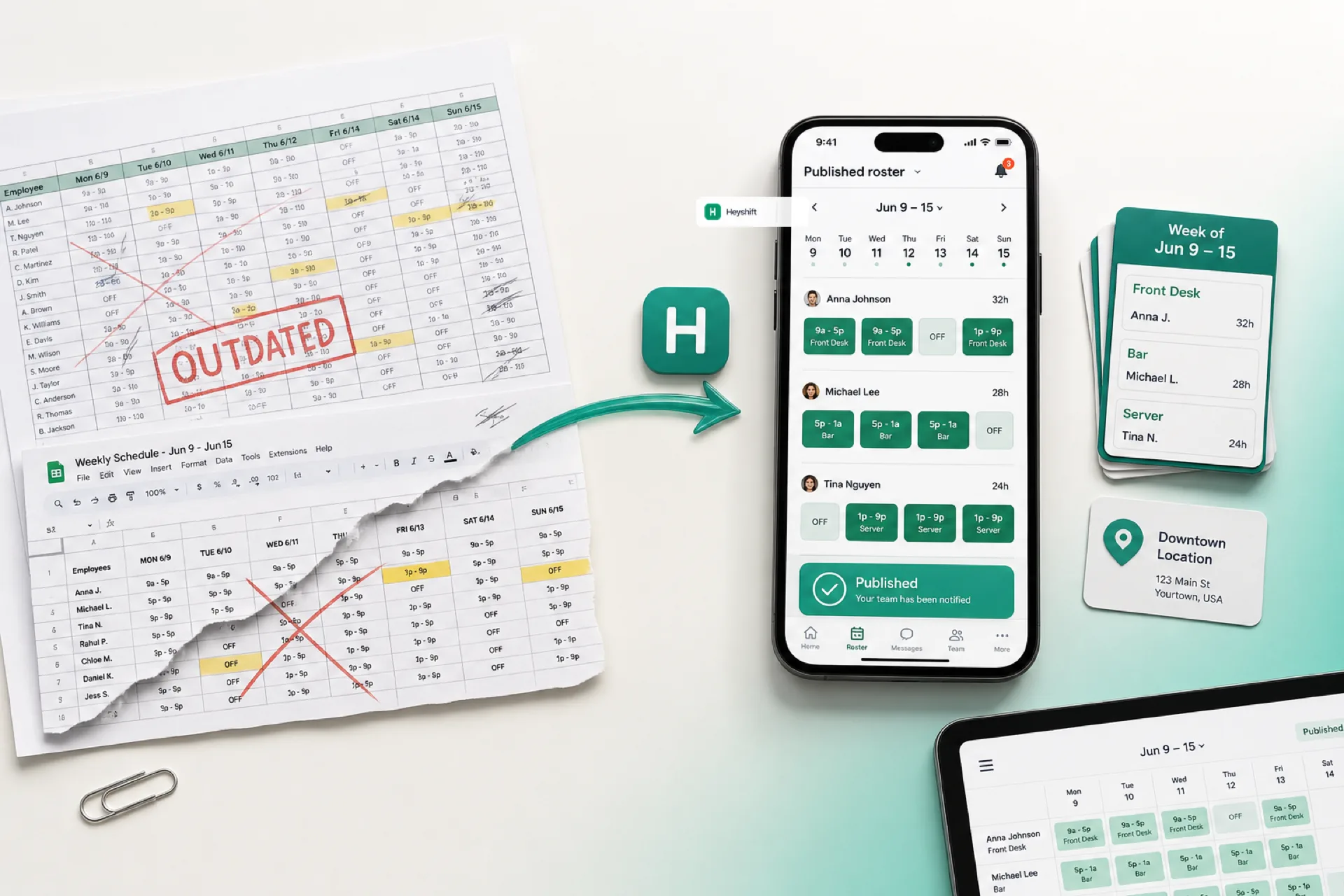
Most teams assume rollout fails because managers “do not adopt.” Often the real issue is two truths at once: the official schedule in the tool, and the “working” version in chat, screenshots, or a personal spreadsheet.
That split is expensive. Supervisors optimize against the wrong file. Finance reconciles exports that do not match what crews actually ran. Audits get fuzzy because nobody agrees which version was authoritative on a given night.
Heyshift is oriented around publish-first discipline: after publish, changes flow through approvals instead of side channels. Rollout works better when you treat that rule as the product you are implementing, not a nice-to-have checkbox.
Rollout sits on multi-location scheduling software that keeps one publish calendar across sites. Map day-to-day work to shift scheduling and multi-location areas before you flip the switch.
Name the calendar everyone defends
Before you tune templates, decide what one calendar means for your org:
- Which roles must publish versus only view or request swaps?
- What freeze window lines up with finance week cutoffs?
- Which exceptions are allowed after publish, and who approves them?
Write those answers in plain language for leads at each site. If the rule fits on half a page, managers will repeat it. If it lives only in a procurement deck, they will improvise.
Areas and locations beat generic rows
Rollout gets smoother when the structure matches how supervisors walk the building. Named areas (bars, pits, docks, wings) turn vague coverage into something people can scan.
That matters during onboarding because new sites do not have to relearn your abstraction. They copy structure that already matches language on headsets and radios.
Templates are how you scale without cloning chaos
Strong rollout teams invest early in repeatable patterns:
- Role mixes that recur across similar stores or shifts.
- Copy-week flows when Tuesday looks like last Tuesday on purpose.
- Bulk publish when the same decision applies to many rows.
Templates are not laziness. They are how you stop every site from reinventing formatting and quietly drifting into local spreadsheets “just for this week.”
Measure rollout by publish behavior, not login counts
Vanity adoption metrics hide shadow workflows. Pair activity inside the tool with publish integrity:
- Did exceptions route through approvals instead of offline edits?
- Did attendance or worked hours tie back to what was published?
- Did finance-week summaries match the roster leaders defended on Wednesday?
If those three stay aligned as you add sites, you are implementing scheduling. If not, you bought another calendar skin.
Where to go next