

Summary
Shift coverage is the process of ensuring every scheduled shift has the right number of qualified employees available to meet business demand while maintaining service quality, compliance, and labor cost targets. It is not the same as headcount: coverage asks whether each shift block is staffed correctly today, while staffing levels ask how many people you employ overall. Managers improve coverage through workforce planning, employee availability, open shift management, and real-time attendance tracking.
Step-by-step
How to Improve Shift Coverage
Coverage improves when planning, scheduling, attendance, and gap-fill run as one loop. Use the shift coverage gap calculator to stress-test your plan before you publish.
Step 1: Collect employee availability
Gather preferred hours, restrictions, and secondary jobs before building the roster. Availability is an input to coverage, not an afterthought.
Step 2: Forecast staffing demand
Use historical sales, traffic, or production data through workforce forecasting and workforce planning to predict busy blocks by day and hour.
Step 3: Build schedules in advance
Publish rosters early via shift scheduling so gaps surface with time to fix, not an hour before open.
Step 4: Monitor attendance in real time
Track clock-ins and no-shows on the attendance tracker so managers see coverage drift during the week.
Step 5: Publish open shifts quickly
Post unassigned shifts immediately to eligible staff through open shift management.
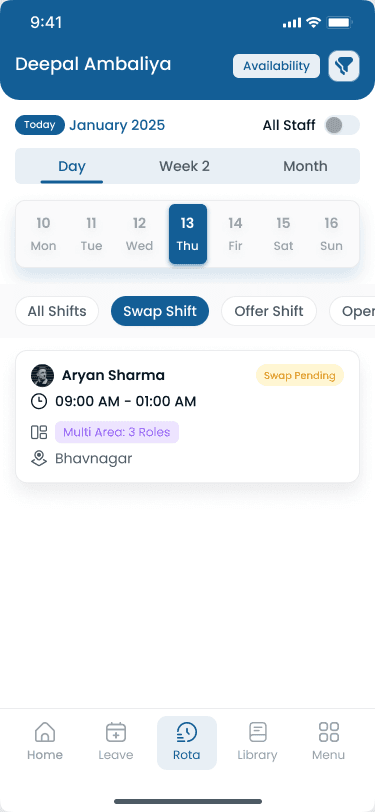
Step 6: Use shift bidding or shift swapping
Let qualified employees claim open shifts through shift bidding or trade assigned shifts via shift swapping with manager approval.
Step 7: Review labor costs before approving overtime
Coverage does not mean unlimited OT. Check hour totals and labor percentage before you confirm extra hours.
“Coverage is a shift-by-shift question. Headcount is a company-wide question. You can have enough employees on payroll and still run understaffed on Tuesday dinner if availability and demand do not match.”
Examples
Shift Coverage vs Staffing Levels
Operators often confuse coverage with headcount. Both matter, but they answer different questions.
Shift coverage vs staffing levels
| Topic | Shift coverage | Staffing levels |
|---|---|---|
| Focus | Each scheduled shift | Overall workforce size |
| Measures | Operational readiness per block | Headcount and FTE |
| Adjusts | Daily or weekly | Monthly or quarterly (hiring) |
| Typical owner | Location or shift manager | HR or district leadership |
| Fix when wrong | Open shifts, swaps, OT, cross-training | Hiring, turnover, scheduling capacity |
Shift coverage KPIs to track
Review these metrics weekly by location. Trends matter more than one bad day.
| Metric | What it measures | Why it matters |
|---|---|---|
| Shift fill rate | % of shifts fully staffed before start | Leading indicator of coverage health |
| Open shifts | Count of unassigned shifts per week | Volume of gaps to close |
| No-show rate | Missed shifts vs scheduled | Reliability and attendance discipline |
| Overtime hours | OT hours as % of total hours | Cost of reactive coverage |
| Labor cost % | Labor spend vs revenue | Coverage quality vs budget |
| Schedule adherence | Actual hours vs scheduled | Roster accuracy |
| Time-to-fill open shifts | Hours from post to confirm | Speed of gap recovery |
Best practices
Common Causes of Coverage Gaps
Coverage gaps rarely appear without warning. These triggers show up on almost every hourly roster.
| Practice | Why it works |
|---|---|
| Sick leave | Call-offs remove assignees hours before a shift starts. Fast open shift posting limits damage. |
| Vacation requests | Approved leave creates predictable gaps if managers build schedules before leave is reflected. |
| No-shows | Attendance gaps discovered at clock-in require same-day fill from a qualified pool. |
| High employee turnover | Open roles and training lag leave shifts short until new hires are onboarded. |
| Demand spikes | Traffic, orders, or occupancy jump faster than the roster was built for. |
| Scheduling mistakes | Understaffed templates, missed publishes, or wrong role counts on the official roster. |
| Poor availability planning | Schedules built without current availability data guarantee swaps and gaps later in the week. |
Why it matters
Why Shift Coverage Matters
Proper shift coverage keeps operations running when demand, attendance, and availability change every week. Understaffed shifts hurt service; overstaffed shifts hurt labor margin. The goal is the right people, in the right roles, at the right time.
| Pain point | What operators see |
|---|---|
| Maintain customer service | Enough qualified staff on each shift so wait times, queues, and service quality stay on target. |
| Avoid understaffing | Gaps during peaks create missed sales, safety risks, and compliance exposure in licensed roles. |
| Prevent unnecessary overtime | Planned coverage reduces reactive OT when the same employees absorb every call-off. |
| Reduce employee burnout | Balanced rosters spread hours instead of relying on a few dependable people every week. |
| Improve productivity | Right-sized crews match workload so teams are busy, not drowning or idle. |
| Meet compliance requirements | Break rules, minor limits, and credential coverage depend on shifts being staffed correctly. |
Strong coverage connects to labor cost management and overtime management so managers fix gaps before payroll, not after.
Industries
Industries That Depend on Shift Coverage
Any hourly operation with variable demand and shift-based work needs deliberate coverage planning.
| Industry | Typical scheduling challenge |
|---|---|
| Restaurants | Match servers, cooks, and hosts to lunch and dinner rushes without idle labor on slow blocks. |
| Retail | Staff floors and registers for weekend traffic and holiday peaks. |
| Healthcare | Maintain licensed coverage across every shift and credential requirement. |
| Warehouses | Align pick-and-pack headcount with shipment volume and cutoff times. |
| Hospitality | Cover front desk, housekeeping, and F&B as occupancy and events shift. |
| Manufacturing | Staff production lines and maintenance windows on rotating crews. |
| Construction | Crew job sites with the right trades scheduled for each phase. |
| Cleaning services | Assign teams across client routes without leaving sites uncovered. |
| Security | Maintain post coverage and guard rotations 24/7 across locations. |
| Multi-location businesses | Roll up fill rate and open shifts district-wide before one site drags averages. |
“The cost of a coverage gap shows up as overtime, burnout, or a customer waiting longer than they should. All three are expensive.”
Buyer's guide
Shift Coverage Best Practices
These habits keep coverage predictable as demand, turnover, and locations change.
| # | Question | What to verify |
|---|---|---|
| 1 | Schedule early | Publish rosters with enough lead time for swaps, bids, and manager review. See [how shift scheduling works](/answers/how-does-shift-scheduling-work). |
| 2 | Keep employee availability updated | Require self-service updates through [staff management](/features/staff-management) before each schedule cycle. |
| 3 | Cross-train staff | Flexible coverage without extra hires when one role is short and another has surplus capacity. |
| 4 | Use mobile notifications | Push schedule changes and open shifts through the [mobile app](/features/mobile-app) so staff act on the official roster. |
| 5 | Track coverage by location | Compare fill rate and open shifts per site on one dashboard with [multi-location scheduling](/answers/what-is-multi-location-scheduling). |
| 6 | Review coverage reports weekly | Look for repeat gaps by day, role, and location. Feed patterns back into workforce planning for the next cycle. |
Expertise & sources
Why trust this guide
ReviewedWritten by the Heyshift Team for managers scheduling hourly employees across restaurants, retail, healthcare, warehouses, hospitality, manufacturing, construction, cleaning, security, and other multi-location businesses in the USA. It explains shift coverage as a weekly operational discipline, not abstract HR theory.
Heyshift Team
Workforce scheduling research · USA multi-location operators
Heyshift publishes scheduling playbooks for operators who need every shift covered without surprise overtime or last-minute group texts.
Published & updated
Sources
2 external · 2 on Heyshift
| Source | Reference |
|---|---|
DOLU.S. Department of Labor | Fair Labor Standards Act (FLSA) |
SHRMSHRM | Society for Human Resource Management (SHRM) |
| Further reading on Heyshift | |
| Heyshift tools | Shift coverage gap calculator |
| Heyshift answers library | How does shift scheduling work? |
Frequently asked questions
Improve shift coverage with Heyshift
Heyshift helps businesses create schedules faster, fill open shifts, monitor attendance, and maintain staffing coverage across multiple locations while controlling labor costs. Start your free trial or book a demo.
No credit card required
Related resources
| Resource | Link |
|---|---|
| What is workforce planning? | Open |
| What is workforce forecasting? | Open |
| What is employee availability management? | Open |
| What is open shift management? | Open |
| What is shift bidding? | Open |
| What is shift swapping? | Open |
| What is overtime management? | Open |
| How does shift scheduling work? | Open |
| What is multi-location scheduling? | Open |
| What is labor cost management? | Open |
| What is employee scheduling software? | Open |
| Shift scheduling feature | Open |
| Staff management feature | Open |
| Attendance tracker feature | Open |
| Mobile app feature | Open |
| Shift coverage gap calculator | Open |
| Labor cost percentage calculator | Open |
| Overtime risk calculator | Open |