

Summary
Open shift management is the process of identifying, publishing, assigning, and tracking unfilled employee shifts. Businesses use it to maintain staffing coverage, reduce overtime, control labor costs, and ensure customer service is not disrupted when someone calls off or demand changes. An open shift is a scheduled block that has not yet been assigned to an employee. Managers post it to qualified staff through shift scheduling and the mobile app, check availability and overtime limits, then confirm coverage on the published roster.
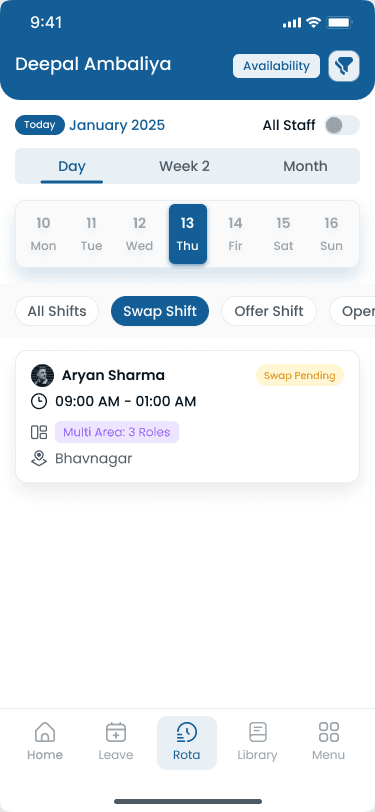
Step-by-step
How Open Shift Management Works
A typical open shift workflow runs inside your published shift scheduling process. Software automates notifications, eligibility checks, and roster updates when a shift becomes unassigned.
Step 1: Shift becomes unassigned
A call-off, leave approval, new shift template, or scheduling change leaves a shift without an assignee. The open shift appears on the manager dashboard.
Step 2: Review staffing requirements
Confirm role, location, certifications, and minimum coverage for that block. Match requirements before you notify anyone.
Step 3: Notify qualified employees
Push the open shift to eligible staff through the mobile app. Filter by location, role, availability, and hours remaining before overtime.
Step 4: Employees volunteer or manager assigns
Staff claim the shift or the manager assigns directly. First qualified volunteer is not always the right pick if they are near 40 hours.
Step 5: Confirm the assignment
Manager approves the pick, verifies overtime management limits, and locks coverage before the shift starts.
Step 6: Schedule updates automatically
The published roster refreshes for the whole team. Attendance and payroll see the same assignee everyone else sees.
“Open shifts are normal. What breaks teams is posting them in group chats with no overtime check, no skill match, and no record on the official roster.”
Best practices
Common Open Shift Management Challenges
Hourly teams hit the same open shift problems as they add locations, seasons, and call-off volume.
| Practice | Why it works |
|---|---|
| Last-minute absences | Instant mobile notifications reach every eligible employee at once instead of one manager calling down a contact list. |
| Overtime from open shift fills | Automatic overtime checks before assign stop you from giving a 38-hour employee an eight-hour open shift. |
| Multiple locations | Centralized multi-location scheduling shows open shifts and hour totals across every site in one view. |
| Slow communication | Mobile app alerts replace group texts so staff see the same open shift on the official roster, not a screenshot in chat. |
| Wrong skill match | Role and certification filters narrow the pool before notify so managers do not approve unqualified pickups. |
| No visibility into fill rate | Track how long open shifts stay unfilled and which locations lag. Use the shift coverage gap calculator to stress-test staffing plans. |
Features
Benefits of Open Shift Management
When open shifts run through scheduling software instead of ad hoc texts, managers and employees both save time.
| Feature | Why it matters |
|---|---|
| Faster shift coverage | Qualified staff see open shifts immediately and can claim them from their phone before managers start calling. |
| Lower labor costs | Fill gaps with part-time or under-cap employees before defaulting to overtime on full-time staff. Tie picks to [labor cost management](/answers/what-is-labor-cost-management). |
| Better employee satisfaction | Voluntary open shifts give motivated staff extra hours without favoritism or last-minute pressure on one person. |
| Reduced manager workload | Automated notify, eligibility, and roster updates cut hours spent on phone coverage every week. |
| Improved schedule accuracy | One published roster reflects confirmed assignees, open posts, and approvals so [attendance](/features/attendance-tracker) matches what payroll expects. |
Why it matters
Why Open Shifts Happen
Open shifts appear on almost every hourly roster. They are not a scheduling failure by themselves. They become a problem when managers discover the gap too late or fill it without checking hours, skills, or availability.
| Pain point | What operators see |
|---|---|
| Employee sick leave | Call-offs create immediate coverage gaps, especially on short notice. |
| Vacation and leave approvals | Approved [leave](/answers/what-is-employee-leave-management) removes someone from the roster before the shift starts. |
| No-shows | Attendance gaps discovered at clock-in require same-day open shift fill. |
| Last-minute demand increases | Traffic spikes or rush periods may require an extra body on the schedule. |
| New locations | Opening a site adds shifts before every role has a permanent assignee. |
| Seasonal demand | Peak seasons add shifts faster than hiring catches up. |
| Scheduling mistakes | Understaffed templates, missed publishes, or manual errors leave shifts unassigned. |
Strong open shift management connects to workforce planning so managers expect gaps before they happen, and to shift swapping when two employees can trade instead of leaving a shift open.
Industries
Industries That Rely on Open Shift Management
Any hourly operation with call-offs, variable demand, or multi-site coverage needs a repeatable open shift process.
| Industry | Typical scheduling challenge |
|---|---|
| Restaurants | Fill server, cook, and host gaps during rushes without texting the whole team. |
| Retail | Cover floor and cashier shifts during sales events and seasonal peaks. |
| Healthcare | Post clinical shifts with license checks before approval. |
| Warehouses | Add pick-and-pack coverage when shipment volume spikes mid-week. |
| Hospitality | Staff events, housekeeping, and front desk when occupancy jumps. |
| Manufacturing | Cover line roles and maintenance windows on rotating crews. |
| Cleaning services | Reassign crews when a client site needs extra hours or a worker calls off. |
| Construction | Fill job-site roles when weather or deadlines shift the weekly plan. |
| Security | Post guard coverage across posts and overnight rotations quickly. |
“The fastest coverage comes from notifying every eligible employee at once, not calling the same three people until someone says yes.”
Buyer's guide
Open Shift Management Best Practices
These habits keep open shift fill fast, fair, and compliant across locations.
| # | Question | What to verify |
|---|---|---|
| 1 | Notify eligible employees instantly | Post open shifts to every qualified person at once. Avoid phone trees that burn out the same employees every week. |
| 2 | Prevent overtime before assigning | Check weekly hour totals before you confirm. Use [overtime alerts](/answers/what-is-overtime-management) and the [overtime risk calculator](/tools/overtime-risk-calculator) when coverage is tight. |
| 3 | Match skills and certifications | Only notify staff who can legally and safely perform the role. Food handler, CNA license, and forklift certs matter as much as availability. |
| 4 | Respect employee availability | Do not assign staff outside their submitted [availability](/answers/what-is-employee-availability-management). Voluntary picks work better when the pool is already filtered. |
| 5 | Keep a complete audit trail | Log who was notified, who volunteered, and who was approved. See [open shift and swap approvals](/blog/open-shift-swap-approvals-published-roster) for publish-first workflow detail. |
Expertise & sources
Why trust this guide
ReviewedThis guide was created by the Heyshift Team for managers scheduling hourly employees across restaurants, retail, healthcare, warehouses, hospitality, manufacturing, construction, cleaning, security, and multi-location businesses throughout the USA. It explains open shift workflows managers can run every week, not abstract HR theory.
Heyshift Team
Workforce scheduling research · USA multi-location operators
Heyshift publishes scheduling playbooks for operators who fill coverage gaps without surprise overtime or group-text chaos.
Published & updated
Sources
1 external · 3 on Heyshift
| Source | Reference |
|---|---|
DOLU.S. Department of Labor | Fair Labor Standards Act (FLSA) |
| Further reading on Heyshift | |
| Heyshift answers library | What is shift swapping? |
| Heyshift answers library | How does shift scheduling work? |
| Heyshift blog | Open shift and swap approvals playbook |
Frequently asked questions
Fill open shifts faster with Heyshift
Heyshift helps managers publish open shifts, notify qualified employees, reduce overtime, and keep schedules updated across multiple locations. Start your free trial or book a demo to see open shift management in action.
No credit card required
Related resources
| Resource | Link |
|---|---|
| What is shift swapping? | Open |
| What is workforce planning? | Open |
| What is time and attendance software? | Open |
| What is employee availability management? | Open |
| How does shift scheduling work? | Open |
| What is overtime management? | Open |
| What is multi-location scheduling? | Open |
| What is employee leave management? | Open |
| What is employee scheduling software? | Open |
| Shift scheduling feature | Open |
| Staff management feature | Open |
| Mobile app feature | Open |
| Attendance tracker feature | Open |
| Shift coverage gap calculator | Open |
| Labor cost percentage calculator | Open |
| Overtime risk calculator | Open |
| Open shift and swap approvals playbook | Open |