

Same Day Employee Call Off Coverage: How to Handle Call-Offs Without Creating Overtime
A 30-minute response sequence for same-day call-offs: build a qualified list, post an open shift to everyone at once, and check overtime before you approve anyone.
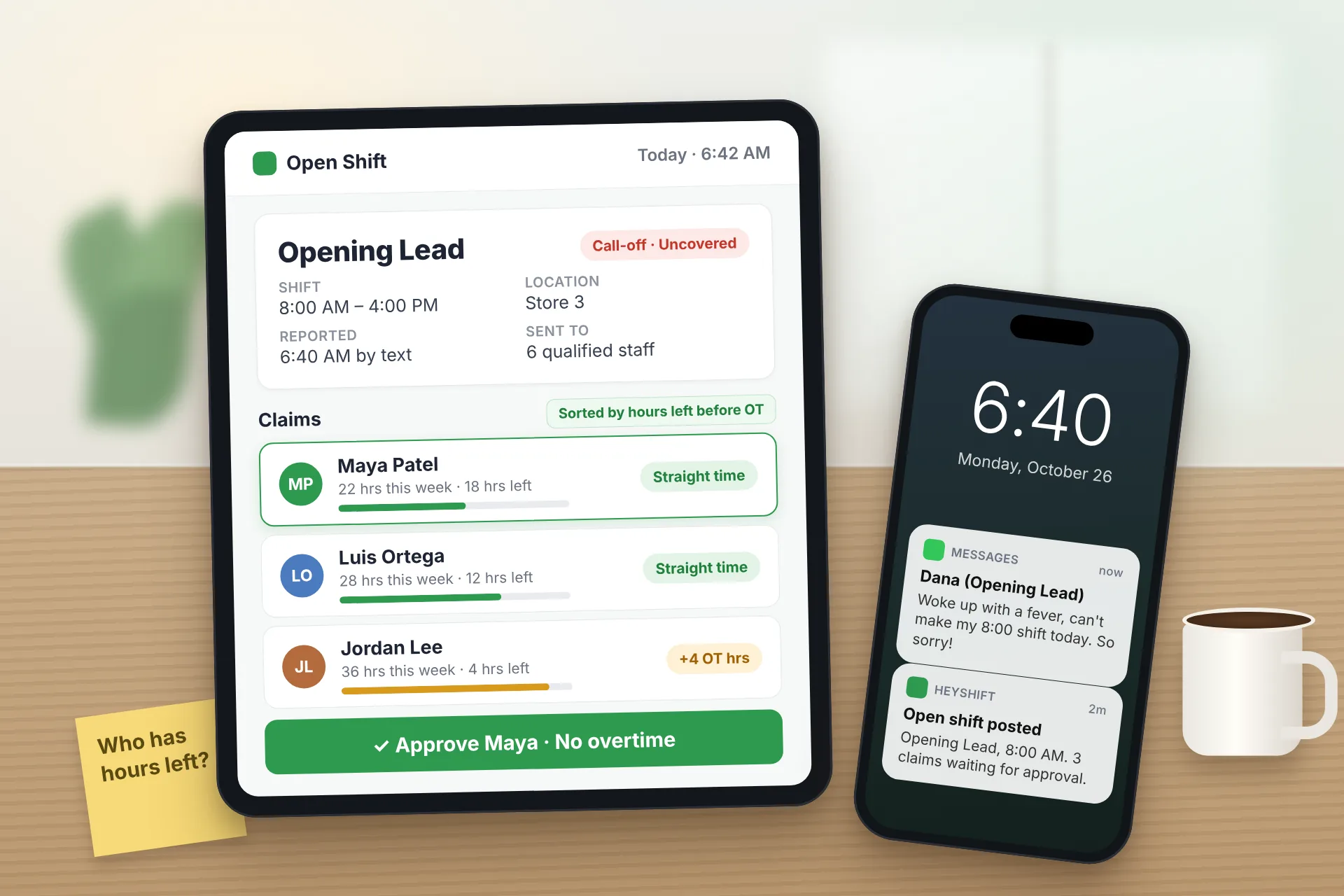
It's 6:40 a.m. The store opens at 8:00, and your opening lead just texted that she has a fever. The first name that comes to mind is the person who always says yes. That person is also sitting at 36 hours this week. Good same day employee call off coverage starts with a better question. Don't ask "who will come in?" Ask "who can come in without pushing this week into overtime?"
This guide gives you a 30-minute response sequence built for restaurants, retail stores, hotels, healthcare teams, and warehouses. You'll learn how to find qualified internal coverage, send the gap out as an open shift, and check overtime before you approve anyone. It also covers the overtime rules that catch managers off guard, a side-by-side look at your replacement options, and the honest limits of any coverage process.
Key Takeaways
- Sort your replacement list by hours left before overtime, not by who answers fastest.
- Offer the open shift to every qualified person at once instead of calling one by one.
- Check weekly and daily overtime triggers before you approve the swap. Paying for it afterward isn't optional.
- Decide your fallback order and who can approve overtime long before the next call-off.
What Is Same Day Employee Call Off Coverage?
Same day employee call off coverage is the process of filling a shift after a worker tells you, on the day of that shift, that they can't come in. It involves three jobs at once: confirming the gap, finding a qualified replacement, and keeping that replacement from adding labor cost you didn't plan for.
A call-off (some teams say "call-out") is different from a no-call no-show, where the employee never contacts you, and from planned leave, which you can schedule around days ahead. The difference matters because each one gives you a different amount of time to react.
Call-off, no-call no-show, or planned absence?
| Absence type | When you find out | Rough time to react | What to do first |
|---|---|---|---|
| Planned absence | Days or weeks ahead | Plenty | Adjust the schedule and post the shift early |
| Same-day call-off | Minutes or hours before the shift | Often 30 to 90 minutes | Run the response sequence below |
| No-call no-show | After the shift has started | Minutes | Cover first, then follow your attendance policy |
| Mid-shift departure | During the shift | Immediate | Shift tasks around, then decide whether the rest of the shift needs a person |
Why Last-Minute Coverage So Often Turns Into Overtime
Last-minute coverage turns into overtime because the people most likely to say yes usually already have the most hours. Full-timers know the job, live close, and answer early. They're also the ones scheduled at 32 to 38 hours, so one extra shift tips them over.
Here's a simple example. A line cook earns $18 an hour and has already worked 36 hours this week. If he covers an 8-hour shift, he lands at 44 hours. The first 4 hours cost $72 and the last 4 cost $108 at time and a half, so the shift costs $180. A qualified part-timer at 20 hours would cost $144 for the same 8 hours.
That's a $36 difference on one shift. Repeat it twice a week across five locations and you're near $360 a week, or roughly $18,700 a year, without anyone deciding to spend it.
Absences carry costs beyond the wage line, too. CDC figures shared by the CDC Foundation put the productivity losses tied to absenteeism at $225.8 billion a year for U.S. employers, about $1,685 per employee (a 2015 estimate). Overtime from rushed coverage is one of the few parts of that cost you can control on the spot. For the wider picture on stopping call-offs before they happen, see our guide to reducing no-shows and last-minute call-offs.
How Overtime Is Calculated When You Add Hours
Under federal law, covered non-exempt employees earn at least one and a half times their regular rate for every hour beyond 40 in a workweek, and some states and industries add daily triggers on top of that. Knowing which rule applies to each worker is the core of the overtime check.
The federal workweek rule
The Department of Labor's Fact Sheet #23 defines a workweek as a fixed, recurring block of 168 hours that can start on any day and at any hour, and it doesn't allow averaging hours across two or more weeks. In practice, that means a Saturday shift might fall into a different workweek than you assume. Check when your workweek actually starts.
The regular rate isn't always the base wage. The same fact sheet says the regular rate includes nearly all pay for employment, minus a short list of exclusions, so shift differentials can raise the overtime cost of a night or weekend fill.
Daily overtime in California
California requires time and a half for hours over eight in a workday or over 40 in a workweek, and double time for hours past 12 in a day or past eight on the seventh consecutive workday, according to SHRM. So if you ask someone to stay four extra hours after their own 8-hour shift, that's daily overtime even if they're only at 30 hours for the week.
Healthcare's 8 and 80 system
Hospitals and residential care facilities can adopt, by agreement with employees, a 14-day work period instead of the usual workweek, as long as they pay overtime for hours over 8 in a day and over 80 in that period. Under this system, a double shift or a holdover triggers overtime the same day, no matter how light the rest of the two weeks looks.
A "no overtime" policy doesn't cancel the bill
The DOL states that announcing overtime won't be paid unless approved in advance does not remove an employee's right to be paid for overtime hours they actually work. If someone covers and goes over, you owe it. That's why the check has to happen before you say yes, not at payroll.
| Rule | Who it applies to | Overtime trigger | Where same-day coverage trips it |
|---|---|---|---|
| Federal FLSA | Covered non-exempt employees nationwide | Hours over 40 in a fixed workweek | Late-week coverage by full-timers |
| California daily overtime | Non-exempt workers in California | Over 8 hours a day or 40 a week; double time past 12 a day | Holdovers and double shifts |
| 8 and 80 system | Hospitals and residential care facilities that adopt it by agreement | Over 8 hours a day and over 80 in a 14-day period | Doubles and extended shifts |
Other states, union contracts, and local ordinances can add their own rules. Treat this as a starting point, not legal advice.
How Shift Coverage Works From Call-Off to Clock-In
Every covered shift moves through the same pipeline: the absence is reported, logged, turned into a role requirement, matched against eligible staff, checked for hours and rules, offered, accepted, approved, and recorded.
- Report. The employee notifies you through an approved channel.
- Log. You record who, when, how, and which shift.
- Define the gap. You decide the role, skills, and hours the replacement must cover.
- Filter eligible staff. You narrow the roster to people qualified for that role at that location.
- Check hours and rules. You compare each person's worked and scheduled hours against overtime, rest, and local scheduling triggers.
- Offer. You send the shift to everyone who passed the filter.
- Approve. You confirm the person who claims it and update the schedule.
- Record. The swap, the reason, and any premium pay go into the timekeeping record.
Whether you run this from a whiteboard, a group chat, or scheduling software, the steps don't change. Software mostly speeds up steps 4 and 5, because that's where the data lives.
The Same-Day Response Sequence: 30 Minutes From Call-Off to Covered
The fastest way to cover a call-off without overtime is a fixed sequence: log the gap, build a qualified list sorted by hours left, post an open shift to that whole list at once, check overtime before approving, and fall back in a set order if nobody claims it. Treat 30 minutes as a target, not a law.
Minutes 0 to 5: Log the call-off and size the gap
Write down the employee's name, the time they reached you, the channel they used, and the shift affected. Then size the gap honestly. Do you need someone for the full 8 hours, or just the 11:00 to 3:00 rush? A partial gap is much easier to fill at straight time.
Minutes 5 to 10: Pull a qualified list, sorted by hours left
"Qualified" means the right role, training, certifications, and location. Once you have that group, sort it by hours remaining before each person hits an overtime trigger. Someone at 22 hours goes to the top. Someone at 38 drops to the bottom, and in California, anyone already finishing an 8-hour shift today drops too.
This step is where same day employee call off coverage either holds the budget or loses it. Most overtime gets created right here, when a manager skips the sort and goes with whoever comes to mind.
Minutes 10 to 20: Post it as an open shift to everyone at once
Send the shift to the whole qualified list at the same time. Calling one person, waiting, then calling the next can burn your entire response window. Make it clear that partial claims are welcome, and that a claim isn't final until you approve it.
Open shifts work best when everyone on the list sees the same post at the same moment and can claim it from their phone. If you're still texting people one at a time, would a tool built for open shift management cut this step from fifteen minutes to two?
Minutes 20 to 25: Run the overtime check before you approve
For each person who claims the shift, add hours already worked this week, hours still scheduled, and the new shift. Compare the total against every trigger that applies to them: weekly, daily, and any 14-day period. Check rest-between-shifts rules where your city has them.
The math is simple, but it's easy to get wrong at 6:45 a.m. with three people claiming at once. Before your next busy week, you can run a few what-if scenarios through an overtime risk calculator so the numbers feel familiar when it counts.
Minutes 25 to 30: Fall back in a planned order
If nobody passes the check, move down a list you wrote in advance:
- Split the shift between two people who each have a few hours left.
- Pull a cross-trained employee from a role that's covered for the day.
- Approve overtime on purpose, choosing the person with the fewest overtime hours, and document why.
- Call your float pool or staffing agency.
- Run short and cut lower-priority tasks for the day.
Name who can approve step 3. If only the general manager can, and she's off today, the sequence stalls.
Comparing Your Absence Replacement Options
The best absence replacement option fills the skill gap at straight-time pay, which usually means a part-timer with spare hours or a split shift, before you turn to overtime or outside help.
| Option | Works best when | Overtime risk | Main drawback |
|---|---|---|---|
| Part-timer with open hours | You have qualified part-timers | Low | They may not be free on short notice |
| Split shift between two people | The shift is long and two people have a few hours each | Low | A mid-shift handoff to manage |
| Employee-arranged swap | The absent employee finds their own cover | Depends on who picks it up | Swaps can quietly move overtime around |
| Cross-trained employee | A nearby role is fully staffed | Low to medium | Their usual station runs thinner |
| Voluntary overtime | No one else is qualified | High | Premium pay and fatigue |
| Float pool or agency | Multi-site operations or licensed roles | None internally | Higher hourly cost, site orientation |
| Run short | Demand is soft that day | None | Slower service and a stretched team |
Outside emergency staffing makes sense when the role needs a license or certification nobody on your roster holds. Depending on your market, though, agency rates can exceed your own overtime cost, so it's rarely the cheaper choice.
Overtime isn't always the villain. Sometimes approving 4 overtime hours is the right call because the alternative is a closed register, a lost dinner rush, or an unsafe staffing level. The goal is to choose it on purpose.
How Coverage Rules Differ by Industry
The sequence stays the same across industries, but the definition of "qualified" and the extra rules that apply change a lot between a restaurant line and a hospital unit.
Restaurants and hospitality
Station skills matter more than job titles. A server who can't run expo isn't a real fill for an expo call-off. In Oregon, employers may keep a voluntary standby list of workers who agreed in writing to take extra hours for unexpected absences, and those workers don't earn extra predictability pay when they accept hours through that list, according to the state's Bureau of Labor and Industries. A list like that is worth building if you operate there.
Retail
Retail chains in some cities face predictive scheduling laws (also called Fair Workweek laws). Oregon has a statewide law, and cities including New York City, Chicago, Seattle, Philadelphia, San Francisco, and Los Angeles have local ordinances, per Rippling's overview. Changing a posted schedule late can trigger premium pay in some of these places, and exceptions for covering absences vary by ordinance. Check your local rules before you assume a voluntary pickup is free.
Healthcare
Licensure, unit competencies, and patient ratios shrink your qualified list fast. Some states also limit how far you can push staff. Employment law firm Littler reported that Rhode Island became the tenth state to prohibit or restrict mandatory overtime for nurses back in 2007, joining states such as Connecticut, Illinois, Maryland, Minnesota, New Jersey, Oregon, and Washington. If you use the 8 and 80 system, any holdover past 8 hours is overtime that day.
Warehouses
Equipment certifications, such as forklift operation, decide who can actually cover a role. Peak-season volume also makes running short riskier. Splitting a shift between two certified part-timers is often the cleanest fix, provided each one's hours stay under the trigger.
Setting Up Call-Off Coverage Before You Need It
Most same-day scrambling comes from decisions nobody made in advance, so the best preparation is writing down who gets contacted, how, who approves overtime, and when you stop trying to fill the shift.
Write notification rules people can follow
Set a notice window, such as two hours before shift start when possible, and name the approved channels. Make it clear that a text to a coworker doesn't count. Separate an excused call-off, a late call-off, and a no-call no-show in your attendance policy so each is handled the same way every time. Some absences may be protected by federal, state, or local leave laws, so check before treating a call-off as a policy problem.
Keep a live view of hours
The overtime check only works if you know, by Wednesday, who's already near 40. Review hours mid-week, not at payroll close (our guide to preventing overtime before payroll walks through that weekly rhythm). Make sure missing punches get fixed quickly, because one forgotten clock-out can make someone look available when they aren't.
Build an opt-in standby group and cross-train
Ask who wants extra hours and get it in writing. Cross-train a few people on your most fragile roles so one absence doesn't empty an entire station. Rotate offers so the same three people don't carry every gap.
Track fairness and patterns
Record who was offered each shift, who accepted, and who declined. Review call-off patterns monthly. If one shift or one team keeps showing up, a quiet return-to-work conversation often surfaces a fixable cause, like a childcare conflict or a schedule that never fit.
Where This Process Falls Short
A structured sequence reduces overtime and stress, but it can't create qualified people who don't exist, and it won't make every call-off cheap.
- Thin rosters. If your team has six people and four are full-time, there may be no straight-time option. The real fix is hiring a part-timer or two, not a better script.
- Specialized roles. For a licensed nurse or a certified equipment operator, your qualified list might be zero on a given day.
- Bad data. The hours check is only as accurate as your timekeeping. Missing punches produce wrong answers.
- Location rules. This guide covers common federal and state rules. Local ordinances and union contracts can change the math, and none of this is legal advice.
- Burnout shifts around. Protecting the overtime budget by leaning on the same part-timers just moves the strain to different people.
This also isn't for everyone. If you run a small shop with a handful of hourly staff, a written 30-minute sequence may be overkill. A clear notice rule and one named person who approves overtime might be all you need.
Make Every Call-Off a Routine Decision
The way to stop call-offs from inflating labor costs is to make the response routine: qualified list, open shift, overtime check, planned fallback, every single time.
Reliable same day employee call off coverage depends on two things you can't fake at 6:45 a.m.: accurate hours data and a clean record of who called off, when, and how. Tools that keep attendance records and hours in one place make both much easier to trust under pressure. To see what that looks like for your team, explore Heyshift's attendance management software and test it against your next week of call-offs.
Frequently Asked Questions
Continue with related topics
More articles on topics related to this one.
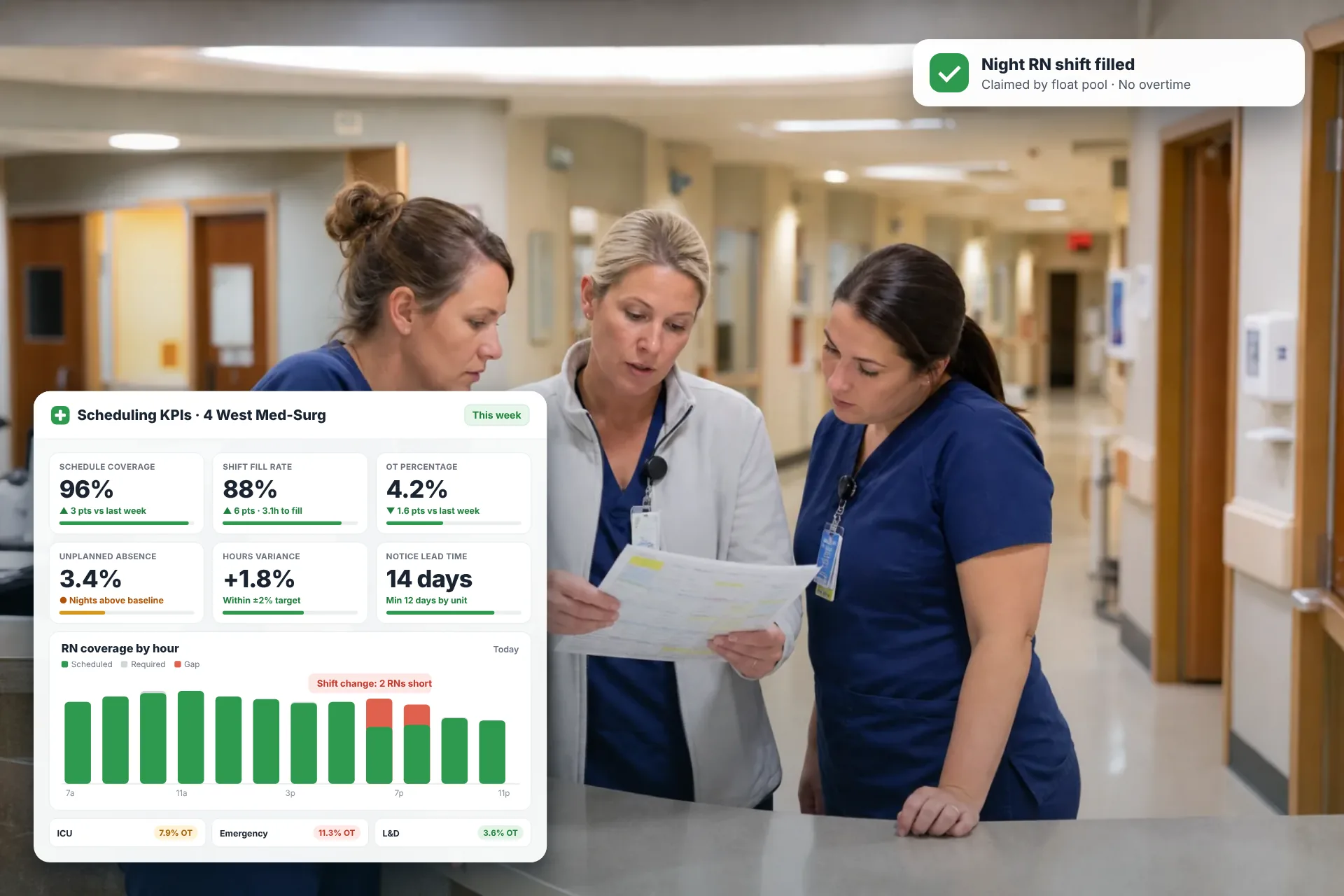
Employee Scheduling KPIs: 12 Metrics Every Operations Manager Should Track
Twelve employee scheduling KPIs with formulas, review cadences, and first actions, plus the trade-offs between them that most KPI lists skip.
Read article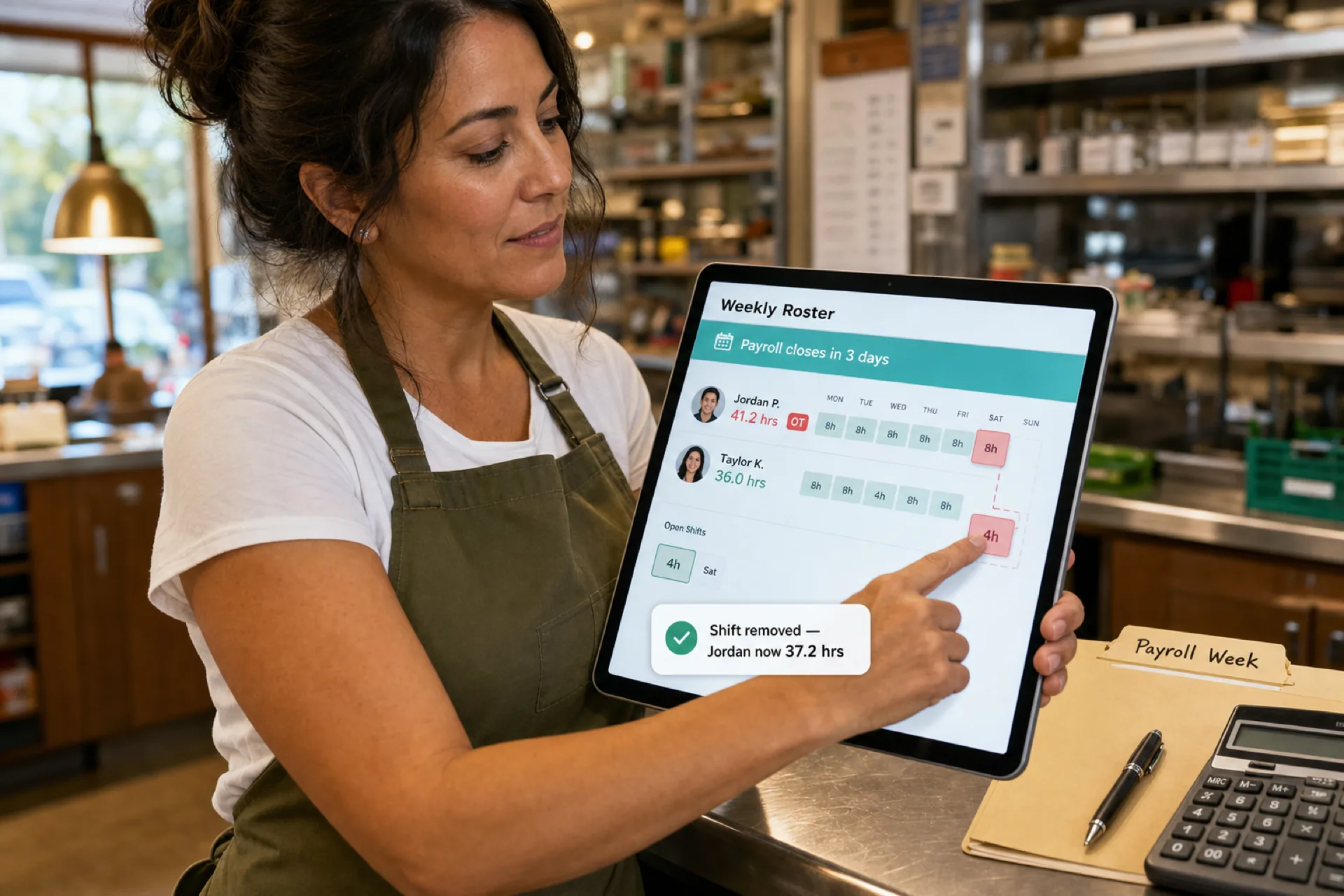
How to prevent overtime before payroll (2026 guide)
Learn how to prevent overtime before payroll with weekly hour monitoring, labor budgets, swap controls, and workforce scheduling visibility for growing USA teams.
Read article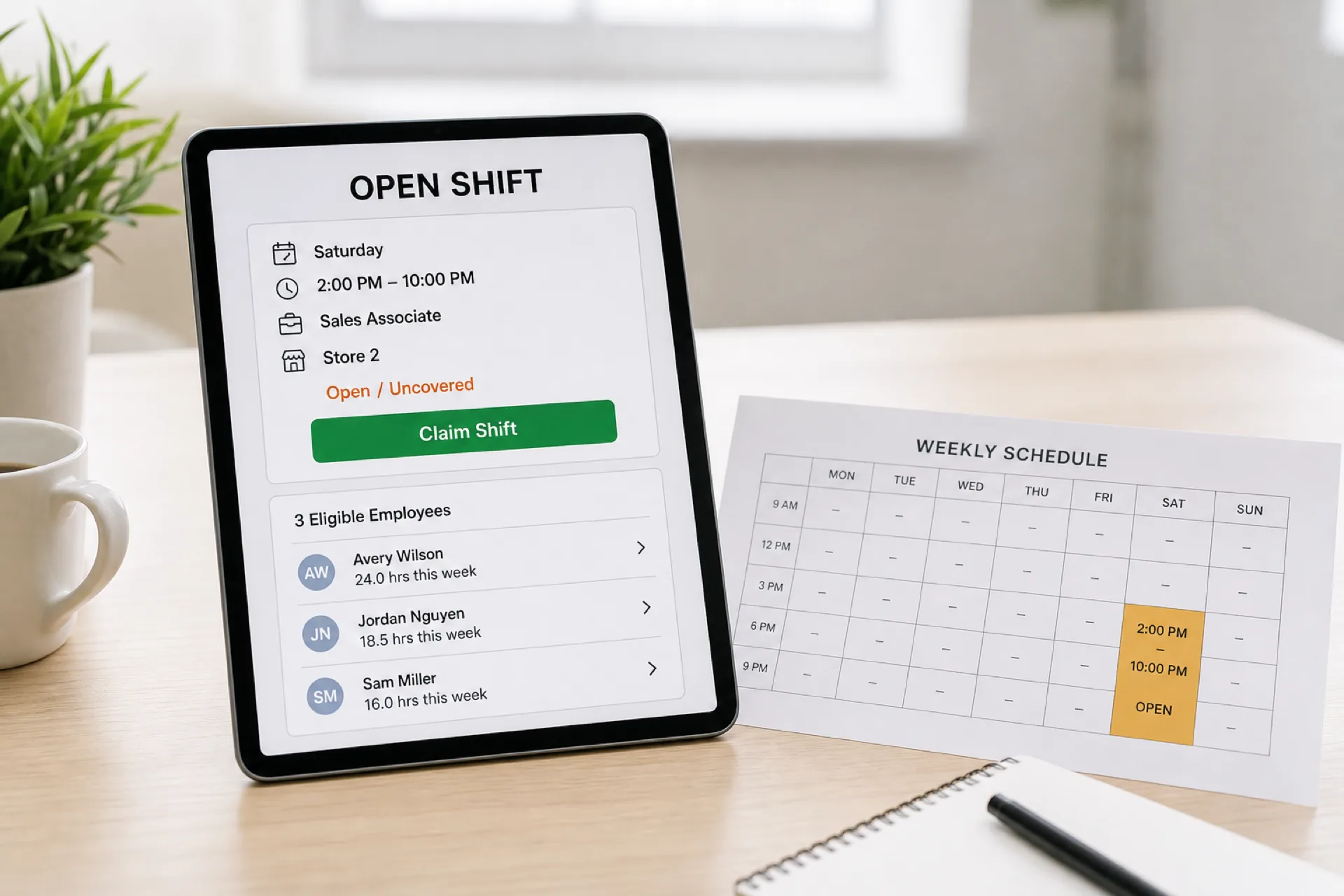
Employee scheduling software with open shifts: features, benefits, and how to choose
Compare employee scheduling software with open shifts. See how to publish uncovered hours, find eligible people, and update the official roster.
Read article