

Summary
Employee time tracking is the process of recording when employees clock in, clock out, take breaks, and complete scheduled work. Businesses use time tracking to calculate payroll, monitor attendance, control labor costs, reduce payroll errors, and ensure employees are working their assigned shifts. Modern teams record time through the attendance tracker and mobile app, then tie hours to published schedules on shift scheduling so payroll matches the official roster. Full time and attendance software adds leave, overtime alerts, and reporting on top of raw clock events.
Step-by-step
How Employee Time Tracking Works
A typical time tracking workflow connects clock events to schedules, manager review, and payroll export. Software automates hour totals and exception flags.
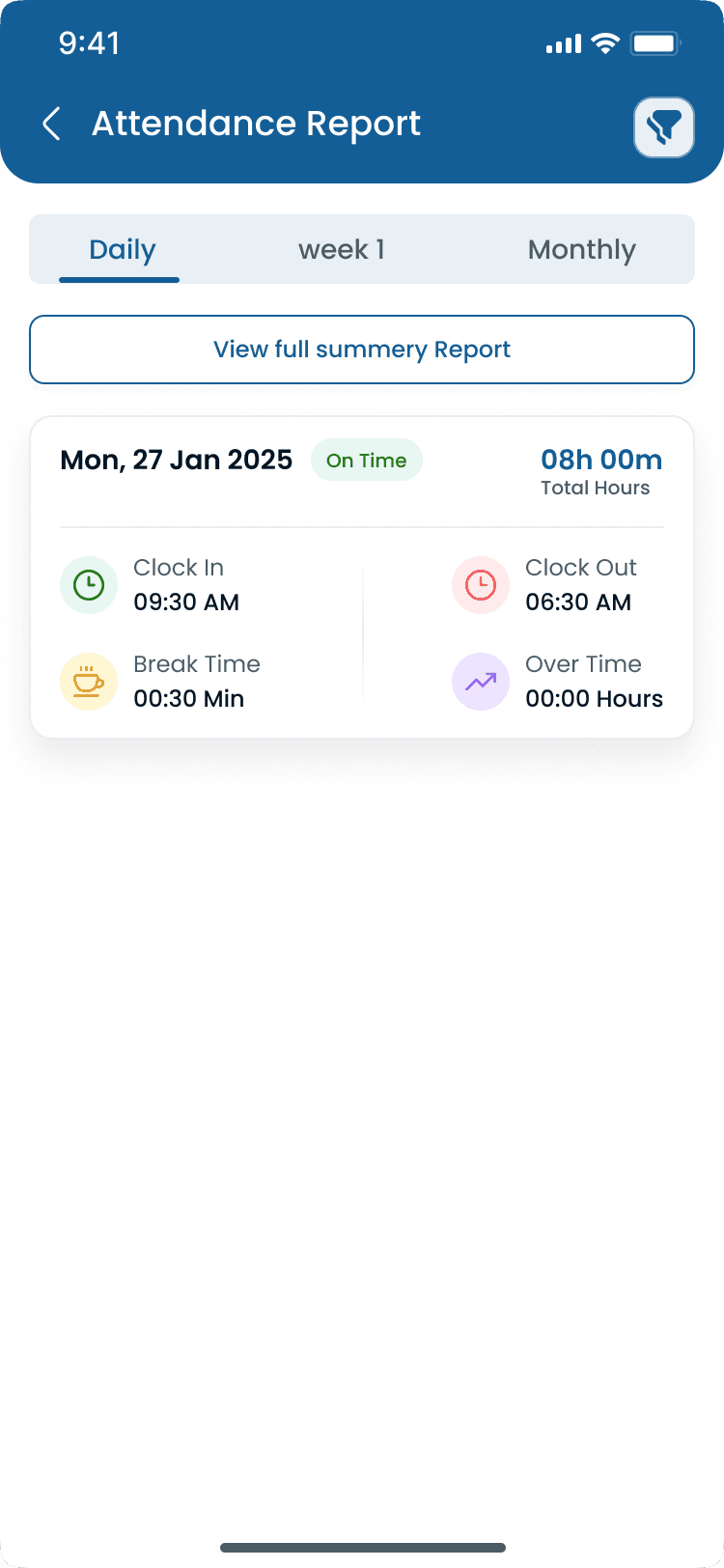
Step 1: Employee clocks in
Staff start their shift using the mobile app, web portal, or shared kiosk at the work site.
Step 2: System records time and location
The system stores timestamp and optional GPS or geofence data for field and multi-site teams.
Step 3: Breaks and shift changes are recorded
Meal, rest, and role changes are logged so paid vs unpaid time is clear for payroll and compliance.
Step 4: Employee clocks out
End-of-shift punch closes the record and calculates total hours for the day.
Step 5: Managers review and approve
Supervisors fix missed punches, compare to the published schedule on shift scheduling, and approve timesheets.
Step 6: Hours export to payroll
Approved regular and overtime hours export to payroll with fewer manual corrections and disputes.
“Time tracking records hours worked. Attendance tracking adds whether those hours matched the schedule, leave, and policy. You need both for hourly teams.”
Examples
Common Time Tracking Methods
The best clock-in method depends on where employees work and how much location verification you need.
Time tracking methods by work environment
| Method | Best for |
|---|---|
| Mobile app | Mobile and field teams |
| Web browser | Office and back-office staff |
| Shared kiosk | Retail and hospitality |
| Tablet kiosk | Warehouses and factories |
| Biometric device | High-security workplaces |
Employee time tracking vs time and attendance software
| Topic | Employee time tracking | Time and attendance software |
|---|---|---|
| Focus | Hours worked and clock events | Full attendance lifecycle |
| Typical scope | Clock in, breaks, clock out | Time tracking plus leave, OT, reporting |
| Schedule link | Strong when paired with scheduling | Built-in schedule vs actual |
| Payroll output | Approved hours export | Approved hours plus compliance reports |
| Best for | Core hour capture | Complete workforce attendance management |
Best practices
Common Employee Time Tracking Challenges
Time tracking fails when policies are unclear or clock data is disconnected from schedules and payroll.
| Practice | Why it works |
|---|---|
| Missed clock-ins | Forgotten punches require manager edits before payroll. Daily exception review catches gaps early. |
| Buddy punching | Shared PINs and honor-system clocks invite fraud. Mobile, photo, or geofence options reduce risk. |
| Forgotten breaks | Missing break punches create compliance and overtime calculation errors. |
| Manual corrections | Spreadsheet edits after export reintroduce errors. Fix exceptions in the system before payroll export. |
| Multi-location tracking | Separate site logs hide total weekly hours. One platform across locations prevents OT surprises. See multi-location scheduling. |
| Payroll disputes | Mismatch between schedule and punches drives most hourly pay disagreements. |
Features
Benefits of Employee Time Tracking
Accurate time data improves payroll, labor visibility, and compliance across hourly operations.
| Feature | Why it matters |
|---|---|
| Accurate payroll | Approved punches reduce overpayments, underpayments, and post-close corrections. |
| Better attendance visibility | Managers see late arrivals, no-shows, and early departures against the published roster in real time. |
| Faster payroll processing | Automated hour totals and exports cut manual timesheet entry before each run. |
| Reduced labor costs | Catch extra hours and leakage early with the [attendance leakage calculator](/tools/attendance-leakage-calculator). |
| Real-time workforce insights | Live dashboards show who is working now across locations for coverage decisions. |
| Easier compliance reporting | Digital records support overtime, break, and audit requests with less reconstruction. |
Why it matters
Why Employee Time Tracking Matters
Hourly businesses pay for time worked. Without reliable time tracking, payroll errors, compliance risk, and labor cost blind spots follow.
| Pain point | What operators see |
|---|---|
| Improves payroll accuracy | Approved clock data reduces manual math and pay corrections after close. |
| Reduces manual timesheets | Digital punches replace paper logs managers re-key into payroll. |
| Prevents buddy punching | Mobile, kiosk, and GPS options reduce fraudulent clock-ins for other employees. |
| Tracks overtime | Weekly hour totals surface before payroll, not after. See [overtime management](/answers/what-is-overtime-management). |
| Supports labor law compliance | Accurate records support FLSA overtime, break, and recordkeeping requirements. |
| Improves workforce visibility | Managers see who is on the clock, late, or missing across locations in real time. |
Time tracking feeds labor cost management and shift coverage when scheduled hours and actual punches live in one platform.
Industries
Industries That Use Employee Time Tracking
Any business with hourly or non-exempt employees who must record work hours for payroll and compliance uses time tracking.
| Industry | Typical scheduling challenge |
|---|---|
| Restaurants | Track FOH and BOH punches through rushes with kiosk or mobile clock-ins. |
| Retail | Kiosk and mobile options for floor staff across store locations. |
| Healthcare | Accurate clinical hour records with credential and shift alignment. |
| Warehouses | Tablet kiosks and mobile punches for pick-and-pack and receiving teams. |
| Hospitality | Clock events tied to housekeeping, front desk, and F&B schedules. |
| Construction | GPS-enabled mobile tracking for crews across job sites. |
| Manufacturing | Kiosk punches on production lines with OT visibility by crew. |
| Cleaning services | Mobile clock-ins at client sites with route verification. |
| Security | Post-level time records across 24/7 guard rotations. |
| Multi-location businesses | One hour total per employee across sites for OT and payroll accuracy. |
“Payroll disputes usually start when clock data lives in one place and the official schedule lives in another. One system fixes most of it.”
Buyer's guide
Employee Time Tracking Best Practices
These habits keep time data accurate, auditable, and payroll-ready every week.
| # | Question | What to verify |
|---|---|---|
| 1 | Use GPS or geofencing where appropriate | Field and site-based teams benefit from location verification on mobile clock-ins. Define policy clearly for off-site work. |
| 2 | Define clear clock-in policies | Document when employees must clock in, grace periods, and how missed punches are corrected. |
| 3 | Review exceptions daily | Do not wait until payroll. Fix missed punches and schedule mismatches the same day when possible. |
| 4 | Link time tracking with employee schedules | Compare punches to the published roster on [shift scheduling](/features/shift-scheduling) so scheduled vs worked hours stay aligned. |
| 5 | Automate payroll exports | Export approved regular and OT hours directly instead of re-keying totals. |
| 6 | Monitor overtime before payroll closes | Use live hour totals and the [overtime risk calculator](/tools/overtime-risk-calculator) during the week. |
Expertise & sources
Why trust this guide
ReviewedCreated by the Heyshift Team for businesses managing hourly employees across restaurants, retail, healthcare, warehouses, hospitality, construction, manufacturing, cleaning, security, and other multi-location operations in the USA. It explains time tracking as a practical payroll and attendance workflow, not abstract HR theory.
Heyshift Team
Workforce scheduling research · USA multi-location operators
Heyshift publishes scheduling and attendance playbooks for operators who need accurate hours tied to published schedules across every location.
Published & updated
Sources
3 external · 2 on Heyshift
| Source | Reference |
|---|---|
DOLU.S. Department of Labor | Fair Labor Standards Act (FLSA) |
DOLU.S. Department of Labor | Overtime pay requirements |
SHRMSHRM | Society for Human Resource Management (SHRM) |
| Further reading on Heyshift | |
| Heyshift answers library | What is time and attendance software? |
| Heyshift tools | Attendance leakage calculator |
Frequently asked questions
Track employee work hours accurately with Heyshift
Record clock-ins, monitor attendance, reduce payroll errors, and manage hourly teams from one workforce management platform. Start your free trial or book a demo.
No credit card required
Related resources
| Resource | Link |
|---|---|
| What is time and attendance software? | Open |
| What is employee scheduling software? | Open |
| What is employee availability management? | Open |
| What is labor cost management? | Open |
| What is shift coverage? | Open |
| What is overtime management? | Open |
| How does shift scheduling work? | Open |
| What is multi-location scheduling? | Open |
| Attendance tracker feature | Open |
| Mobile app feature | Open |
| Shift scheduling feature | Open |
| Attendance leakage calculator | Open |
| Overtime risk calculator | Open |
| Labor cost percentage calculator | Open |