

Summary
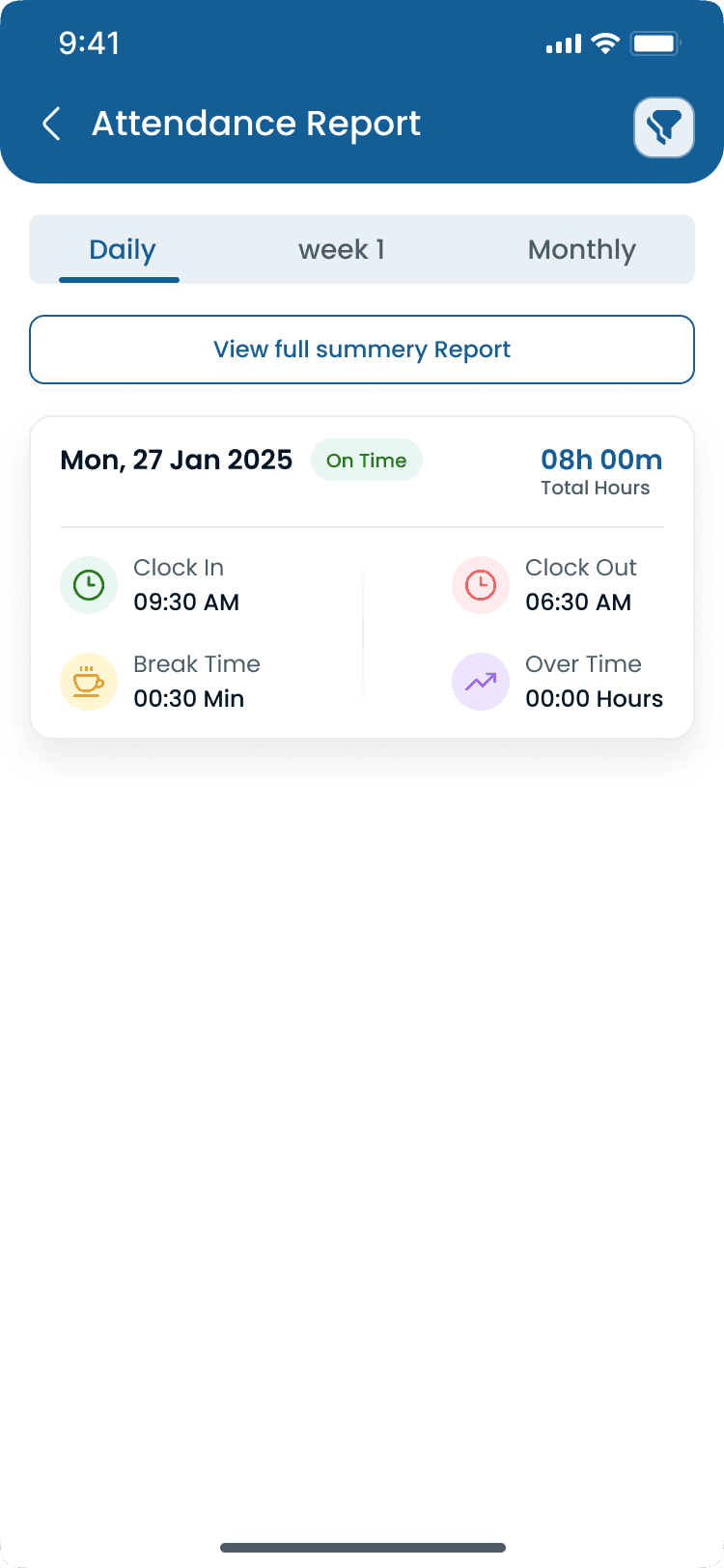
Employee attendance tracking is the process of monitoring when employees are present, absent, late, leave early, or miss scheduled shifts. It helps businesses maintain accurate attendance records, improve payroll accuracy, reduce labor costs, ensure shift coverage, and support compliance with company policies and labor regulations. Modern attendance tracking uses the attendance tracker, mobile app with GPS verification, kiosks, and cloud-based software instead of paper registers or spreadsheets, tied to schedules on shift scheduling.
Step-by-step
How Attendance Tracking Works
Modern attendance tracking starts with the schedule, not the punch. Compare clock events to planned shifts, then route exceptions to managers before payroll.
Step 1: Schedule employees
Managers publish employee schedules so attendance has a baseline for present, late, absent, and on-leave status.
Step 2: Employees clock in
Attendance is recorded through mobile app, GPS clock-in, geofencing, tablet kiosk, web browser, or biometric device.
Step 3: Attendance monitoring
The system tracks present, late arrivals, early departures, missed shifts, breaks, overtime, and other exceptions automatically.
Step 4: Manager review
Supervisors receive alerts for no-shows, missed punches, unauthorized overtime, and attendance policy violations.
Step 5: Payroll processing
Approved attendance records export to payroll with an audit trail for corrections.
“Attendance is not just clock data. It is scheduled vs actual: who showed up, who was late, who left early, and who never arrived at all.”
Examples
Attendance Status Types and Methods
Clear status labels help managers act fast: cover a no-show, approve leave, or fix a missed punch before hours lock for payroll.
Attendance status types
| Status | Meaning |
|---|---|
| Present | Employee worked as scheduled |
| Late | Employee arrived after shift start |
| Absent | Employee did not report to work |
| No show | Employee missed shift without notice |
| Early departure | Left before scheduled end time |
| On leave | Approved leave request |
| Holiday | Company holiday |
| Overtime | Worked beyond scheduled hours |
Common attendance tracking methods
| Method | Best for |
|---|---|
| Mobile app | Field teams and multi-site hourly staff |
| GPS attendance | Multi-location businesses and job sites |
| Tablet kiosk | Restaurants and high-traffic hourly sites |
| Shared kiosk | Warehouses and manufacturing |
| Web attendance | Office and back-office employees |
| Biometric scanner | High-security workplaces |
Attendance tracking vs time tracking
| Topic | Attendance tracking | Time tracking |
|---|---|---|
| Primary record | Attendance status (present, absent, late) | Hours worked |
| Focus | Presence and schedule adherence | Work duration and punch totals |
| Typical use | Workforce management and coverage | Payroll hours and project time |
| Best for | Hourly shift operations | Detailed hour accounting |
Attendance tracking vs time and attendance software
| Topic | Attendance tracking | Time and attendance software |
|---|---|---|
| Scope | Attendance monitoring | Complete attendance plus payroll workflow |
| Data | Present, absent, late, exceptions | Attendance, leave, overtime, reporting |
| Output | Attendance records and alerts | Full workforce management and export |
Best practices
Common Attendance Tracking Problems
Most attendance issues come from weak policies, disconnected schedules, or reviewing exceptions too late. Fix the process before adding more tools.
| Practice | Why it works |
|---|---|
| Buddy punching | Proxy clock-ins corrupt presence data. Use individual accounts, GPS, and geofencing. |
| Frequent lateness | Without schedule comparison, late arrivals look like on-time starts until payroll. |
| Unplanned absences | No-shows discovered at shift start hurt coverage. Alerts and backup staffing reduce impact. |
| Missed clock-ins | Forgotten punches require manager edits. Daily exception review prevents backlog. |
| Attendance disputes | Mismatch between schedule and punches drives most hourly disagreements. |
| Unauthorized overtime | Long shifts and missed clock-outs inflate OT. Monitor with the overtime risk calculator. |
| Manual attendance errors | Spreadsheet edits after export reintroduce mistakes digital systems were meant to fix. |
| Poor schedule adherence | Without published schedules, attendance tracking has no baseline for late or absent status. |
Features
Benefits of Employee Attendance Tracking
Operators adopt attendance tracking when payroll accuracy, coverage, and manager time savings depend on knowing who is actually at work.
| Feature | Why it matters |
|---|---|
| Accurate payroll | Approved attendance reduces overpayments from no-shows marked present and underpayments from missed punches. |
| Real-time attendance visibility | Dashboards show who is on the clock now at each location for coverage decisions. |
| Better shift coverage | No-show alerts trigger [shift coverage](/answers/what-is-shift-coverage) actions before service levels drop. |
| Reduced absenteeism | Trend reports surface repeat lateness and unplanned absences for coaching. |
| Faster payroll processing | Pre-approved attendance exports cut manual reconciliation before each pay run. |
| Improved labor cost control | Use the [attendance leakage calculator](/tools/attendance-leakage-calculator) to estimate cost from attendance gaps. |
| Easier compliance | Digital history supports break, overtime, and policy audit requests. |
| Better workforce planning | Attendance trends inform [workforce planning](/answers/what-is-workforce-planning) and scheduling decisions. |
Why it matters
Why Employee Attendance Tracking Matters
Attendance tracking turns raw clock events into workforce visibility: who is working, who is missing, and where coverage gaps will appear before the rush hits.
| Pain point | What operators see |
|---|---|
| Reduce payroll errors | Approved attendance records feed accurate regular and overtime hour totals. |
| Improve schedule adherence | Late arrivals and early departures surface against the published roster. |
| Minimize absenteeism | Patterns of unplanned absences become visible for coaching and staffing fixes. |
| Prevent buddy punching | Individual verified clock-ins reduce proxy punches. See [buddy punching](/answers/what-is-buddy-punching). |
| Monitor overtime | Unauthorized OT and long shifts trigger alerts before payroll export. |
| Improve workforce productivity | Managers staff to actual presence instead of assuming full scheduled coverage. |
| Reduce labor costs | Better visibility supports [labor cost management](/answers/what-is-labor-cost-management). |
| Maintain accurate attendance history | Digital records support disputes, audits, and trend analysis over time. |
| Support labor law compliance | Documented presence, breaks, and OT support wage-hour and policy reviews. |
Attendance tracking works best inside a connected stack: schedules on shift scheduling, punches from clock in and clock out, leave data from employee leave management, and payroll export from time and attendance software.
Industries
Industries That Use Attendance Tracking
Any hourly or shift-based operation with coverage risk benefits from tracking who is present, late, or absent in real time.
| Industry | Typical scheduling challenge |
|---|---|
| Restaurants | Rush coverage depends on knowing who arrived before the dining room opens. |
| Retail | Store managers track opening crews, breaks, and no-shows across districts. |
| Healthcare | Clinics and facilities need accurate presence for licensed shift roles. |
| Hospitality | Housekeeping and front-of-house teams across properties and events. |
| Warehouses | High-volume shifts with kiosk or mobile punches and exception alerts. |
| Manufacturing | Line coverage tied to plant shift schedules and OT monitoring. |
| Construction | Job-site presence verified with mobile GPS attendance. |
| Cleaning services | Client-site arrival proof before billed hours. |
| Security | Post presence required before shift pay and client reporting. |
| Property management | Maintenance and onsite staff tracked across buildings and work orders. |
| Multi-location businesses | HQ rollups of present, late, and absent status across every branch. |
“Fixing attendance exceptions daily beats reconstructing no-shows and missed punches on payroll night.”
Buyer's guide
Employee Attendance Tracking Best Practices
These habits keep attendance data accurate, fair, and payroll-ready across hourly teams.
| # | Question | What to verify |
|---|---|---|
| 1 | Publish schedules in advance | Attendance only makes sense against a known plan. Use [employee scheduling software](/answers/what-is-employee-scheduling-software) to set expectations early. |
| 2 | Require employees to clock in themselves | Proxy punches break attendance integrity. Each employee uses their own login. |
| 3 | Use GPS verification where appropriate | Field and multi-site teams benefit from location checks at punch time through [geofencing](/answers/what-is-geofencing-for-employee-attendance). |
| 4 | Review attendance exceptions daily | Fix no-shows, missed punches, and OT flags the same day when possible. |
| 5 | Connect attendance with leave management | Approved leave should show as on leave, not absent or no-show. See [employee leave management](/answers/what-is-employee-leave-management). |
| 6 | Monitor attendance trends | Weekly lateness and absence patterns inform staffing and coaching before costs compound. |
| 7 | Communicate attendance policies clearly | Document grace periods, no-show rules, and correction workflows in writing. |
| 8 | Maintain digital attendance records | Searchable history beats paper registers for audits, disputes, and trend analysis. |
Expertise & sources
Why trust this guide
ReviewedCreated by the Heyshift Team for businesses managing hourly employees across restaurants, retail, healthcare, hospitality, warehouses, manufacturing, construction, cleaning, security, property management, and other multi-location operations in the USA. It focuses on practical attendance management strategies that improve workforce visibility and operational efficiency.
Heyshift Team
Workforce scheduling research · USA multi-location operators
Heyshift publishes scheduling and attendance playbooks for operators who need real-time presence data tied to published schedules across every location.
Published & updated
Sources
3 external · 2 on Heyshift
| Source | Reference |
|---|---|
DOLU.S. Department of Labor | Fair Labor Standards Act (FLSA) |
SHRMSHRM | Society for Human Resource Management (SHRM) |
EEOCU.S. Equal Employment Opportunity Commission | Equal Employment Opportunity Commission (EEOC) |
| Further reading on Heyshift | |
| Heyshift answers library | What is time and attendance software? |
| Heyshift tools | Attendance leakage calculator |
Frequently asked questions
Improve employee attendance with Heyshift
Track attendance in real time, verify clock-ins with GPS, reduce payroll errors, prevent buddy punching, and manage schedules across every location from one workforce management platform. Start your free trial or book a demo.
No credit card required
Related resources
| Resource | Link |
|---|---|
| What is time and attendance software? | Open |
| What is employee time tracking? | Open |
| What is employee clock in and clock out? | Open |
| What is buddy punching? | Open |
| What is geofencing for employee attendance? | Open |
| What is employee scheduling software? | Open |
| What is labor cost management? | Open |
| What is employee leave management? | Open |
| Attendance tracker feature | Open |
| Mobile app feature | Open |
| Shift scheduling feature | Open |
| Staff management feature | Open |
| Attendance leakage calculator | Open |
| Overtime risk calculator | Open |
| Labor cost percentage calculator | Open |
| Manager time savings calculator | Open |