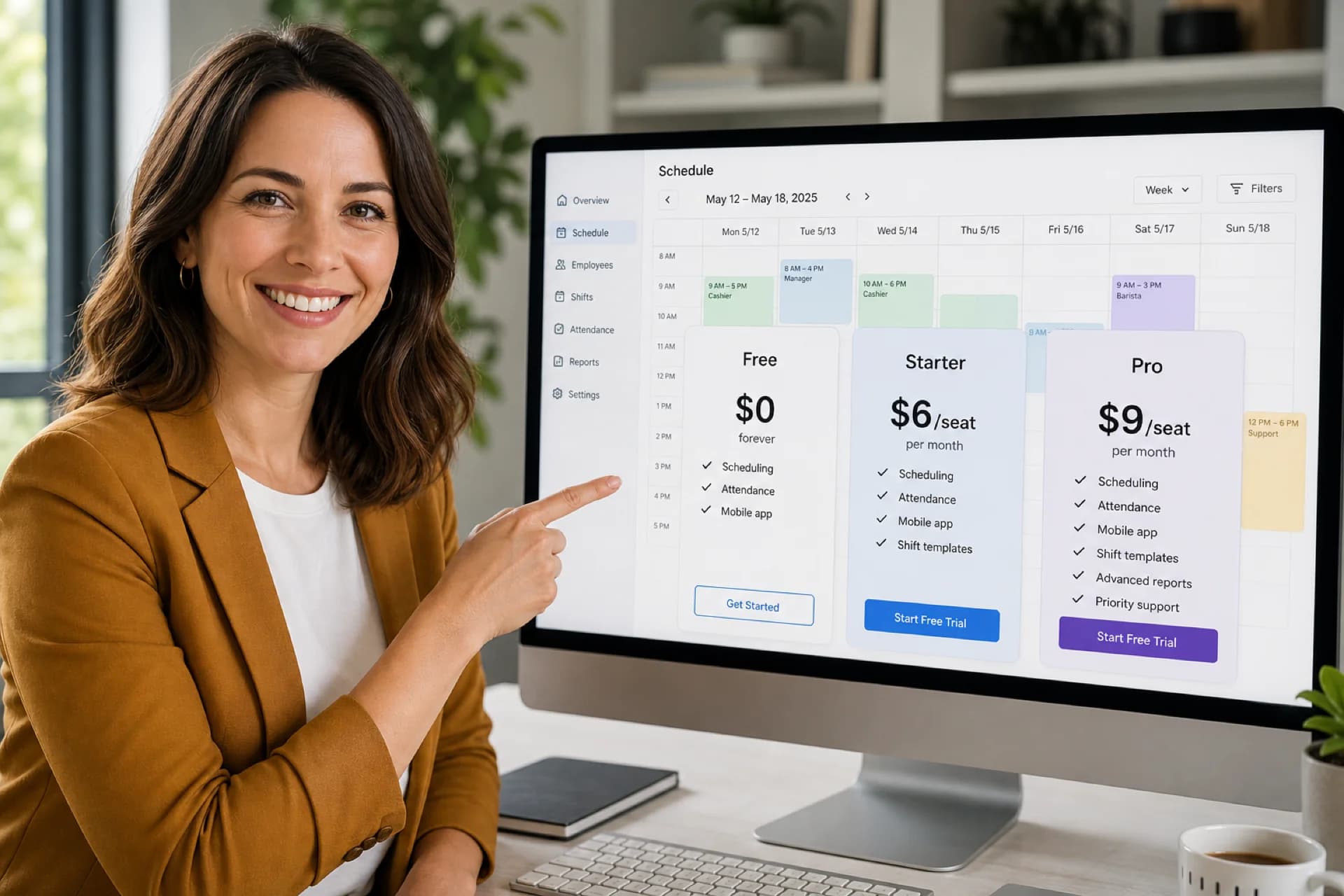
1. Heyshift
Best for: growing restaurants and multi-location operators who want scheduling and attendance in one workflow.
Heyshift combines restaurant employee scheduling, attendance tracking, shift swap management, open shifts, mobile access, and multi-location visibility in one platform.
Key features
- Shift scheduling by role, station, and location
- Mobile app for staff and managers
- Attendance tied to published shifts
- Open shifts and swap approvals
- Labor context beside the roster
- Multi-location areas for groups and franchises
Pros
- 30-day free trial with all features unlocked
- Mobile and web access included for hourly staff during your 30-day free trial
- Attendance tracking included, not a separate bolt-on
- Built for growing restaurant and hospitality operations
- Multi-location support on paid plans
Consider
- Advanced payroll and compliance controls scale on higher plans (see pricing)
Ideal for: independent restaurants, quick-service concepts, restaurant groups, and multi-unit brands evaluating employee scheduling software for restaurants without HRMS bloat.
Start 30-day free trial or compare Heyshift to your current stack on our 7shifts alternative page.
2. 7shifts
Best for: restaurant teams already familiar with a hospitality-first scheduling brand.
7shifts focuses on restaurant workforce management with scheduling, labor tools, and team communication.
Pros
- Restaurant-oriented feature set
- Scheduling and labor cost controls
- Established hospitality user base
Cons
- Total cost often rises as headcount and locations grow
- Some advanced capabilities sit on higher tiers
Teams comparing options often read our 7shifts alternative for a side-by-side capability view.
3. Homebase
Best for: very small restaurant teams prioritizing fast setup.
Homebase combines scheduling, time tracking, and team messaging for small hourly teams.
Pros
- Free tier for small teams
- Straightforward onboarding
Cons
- Multi-location and advanced workforce workflows can feel limited as you scale
- Restaurant-specific depth varies by plan
See Homebase alternative for how teams evaluate fit at growth stage.
4. Deputy
Best for: operators who prioritize scheduling automation and compliance-oriented workflows.
Deputy offers scheduling, time tracking, and workforce tools used across hospitality and retail.
Pros
- Scheduling automation options
- Labor compliance and rule tooling on higher plans
Cons
- Smaller teams may face a steeper setup curve
- Pricing scales with workforce size
Compare on our Deputy alternative page.
5. Sling
Best for: budget-conscious teams needing core scheduling and messaging.
Sling provides employee scheduling, shift management, and team communication at accessible price points.
Pros
- Affordable entry pricing
- Shift management basics
Cons
- Reporting and workforce depth can feel basic vs hospitality-focused platforms
- Multi-location visibility may require workarounds for larger groups
See Sling alternative for a structured comparison.
Comparison table
| Software |
Scheduling |
Attendance |
Shift swaps |
Multi-location |
| Heyshift |
Yes |
Yes |
Yes |
Yes |
| 7shifts |
Yes |
Yes |
Yes |
Yes |
| Homebase |
Yes |
Yes |
Yes |
Limited |
| Deputy |
Yes |
Yes |
Yes |
Yes |
| Sling |
Yes |
Basic |
Yes |
Limited |
Use this table as a starting point. Your best fit depends on headcount, location count, publish workflow, and how tightly attendance must match the roster.
Common restaurant scheduling problems software should solve
Last-minute call-offs: coverage gaps during peak service (see reduce no-shows and call-offs).
Overtime cost: hours stack when visibility arrives too late (see prevent overtime before payroll).
Shift coverage: managers lose floor time hunting replacements in chat.
Communication gaps: staff miss updates when the official roster lives in one place and changes live elsewhere.
Multi-location complexity: district leads merge exports instead of reviewing one roll-up.
The right restaurant workforce management platform addresses these in one publish-and-track loop.
How scheduling software reduces restaurant labor cost
Strong platforms help restaurants:
- Right-size FOH and BOH hours against demand
- Surface overtime before the pay period closes
- Improve attendance accuracy and correction workflows
- Track utilization trends by role and day part
- Reduce manager rework every Sunday night
Even modest scheduling gains compound across busy weeks and holiday seasons.
Why restaurant managers move beyond spreadsheets
Spreadsheets work for a handful of employees and one manager who holds the whole week in memory.
Growing restaurants need:
- Real-time schedule updates on mobile
- Attendance visibility beside published shifts
- Approved swap and open-shift paths
- Labor monitoring while building the week
- One source of truth across locations
If Excel is still in the loop, read workforce scheduling software vs Excel and why spreadsheets fail for workforce scheduling.
Why growing restaurants choose Heyshift
Heyshift helps restaurants:
30-day free trial highlights
- Up to 15 employees and one location
- Core scheduling, shift swaps, basic attendance, leave calendar, mobile access
- No credit card required to start
Create your free account or book a demo for multi-unit rollouts.
Frequently asked questions
What is restaurant scheduling software?
Software that helps restaurants build schedules, manage attendance, communicate changes, and monitor labor cost in one workflow.
Can scheduling software reduce overtime?
Yes. When scheduled and worked hours stay visible before payroll close, managers can adjust coverage earlier.
Is scheduling software worth it for small restaurants?
Yes. Even single-location concepts benefit when swaps, availability, and attendance stop living in separate chats and files.
What features should restaurants prioritize?
Scheduling, mobile access, shift swaps with approval, attendance tracking, labor visibility, communication, and multi-location support if you plan to grow.
How is this different from generic scheduling software?
Restaurant scheduling software accounts for role mix, day-part peaks, turnover, and service coverage in ways generic tools often handle as afterthoughts.
Final thoughts
The best employee scheduling software for restaurants in 2026 is the platform your managers will publish every week and your hourly staff will actually open on mobile.
Restaurant scheduling shapes labor cost, team satisfaction, and guest experience. Moving beyond spreadsheets gives operators better visibility, fewer conflicts, and a clearer path as locations multiply.
One line to keep: pick software that makes one published roster the only schedule that matters.
Related industry guide: Best employee scheduling software for retail stores (2026). Multi-location: Best scheduling software for multi-location businesses (2026). Pricing: Employee scheduling software cost (2026).