

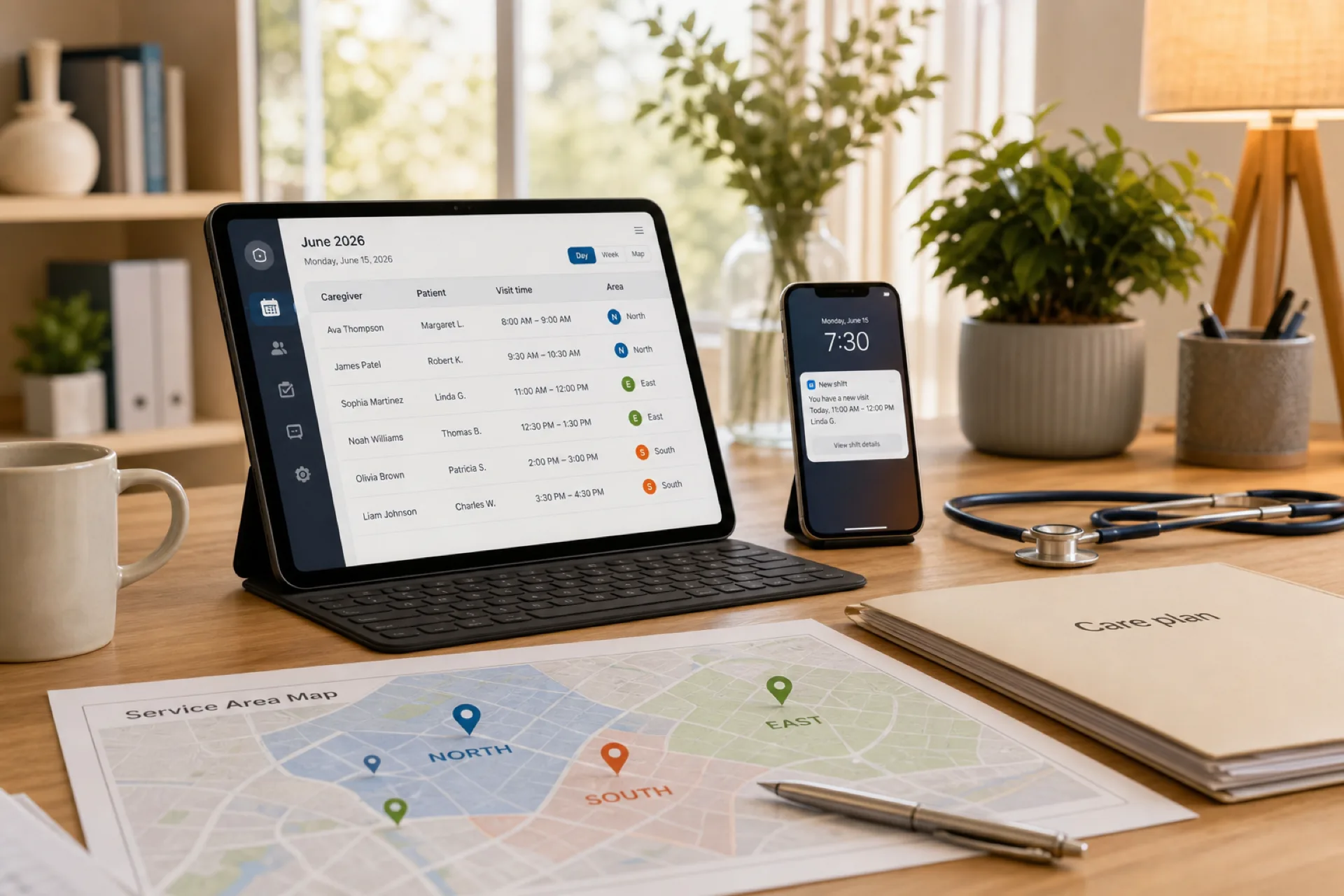
Home healthcare scheduling: best practices for managing caregiver shifts (2026)
Home healthcare scheduling best practices help agencies assign caregivers to patient visits, reduce overtime, manage call-offs, and improve care continuity with publish-first workforce management.
Home healthcare scheduling: best practices for managing caregiver shifts (2026)
Home healthcare agencies run on visit windows, not desk shifts. Caregivers, nurses, home health aides, therapists, and private duty staff move between patient homes all day while coordinators rebuild coverage when acuity changes, visits cancel, or someone calls off.
Home healthcare scheduling is harder than scheduling office staff because every assignment combines employee availability, travel time, patient care requirements, overtime risk, and compliance expectations. Spreadsheets and group texts work until volume, service areas, and payer scrutiny outgrow them.
This guide explains home healthcare scheduling best practices USA agencies use to assign caregivers efficiently, reduce overtime, handle call-offs, and protect care continuity.
Featured answer: What is home healthcare scheduling? Home healthcare scheduling is the process of assigning caregivers, nurses, and healthcare professionals to patient visits while balancing employee availability, travel time, patient care requirements, overtime, and regulatory compliance.
Who should read this: Agency owners, schedulers, and clinical leaders at home health, home care, private duty nursing, hospice, and personal care agencies with roughly 25 to 300 field staff across one or more service areas.
Compare platforms in best employee scheduling software for home healthcare agencies (2026). For product depth, see healthcare staff scheduling software, nurse scheduling software, and nursing home scheduling software. Use the overtime risk calculator before you publish the week.
Executive summary
Scheduling caregivers is more challenging than scheduling desk-based staff because the workforce is mobile, visits move, and care continuity matters as much as clock time.
In this guide you will learn:
- Why home healthcare scheduling breaks when agencies rely on spreadsheets
- Common problems from double-booking to missed visits
- Ten caregiver scheduling best practices you can apply this week
- A sample daily visit schedule table
- How a multi-county agency simplified scheduling without sacrificing patient coverage
- What to look for in home care scheduling software
- Fifteen FAQs schedulers ask before changing process or tools
Table of contents
- Why home healthcare scheduling matters
- Home healthcare workforce trends in 2026
- Why home healthcare scheduling is so challenging
- Common scheduling problems
- Why spreadsheets stop working
- 10 home healthcare scheduling best practices
- Reducing overtime in home healthcare agencies
- Managing travel time between patient visits
- Sample daily caregiver schedule
- How a home healthcare agency simplified caregiver scheduling
- How scheduling software helps
- Choosing home care scheduling software
- Common scheduling mistakes
- Handling call-offs and last-minute cancellations
- 30-day scheduling improvement checklist
- Compliance and workforce planning notes
- Frequently asked questions
- Final thoughts
Why home healthcare scheduling matters
When caregiver shift scheduling is clear and published early:
- Patients receive visits in planned windows with fewer gaps
- Caregivers know routes and assignments before they leave home
- Coordinators fill call-offs through open shifts instead of emergency overtime texts
- Payroll sees planned vs worked hours tied to the same official week
- Agency leaders answer staffing questions with data, not memory
When schedules drift, missed visits, caregiver burnout, overtime surprises, and payer complaints follow. Scheduling is how you translate authorized visits and care plans into safe, reliable coverage on the road.
Explore employee scheduling software for USA hourly teams and shift scheduling for publish-first basics that apply to field healthcare teams.
Home healthcare workforce trends in 2026
Home health and personal care agencies enter 2026 with rising visit volume, persistent caregiver shortages, and payer and survey scrutiny that makes "we'll patch it in texts" a risky operating model. Agencies stabilizing labor cost are publishing earlier, grouping visits by geography, and giving field staff one mobile roster they trust.
| Trend | What operators see | Scheduling implication |
|---|---|---|
| Caregiver and aide shortages | Open roles stay unfilled; overtime fills gaps | Publish two weeks ahead; maintain backup and on-call pools |
| Aging population and more home-based care | Visit volume grows faster than coordinator headcount | Rebuild templates by service area, not one flat grid |
| Acuity and visit mix shifts | Skilled nursing visits interleave with aide blocks | Tag roles and credentials in the roster |
| Medicare and quality focus | Documentation must match planned coverage | One official schedule for operations and attendance |
| Mobile-first caregivers | Field staff ignore email and paper printouts | Same app for schedule, swaps, and alerts |
| Multi-county expansion | Travel time breaks routes built in spreadsheets | Schedule by geographic area with realistic gaps |
Caregiver demand outpaces easy hiring
The BLS outlook for home health and personal care aides projects much faster than average employment growth, driven by aging populations and preference for care at home. The registered nurse outlook notes continued need across home healthcare settings. When requisitions outpace hires, scheduling must assume scarcity: cross-train backups, maintain open-shift pools, and avoid stacking overtime on the same caregivers every week.
Visit windows still break static weekly grids
Patient discharges, new admissions, authorization changes, and emergency visits reshape the day. Static spreadsheets cannot absorb that churn without version conflicts. Publish-first software plus daily review beats rebuilding tabs at 6 a.m.
Payer and CMS quality expectations raise the bar
Medicare-certified home health agencies operate under CMS home health quality programs that tie reimbursement and public reporting to organized, documented care delivery. Scheduling software does not replace clinical documentation or billing systems. It does give coordinators one published visit plan field staff and attendance records can reference.
Roles and crews agencies schedule:
- Registered nurses and licensed practical nurses
- Home health aides and personal care aides
- Physical, occupational, and speech therapists
- Medical social workers
- Private duty and hospice caregivers
- Scheduling coordinators and clinical managers
Scheduling software does not replace your EMR, EVV vendor, or billing platform. It gives coordinators one published roster per service area, mobile access for deskless caregivers, and hour visibility while planning so overtime is a decision, not a payroll surprise. Read employee scheduling software ROI guide when you frame labor savings during evaluation.
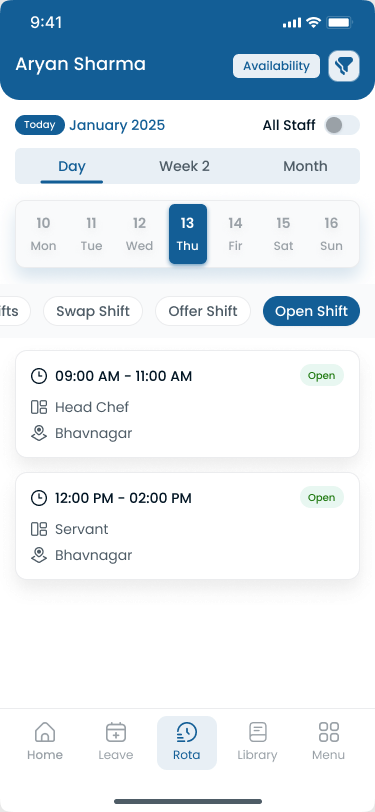
Field teams need the official visit roster on mobile, not a screenshot from yesterday's spreadsheet tab.
Why home healthcare scheduling is so challenging
Mobile workforce: caregivers rarely share one clock-in location. Assignments span counties, not one building.
Multiple patient visits: each day combines duration, skill mix, and continuity rules that spreadsheets hide until someone is double-booked.
Travel between locations: back-to-back visits across town create missed windows when travel time is ignored.
Last-minute cancellations: patient hospitalizations, family requests, and weather reshape routes mid-day.
Emergency visits: acute needs pull available staff off planned routes.
Care continuity: patients expect familiar caregivers; constant reassignment hurts outcomes and satisfaction.
Caregiver availability: part-time aides, second jobs, and PTO stacks create real constraints.
Labor shortages: when backups are thin, every call-off becomes an overtime decision.
Read mobile workforce management guide and best employee scheduling software for home healthcare agencies for field-first patterns.
Common scheduling problems in home healthcare
| Problem | What breaks on the road |
|---|---|
| Double-booking caregivers | Missed visits, compliance risk, caregiver frustration |
| Long travel routes | Late arrivals, shortened visit time, fuel and labor waste |
| Overtime stacking | Margin erosion on the same few names every week |
| Last-minute absences | Coverage scrambles and patient gaps |
| Missed visits | Payer issues, family complaints, readmissions risk |
| Communication delays | Caregivers arrive at old addresses or cancelled windows |
| Spreadsheet errors | Wrong version published; payroll disputes |
| Staffing shortages | Open shifts unfilled until overtime is the only lever |
Pair operational fixes with employee attendance tracking guide and prevent overtime before payroll.
Why spreadsheets stop working
Manual home care employee scheduling fails as agencies grow for predictable reasons:
- Manual updates: every change requires editing tabs, texting screenshots, and hoping field staff see the latest file
- Version conflicts: "Schedule v3 FINAL" is never final when visits move hourly
- No mobile access: caregivers cannot reliably open Excel on the road
- Poor communication: schedule changes live in personal texts, not one official channel
- Payroll inaccuracies: planned visit blocks do not match worked hours without a shared record
- No real-time visibility: coordinators cannot see who is approaching overtime while rebuilding routes
See why spreadsheets fail for workforce scheduling and workforce scheduling software vs Excel.
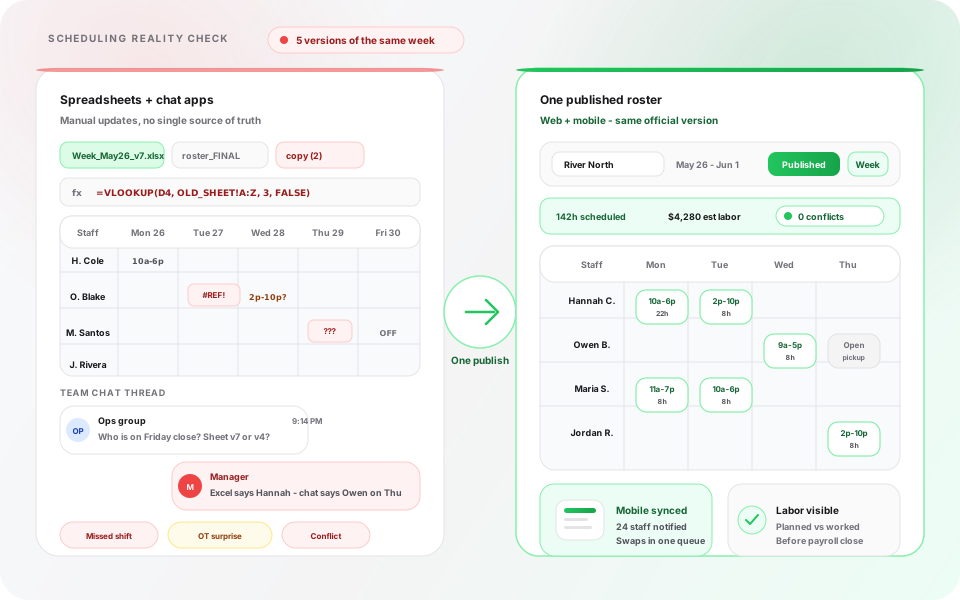
When visit windows change hourly, version conflicts on Excel tabs are how missed visits start.
10 home healthcare scheduling best practices
1. Schedule by geographic area
Group visits by service area, ZIP cluster, or county so caregivers run tight routes instead of crossing the map between appointments. Geographic scheduling reduces travel time, fuel cost, late arrivals, and caregiver fatigue.
Tag each assignment with area codes coordinators can filter while building the day.
2. Publish schedules in advance
Give caregivers at least one to two weeks' notice when payer authorizations allow. Early publish helps staff plan life outside work, request swaps sooner, and reduces same-day overtime panic.
Publish-first means one official roster on mobile, not a photo in a group chat.
3. Track caregiver availability accurately
Maintain PTO, sick leave, preferred days, credential expirations, and secondary jobs in the same system you publish from. Scheduling against outdated availability is how double-bookings start.
Explore people and availability on Heyshift.
4. Minimize travel time between visits
Build realistic gaps between appointments. Back-to-back visits 30 minutes apart across town guarantees missed windows and rushed care.
Review route density weekly by area, not only when complaints arrive.
5. Monitor overtime weekly
Review hour totals while building the week, not after payroll export. Use the overtime risk calculator to stress-test assignments before publish.
See how facility management companies can reduce overtime for parallel habits in mobile operations.
6. Use manager-approved shift swaps
Flexibility improves retention. Unstructured flexibility creates coverage holes. Route swap and open-shift requests through the published roster with coordinator approval.
Read employee shift swapping best practices and open shift and swap approvals.
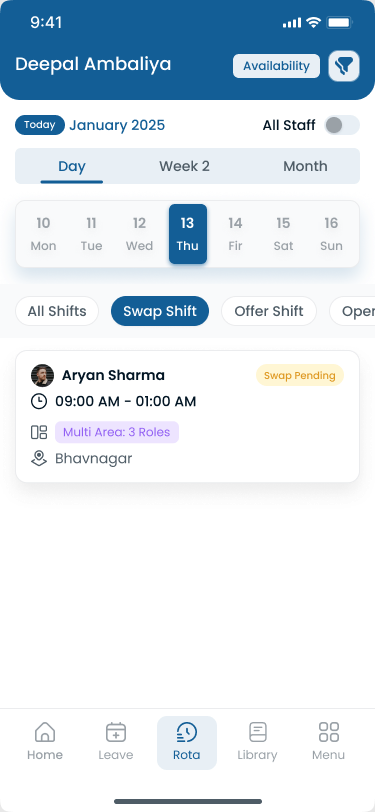
Swap and open-shift requests should update the same published week coordinators and payroll trust.
7. Keep backup caregivers available
Maintain a qualified on-call or float pool by area and skill. When primary caregivers call off, coordinators fill from backups before stacking overtime on exhausted staff.
Track who is credentialed for skilled nursing vs aide visits in role labels.
8. Send instant schedule notifications
Visit time changes, new assignments, and cancellations should hit caregivers through the same app as the schedule. Relying on phone trees alone increases missed visits.
Use Heyshift mobile app patterns for deskless teams.
9. Review staffing levels daily
Morning review beats weekly surprise. Check open visits, call-offs, authorization changes, and area coverage before the first wave leaves home.
Daily coordinator checklist
| Step | Question |
|---|---|
| Open visits | Are any authorized visits unassigned? |
| Call-offs | Did open shifts fill through approved pickup? |
| Travel sanity | Are back-to-back visits realistic by area? |
| Overtime | Who is near hour limits today and this week? |
| Continuity | Did high-acuity patients keep preferred caregivers? |
10. Use scheduling software instead of spreadsheets
Modern home healthcare scheduling software centralizes employee scheduling, caregiver availability, attendance tracking, leave management, open shifts, shift swaps, mobile notifications, multi-area visibility, and workforce reporting.
Compare vendors in best employee scheduling software for home healthcare agencies.
Reducing overtime in home healthcare agencies
Overtime in home health stacks as extra visits, extended blocks, and last-minute coverage on caregivers already near hour limits. Review hour totals while building the week, not after payroll export. Separate reactive call-off overtime from planned coverage gaps, use open shifts with credential filters before premium pay, and cap repeat overtime on the same names every week.
Run scenarios through the overtime risk calculator before you publish. Read prevent overtime before payroll for habits that translate to field healthcare teams.
Coordinators should see who is near hour limits before the week is published, not when payroll exports.
Managing travel time between patient visits
Travel is invisible in spreadsheet grids until a caregiver arrives late or cuts visit time short.
- Area-first routes: sort the day by geography before optimizing individual appointments
- Realistic buffers: a 45-minute visit plus drive time is not a 45-minute block; urban clusters need smaller gaps than rural routes
- Weekly density review: if one caregiver crosses four towns every Tuesday, rebalance the route, not only the person
- One change channel: traffic, weather, and patient delays should update the published roster, not a side text thread
Explore multi-location areas when you operate several service territories from one account. For broader mobile patterns, see mobile workforce management guide.
Sample daily caregiver schedule
Adapt visit times, areas, and roles to your authorization mix. This table shows how coordinators visualize one day across a service region.
| Caregiver | Patient | Visit time | Area | Role | Status |
|---|---|---|---|---|---|
| Sarah M. | Patient A | 8:00 AM to 9:30 AM | North | RN visit | Scheduled |
| David L. | Patient B | 9:30 AM to 11:00 AM | East | Aide block | Scheduled |
| Emily R. | Patient C | 11:00 AM to 12:30 PM | South | PT visit | Scheduled |
| James T. | Patient D | 1:00 PM to 2:00 PM | East | Aide block | Scheduled |
| Maria G. | Patient E | 2:30 PM to 4:00 PM | North | RN visit | Scheduled |
| Open shift | Patient F | 4:00 PM to 5:30 PM | West | Aide block | Open |
For weekly planning templates, download the home healthcare schedule template, caregiver schedule template, nurse schedule template, employee schedule template, or browse healthcare scheduling templates before you move to software.
How a home healthcare agency simplified caregiver scheduling
Before: three counties, one spreadsheet tab per coordinator
A home healthcare agency with roughly 75 caregivers across three counties ran caregiver scheduling through separate Excel files, group texts, and morning phone trees. Coordinators spent hours each day reconciling visit changes. Overtime stacked on a small set of nurses willing to pick up extra visits. Missed windows triggered family complaints and payer questions.
The week that exposed the gap
During a flu season surge, two coordinators published different versions of the same Tuesday route. Three aides arrived at cancelled visits while two authorized skilled nursing visits went uncovered until overtime nurses were called in.
After: one publish path and mobile roster
The agency moved to centralized scheduling with geographic area tags, publish-first discipline, open-shift pickup with approval, and attendance tied to published visit blocks. Coordinators still handled clinical judgment. They stopped rebuilding tabs at dawn.
| Challenge | Before | After |
|---|---|---|
| Schedule versions | Multiple Excel files and text screenshots | One published roster per service area |
| Call-off fill | Phone tree to the same few nurses | Open shifts visible on mobile with approval |
| Travel planning | Visits booked without route logic | Area-based templates and daily review |
| Overtime | Discovered at payroll export | Hour totals visible while building the week |
| Caregiver communication | Personal texts and voicemails | Schedule changes through official app |
| Coordinator time | Hours reconciling files daily | More time on visit matching and continuity |
Scheduling software did not replace their clinical documentation system or EVV process. It gave coordinators one workforce layer payroll and field staff could trust.
Evaluate platforms using the same questions on best employee scheduling software for home healthcare agencies.
How scheduling software helps home healthcare agencies
Modern home healthcare workforce management software typically delivers:
| Capability | Agency outcome |
|---|---|
| Employee scheduling | Faster visit assignment by area and role |
| Caregiver availability | PTO and credentials beside the grid |
| Attendance tracking | Planned vs worked visits before payroll |
| Leave management | Approved time off without surprise conflicts |
| Open shifts | Qualified pickup when call-offs hit |
| Shift swaps | Flexibility with coordinator control |
| Mobile notifications | Field staff see changes instantly |
| Multi-location areas | Separate rosters with leadership roll-up |
| Workforce reporting | Overtime and attendance trends by area |
Technology does not replace clinical judgment. It removes admin drag so coordinators apply these best practices consistently.
Explore attendance management software and attendance tracker for planned-vs-worked discipline.
Choosing home care scheduling software
When you evaluate home healthcare scheduling software, prioritize:
| Requirement | Why it matters |
|---|---|
| Mobile app | Caregivers live on phone, not email |
| Area or territory scheduling | Route density and travel realism |
| Attendance tracking | Payroll accuracy and visit accountability |
| Leave management | PTO visible before assignments go out |
| Overtime visibility | Hour totals while planning, not after export |
| Multi-area support | Counties and branches in one account |
| Ease of use | Coordinators adopt tools that match workflow |
| Reporting | Weekly OT and attendance roll-ups |
Optional advanced needs such as GPS-aware scheduling or EVV integration depend on your payer mix and existing vendors. Heyshift focuses on publish-first scheduling, attendance, leave, swaps, and mobile access; compare tiers on pricing.
For broader healthcare comparisons, read best employee scheduling software for healthcare teams and how to create a nursing home staff schedule for facility-side patterns.
Common home healthcare scheduling mistakes
Scheduling too many visits per caregiver: density looks efficient on paper until every window runs late.
Ignoring travel time: the most common cause of missed visits and caregiver burnout.
Overusing overtime: reactive staffing trains staff to expect premium pay instead of open-shift pickup.
Not planning for call-offs: agencies without backup pools pay overtime tax every flu season.
Poor communication: if the app says one time and a text says another, caregivers trust neither.
Delaying schedule publication: same-day-only planning guarantees overtime and continuity breaks.
Skipping daily review: authorization changes overnight; yesterday's roster is not today's truth.
Handling call-offs and last-minute cancellations
Patient-side cancellations: release the caregiver block quickly and offer open shift credit elsewhere in the area same day when possible.
Caregiver call-offs: publish open shift to qualified staff by credential and geography before calling overtime names.
Emergency visits: pull from on-call pool with explicit hour check, not automatic extension of the prior visit block.
Document the official change on the published roster so attendance and payroll match what coordinators approved.
Read reduce employee no-shows and last-minute call-offs for coverage habits that protect visit windows.
30-day scheduling improvement checklist
Use this rollout path when you are moving from spreadsheets or tightening an existing process. Each week builds on the last without forcing a big-bang cutover.
| Week | Focus | Actions |
|---|---|---|
| Week 1 | Baseline and areas | List service areas, tag caregivers by credential, export one week of visits from your current tool |
| Week 2 | Publish discipline | Choose one official publish channel; stop sending schedule screenshots as the source of truth |
| Week 3 | Travel and OT review | Add buffers between visits by area; review hour totals every Friday before Monday publish |
| Week 4 | Mobile and backups | Confirm caregivers open the official app; document backup pool by area and skill |
When you are ready to compare platforms, start a 30-day free trial, book a demo, or contact Heyshift with your service areas and caregiver count.
Compliance and workforce planning notes
Home healthcare agencies operate under state licensure rules, payer authorization limits, and for Medicare-certified providers, CMS home health quality expectations. Scheduling software supports operational discipline; it does not replace clinical supervision, visit documentation, or EVV requirements where applicable.
The Occupational Safety and Health Administration emphasizes safe work practices for healthcare workers including ergonomic and bloodborne pathogen protections during home visits. SHRM workforce planning guidance consistently ties labor forecasting to retention and cost control, the same levers scheduling affects daily.
When public health guidance affects visit safety, agencies should align schedule changes with current CDC healthcare worker resources and local health department rules.
Frequently asked questions
What is home healthcare scheduling?
Home healthcare scheduling is the process of assigning caregivers, nurses, and healthcare professionals to patient visits while balancing employee availability, travel time, patient care requirements, overtime, and regulatory compliance.
How do home healthcare agencies reduce overtime?
Publish schedules early, group visits by geography, track hour totals while planning, maintain backup pools, use open shifts with approval, and review overtime reports weekly. See prevent overtime before payroll.
What software is best for caregiver scheduling?
The best fit depends on agency size, service areas, and workflow. Compare options in best employee scheduling software for home healthcare agencies and healthcare staff scheduling software.
How do you manage last-minute cancellations?
Release visit blocks on the official roster, notify affected caregivers on mobile, and reassign open capacity within the same geographic area when authorizations allow.
Should caregivers use a mobile scheduling app?
Yes. Field staff need mobile access to the official schedule, open shifts, and change notifications. Paper and email alone fail on the road.
How far ahead should schedules be published?
Aim for one to two weeks when payer authorizations are stable. Shorter horizons increase overtime and continuity breaks.
Can scheduling software reduce missed visits?
Yes, when coordinators publish one official roster, plan realistic travel, review coverage daily, and notify caregivers instantly about changes.
How do you track caregiver attendance?
Track planned visit blocks beside clock-in or EVV records on the same published week. Explore attendance tracker and attendance management software.
What features matter most for home healthcare scheduling?
Employee scheduling by area, mobile access, attendance tracking, leave management, shift swaps, open shifts, workforce communication, multi-area support, and overtime visibility.
How does scheduling software improve patient care?
Reliable visit coverage, continuity-friendly assignments, and fewer late arrivals protect care plans families and payers expect.
Is home healthcare scheduling different from nursing home scheduling?
Yes. Home health assigns mobile visits across a region; nursing homes staff fixed units on recurring shift bands. See how to create a nursing home staff schedule.
Where should agencies start if they still use spreadsheets?
Download the nurse schedule template, adopt geographic area tags, publish one week ahead, then trial home healthcare scheduling software on one service area.
How do I evaluate ROI on scheduling software?
Use the overtime risk calculator and employee scheduling software ROI guide before vendor demos.
Final thoughts
Better home healthcare scheduling improves patient care, caregiver satisfaction, operational efficiency, and labor cost control while reducing coordinator burnout.
Agencies that publish early, schedule by area, track attendance digitally, and replace spreadsheet rotas with modern workforce software gain the visibility to keep visits covered without defaulting to overtime.
One line to keep: plan visits by area, publish once, and review the roster every morning before caregivers hit the road.
Related Healthcare Resources
Continue with related topics
Pulled from shared tags when possible, otherwise the newest notes from the blog.

Medical Office Scheduling: Best Practices for Clinics and Healthcare Practices (2026)
Learn medical office scheduling best practices to improve staff coverage, reduce overtime, streamline attendance, and optimize workforce management for healthcare practices and multi-location clinic groups.

Healthcare Workforce Management: The Complete Guide for Hospitals, Clinics & Care Providers (2026)
Learn healthcare workforce management best practices for hospitals, clinics, and care providers: staff scheduling, attendance tracking, labor planning, overtime reduction, compliance, and workforce communication in one guide.

Best Healthcare Staff Scheduling Software (2026): Compare the Top Solutions
Compare the best healthcare staff scheduling software for hospitals, clinics, nursing homes, assisted living, and home healthcare agencies. Features, pricing factors, and buying guidance for growing care organizations.