

Free 10-Hour Shift Schedule Template
Create balanced 10-hour employee schedules with our free Excel, Google Sheets, and PDF templates. Organize four-day workweeks, rotating shifts, and team coverage while reducing overtime and improving workforce planning.
Free download · No account required · CSV opens in Google Sheets
- Healthcare facilities
- Manufacturing plants
- Warehouses and distribution
- Construction companies
- Utilities and public works
- Security and field service teams
Table of contents
- Quick overview
- What is a 10-hour shift schedule template?
- Who should use this template?
- Common 10-hour shift patterns
- What's included?
- Template features
- Template preview
- Benefits of 10-hour shifts
- Trade-offs and fatigue planning
- 4x10 staffing math
- Industry quick-start bands
- Setting 10-hour shift times by industry
- Deep dive: manufacturing and warehousing
- Deep dive: healthcare and construction
- Deep dive: utilities, security, and field service
- Breaks, meal periods, and handoffs
- Overtime, labor cost, and compliance basics
- Monthly and multi-week planning workflow
- Pilot rollout: converting from 5x8 to 4x10
- Common scheduling challenges
- Best practices
- Common mistakes
- Getting started checklist
- How to build a 10-hour shift week
- Spreadsheet vs scheduling software
- Compare shift patterns
- Related templates
- Frequently asked questions
Quick overview
| Feature | Details |
|---|---|
| Best for | Healthcare, manufacturing, warehousing, construction |
| Shift pattern | 10-hour |
| Schedule | Weekly and monthly |
| Formats | Excel, Google Sheets, PDF |
| Editable | Yes |
| Printable | Yes |
| Cost | Free |
Featured answer: A free 10-hour shift schedule template gives managers a weekly grid for four-day workweeks with ten-hour shifts, shift pattern labels, daily start and end times, breaks, weekly hours, overtime, supervisor, and notes in Excel, Google Sheets, or PDF.
This guide explains 10 hour shift schedule template, 4x10 work schedule, and compressed workweek planning for teams that want longer shifts and fewer working days per week.
What is a 10-hour shift schedule template?
A 10-hour shift schedule template is a workforce planning tool used to organize employees into ten-hour work blocks, most often in a 4x10 workweek (four shifts per week, 40 hours total, three days off).
Organizations use 10-hour shifts to:
- Extend daily operating hours without adding a fifth workday
- Reduce weekly commutes compared with five 8-hour days
- Lower shift handoffs when overnight coverage is not required every day
- Offer three-day weekends as a recruiting and retention benefit
Unlike an 8-hour shift schedule built around three daily bands, or a 12-hour nurse schedule built for day/night clinical lines, the 10-hour template targets compressed workweeks and four-day patterns across industries.
Who should use this template?
Healthcare
Hospitals and clinics use 10-hour schedules for environmental services, dietary, imaging support, labs, and other ancillary teams that need long day blocks but not 12-hour nursing rotations.
Manufacturing
Production facilities and assembly plants run 4x10 lines to maximize machine uptime while giving crews Fri-Sun or Sat-Mon off blocks.
Warehousing and distribution
Fulfillment and distribution centers staff inbound and outbound waves on ten-hour blocks during peak seasons without five-day commutes.
Construction
Crews on job sites often work four ten-hour days (Mon-Thu) with weather make-up days documented in Notes.
See construction crew scheduling software for multi-site crews.
Utilities and public works
Water, power, and municipal teams schedule maintenance windows on 10-hour day or evening blocks.
Security and field service
Patrol pools and route technicians use rotating 4x10 patterns with Shift Pattern labels for fairness.
Common 10-hour shift patterns
4x10 workweek (Monday through Thursday)
Example: 6:00 AM to 4:00 PM, Mon-Thu; Off Fri-Sun
Advantages: Fixed three-day weekend; simple payroll at 40 hours.
Trade-offs: No weekday coverage on Fridays unless a second crew uses Tue-Fri or Wed-Sat.
4x10 (Tuesday through Friday)
Example: 7:00 AM to 5:00 PM, Tue-Fri; Off Sat-Mon
Advantages: Covers Friday operations; Mon off for appointments and childcare.
Trade-offs: Weekend work on Sat (off) vs Fri (work) may be less popular.
4x10 (Wednesday through Saturday)
Example: 5:00 AM to 3:00 PM, Wed-Sat; Off Sun-Tue
Advantages: Saturday coverage for retail-adjacent plants and construction.
Trade-offs: Sunday-Tuesday off block differs from classic Fri-Sun weekend.
Fixed day shift
Same ten-hour band every scheduled day (e.g., always 5 AM to 3 PM). Best when demand is stable and employees prefer consistency over rotation.
Fixed evening shift
Example: 2:00 PM to 12:00 AM for utilities and processing lines that peak in evening hours.
Rotating 10-hour shifts
Alternate which four days employees work each month, or rotate between day and evening 10-hour bands. Document rotation in Shift Pattern and Notes.
Split crew overlap (Mon-Thu + Tue-Fri)
When one Mon-Thu crew and one Tue-Fri crew share a department, Tuesday through Thursday carry double headcount by design. Use that overlap for training, quality audits, and maintenance rather than accidental overstaffing. Mark overlap purpose in Notes when finance tracks labor by day.
Seasonal 4x10 adjustments
Peak season may add a Wed-Sat crew or temporary fifth-day pickups. Revert Shift Pattern labels when season ends so employees do not assume year-round Sat work.
What's included?
| Column | Purpose |
|---|---|
| Employee Name | Identifies scheduled staff |
| Job Role | Operator, technician, PCT, foreman, etc. |
| Department | Team or cost center |
| Shift Pattern | 4x10 Mon-Thu, Tue-Fri, Wed-Sat, Fixed Day, Rotating |
| Start / End / Break (Mon through Sun) | Ten-hour bands by day |
| Weekly Hours | Should total 40 for standard full-time 4x10 |
| Overtime Hours | Payroll review column |
| Supervisor | Manager or lead of record |
| Notes | Site, route, cert, or coverage flags |
| Leave Status | PTO, training, or active |
Template features
Weekly scheduling
Plan four-day workweeks from Monday through Sunday on one grid. Duplicate the sheet tab for monthly planning or copy rows into a monthly workbook.
Monthly scheduling
Create schedules for longer planning periods by copying weekly tabs or extending rows. Many operators publish two weeks visible and keep a four-week planning horizon in the same file.
Shift pattern labels
Use Shift Pattern so supervisors can scan Mon-Thu, Tue-Fri, Wed-Sat, Fixed Day, Fixed Evening, or Rotating rows without reading every start time.
Department assignment
Organize staff by team or department so leads can filter their rows before publish.
Overtime tracking
Monitor regular and overtime hours in dedicated columns before payroll cutoff. A fifth ten-hour day is 50 hours before you count any extra partial shifts.
Printable layout
Display schedules in staff rooms, job trailers, or break rooms. The PDF download includes Heyshift branding and sample rows for reference.
Template preview
| Employee | Role | Mon | Tue | Wed | Thu | Fri | Sat | Sun | Pattern | Hours |
|---|---|---|---|---|---|---|---|---|---|---|
| A. Rivera | Operator | 10h | 10h | 10h | 10h | Off | Off | Off | Mon-Thu | 40 |
| J. Lee | PCT | Off | 10h | 10h | 10h | 10h | Off | Off | Tue-Fri | 40 |
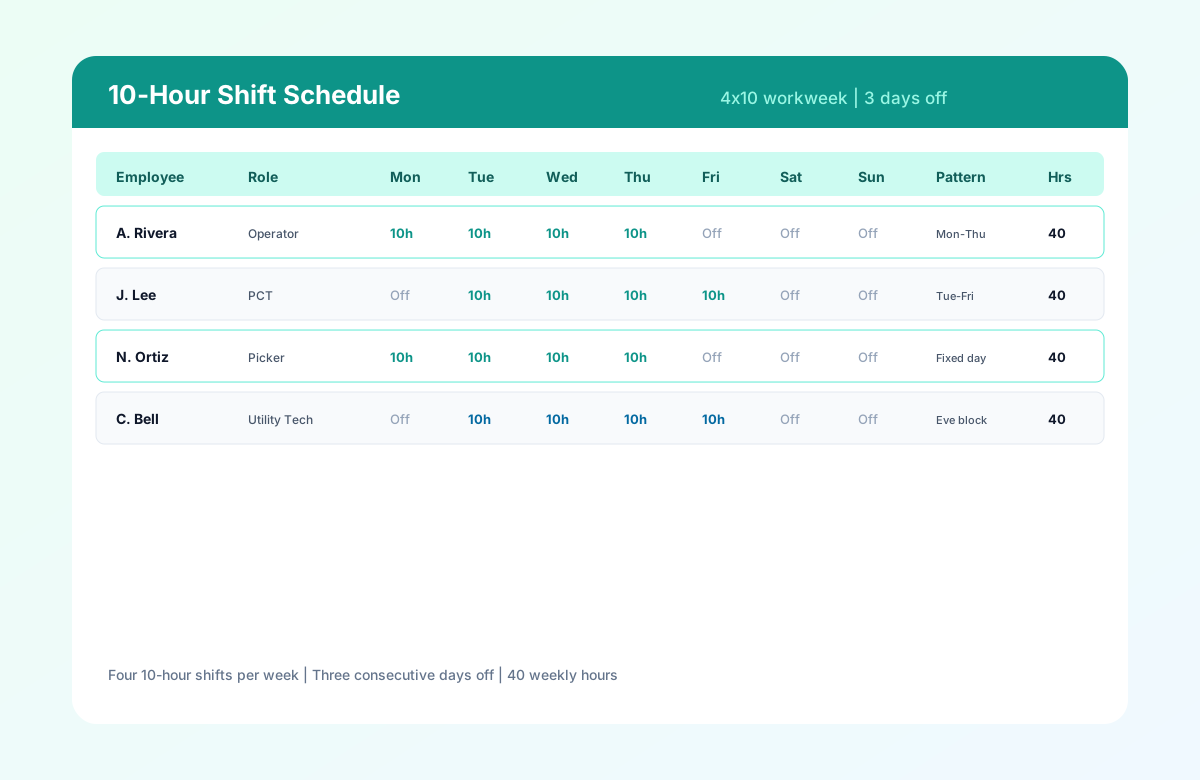
Four 10-hour shifts per week with three days off.
How to build a 10-hour shift week
Follow these five steps to publish a four-day workweek with balanced coverage and clear days off.
- 1
Set the week and site
Fill Week Of, Location / Site, and Schedule Manager in the header. Confirm which 4x10 pattern you are publishing (Mon-Thu, Tue-Fri, Wed-Sat, or rotating).
- 2
Assign shift patterns
Set Shift Pattern per employee so supervisors can read the plan quickly. Match patterns to operating hours and union rules.
- 3
Enter ten-hour bands
Use common bands such as 6 AM to 4 PM, 7 AM to 5 PM, or 2 PM to midnight. Mark Off for rest days. Document breaks in daily Break columns.
- 4
Review hours and fatigue risk
Confirm Weekly Hours total 40 for full-time 4x10 rows. Flag Overtime before you add pickup days.
Overtime risk calculator - 5
Publish and share
Export PDF for the floor, share read-only Google Sheets with leads, and communicate three-day weekend blocks clearly.
Mobile schedule access
Benefits of 10-hour shifts
Three-day weekends
Four ten-hour shifts deliver 40 weekly hours with three consecutive days off, a popular trade for employees who prefer longer rest blocks.
Fewer weekly commutes
Employees commute four days instead of five, which can improve retention in manufacturing, warehouse, and field roles.
Longer daily coverage
Ten-hour blocks extend operating windows without jumping to 12-hour clinical shifts.
Fewer handoffs
Compared with 8-hour three-shift models, 10-hour plans reduce daily transitions when you do not need overnight coverage every day.
Printable roster
PDF export works for plant floors, job trailers, and break rooms.
Trade-offs and fatigue planning
Ten-hour shifts are popular but not universal. Plan deliberately:
Advantages
- Three-day weekends and fewer commutes
- Longer uninterrupted work blocks for project-based roles
- Fewer daily handoffs than 8-hour three-shift models
Risks
- Employee fatigue on physically demanding jobs
- Break compliance across longer blocks (meal and rest rules vary by state)
- Coverage gaps on off days if only one 4x10 crew exists
Mitigations: stagger breaks, cap consecutive 4x10 weeks before mandatory rest, rotate evening blocks fairly, and monitor near-miss incidents after schedule changes.
Longer shifts may not suit every team. Pilot 4x10 with volunteers before converting an entire department.
4x10 staffing math
For a single role covered four days per week at ten hours per day:
- One employee works 40 hours and is off three consecutive days
- That employee covers 4 of 7 calendar days for their role
- You need overlapping crews if the business operates five to seven days per week
Covering Monday through Friday
Many plants use two staggered 4x10 crews:
| Crew | Works | Off | Covers |
|---|---|---|---|
| Crew A | Mon-Thu | Fri-Sun | Mon-Thu |
| Crew B | Tue-Fri | Sat-Mon | Tue-Fri |
Together they cover Mon-Fri with overlap Tue-Thu. Document who owns Friday evening and weekend maintenance in Notes.
Headcount example: warehouse packing (Mon-Fri)
Need 3 packers on the floor whenever the line runs, Mon-Fri only:
- Each 4x10 employee covers 4 days
- Minimum 2 crews to cover 5 weekdays (similar overlap logic to 8-hour planning)
- Plan 6 to 8 packers total with PTO and call-out buffer
Use the Weekly Hours column to keep each row at 40 before you add pickup shifts.
Industry quick-start bands
| Industry | Common 10-hour band | Common pattern |
|---|---|---|
| Manufacturing | 6:00 AM to 4:00 PM | 4x10 Mon-Thu |
| Warehouse | 5:00 AM to 3:00 PM | 4x10 Mon-Thu |
| Healthcare support | 7:00 AM to 5:00 PM | 4x10 Tue-Fri |
| Construction | 5:00 AM to 3:00 PM | 4x10 Mon-Thu |
| Utilities | 2:00 PM to 12:00 AM | 4x10 Tue-Fri |
| Field service | 7:00 AM to 5:00 PM | Rotating 4x10 |
| Public works | 6:00 AM to 4:00 PM | Wed-Sat seasonal |
Adjust for union contracts, meal break rules, and peak season demand.
Setting 10-hour shift times by industry
Ten-hour templates are flexible because start and end times are editable. Below are common bands by sector. Adjust for union contracts, state break rules, and operating hours.
Standard 4x10 day bands
| Band | Start | End | Paid break (example) |
|---|---|---|---|
| Early day | 5:00 AM | 3:00 PM | 30 min unpaid meal + 2 x 15 min rest |
| Standard day | 6:00 AM | 4:00 PM | 30 min unpaid meal + 2 x 15 min rest |
| Late day | 7:00 AM | 5:00 PM | 30 min unpaid meal + 2 x 15 min rest |
Manufacturing and warehouse variants
- 4:00 AM to 2:00 PM: Cold chain and early inbound
- 5:00 AM to 3:00 PM: Production and pick-pack lines
- 6:00 AM to 4:00 PM: Assembly with supervisor overlap at shift start
Healthcare support variants
- 6:30 AM to 4:30 PM: Environmental services aligned with day census
- 7:00 AM to 5:00 PM: Imaging, lab, and transport support
- 8:00 AM to 6:00 PM: Clinic-adjacent ancillary on Tue-Fri patterns
Clinical nursing units on 12-hour lines should use the 12-hour nurse schedule template instead of forcing 10-hour rows for bedside RNs.
Utilities and evening variants
- 2:00 PM to 12:00 AM: Evening maintenance and processing
- 3:00 PM to 1:00 AM: Grid and plant operations with lower daytime load
Document overlap hours in Notes when two crews both cover the same interval for training or turnover.
Deep dive: manufacturing and warehousing
Manufacturing teams adopt 4x10 to keep lines running while offering Fri-Sun off blocks. Supervisors schedule changeovers at shift start when both crews overlap Tue-Thu.
Warehousing peaks often hit mid-morning outbound. A 5 AM to 3 PM 4x10 band aligns pickers with dock appointments. See warehouse scheduling software when you operate multiple fulfillment nodes.
Break strategy: On ten-hour production lines, stagger two 15-minute breaks and one 30-minute meal rather than one long mid-shift gap that stops the line.
Deep dive: healthcare and construction
Healthcare ancillary departments (not 12-hour nursing units) use 4x10 for predictable day blocks. Pair with healthcare employee schedule template when you mix clinical and support on one campus.
Construction crews commonly run Mon-Thu 5 AM to 3 PM with Friday flex for weather. Record site ID in Notes when foremen rotate between job trailers.
See construction crew scheduling software for multi-site roll-ups.
Government and public sector
Municipal public works, parks, and fleet maintenance teams often run Wed-Sat or Tue-Fri 4x10 patterns during peak season and revert to 5x8 in winter. Document seasonal pattern changes in Shift Pattern so employees know when off blocks move.
Emergency operations centers may blend 10-hour planning blocks with on-call overlays. Use Notes for activation windows rather than mixing on-call logic into daily start/end cells.
Deep dive: utilities, security, and field service
Utilities schedule evening 10-hour bands around maintenance windows when daytime traffic or load is high.
Security posts may use Wed-Sat 4x10 to cover weekend events while preserving Sun-Tue off for part of the pool.
Field service technicians benefit from four long days with route density in Notes. Rotating 4x10 pools balance who works Sat-adjacent blocks.
Distribution and fulfillment centers
Cross-dock and sortation hubs often align 10-hour bands with carrier pickup windows. A 5 AM to 3 PM Mon-Thu crew handles inbound while a 2 PM to 12 AM Tue-Fri crew clears outbound trailers. When both crews overlap Tue-Thu, assign float roles in Notes for peak volume days.
Pair this template with warehouse scheduling software when you schedule across multiple buildings or temp labor pools.
Breaks, meal periods, and handoffs
Ten-hour schedules have one handoff per day when a single crew covers a band, compared with three handoffs on 8-hour three-shift models. That continuity helps manufacturing and field roles but concentrates fatigue in one long block.
Break coverage on 10-hour lines
If one person on a four-person crew takes a 30-minute meal break, you still need three on the floor. Options:
- Stagger meals by 30 to 45 minutes
- Float a cross-trained employee from an overlapping Tue-Thu / Tue-Fri crew
- Schedule a brief overlap at shift start for toolbox talks and handoffs
Record break windows in daily Break columns so payroll and compliance audits match the published schedule.
Handoff checklist
- Outgoing crew confirms open tasks in Notes (orders, tickets, patients, equipment status).
- Incoming crew confirms headcount meets minimum before outgoing leaves.
- Supervisor signs the printed PDF when your policy requires documented turnover.
Minimum staffing matrix
Build a simple table by pattern and day type (weekday vs weekend). Example for a Mon-Fri warehouse with two 4x10 crews:
| Day | Crew A (Mon-Thu) | Crew B (Tue-Fri) | Combined minimum |
|---|---|---|---|
| Monday | 4 pickers | Off | 4 |
| Tuesday | 4 pickers | 4 pickers | 8 (overlap) |
| Wednesday | 4 pickers | 4 pickers | 8 (overlap) |
| Thursday | 4 pickers | 4 pickers | 8 (overlap) |
| Friday | Off | 4 pickers | 4 |
| Saturday | Off | Off | 0 (unless weekend crew added) |
| Sunday | Off | Off | 0 (unless weekend crew added) |
Compare row counts on your template against this matrix before publish.
Overtime, labor cost, and compliance basics
Ten-hour schedules make overtime visible when managers add a fifth day or stack pickup shifts on off days.
When 4x10 weeks trigger overtime
In the United States, non-exempt hourly employees often hit overtime after 40 hours in a workweek (state rules may differ). Watch for:
- Fifth day pickup after a completed 4x10 week
- Partial shifts on off days for training or call-outs
- Holiday pay weeks that compress schedules
Use the Overtime Hours column as a pre-publish check, not only a payroll afterthought. See the overtime risk calculator when you model pickup scenarios.
Labor cost planning
Rough weekly labor cost per employee:
Weekly Hours x Hourly Rate x (1 + Burden Rate)
Burden includes taxes, benefits, and shift differential. Evening 10-hour bands often carry 10 to 15 percent differential in utilities and healthcare support. Document differential eligibility in Notes when it affects assignments.
Break and rest compliance
Ten-hour blocks may trigger second meal or extended rest rules in some jurisdictions. Confirm with HR or legal counsel before you publish. The template documents breaks; it does not replace legal advice.
Documentation habits
- Save a published PDF with date stamp each week
- Lock or protect the official Excel tab after publish
- Keep Leave Status current so you do not schedule PTO as active
Monthly and multi-week planning workflow
Operators who outgrow single-week tabs often use this workflow without leaving spreadsheets:
- Week 0 (planning): Copy last week's tab. Adjust for known PTO and seasonal demand.
- Week -1 (draft): Share read-only Google Sheet with supervisors for gap review.
- Week -1 (finalize): Merge feedback, check overtime, publish PDF.
- Rolling horizon: Maintain four tabs (this week plus next three) in one workbook.
When four tabs become unmanageable across sites, evaluate employee scheduling software.
Pilot rollout: converting from 5x8 to 4x10
Many plants and warehouses pilot compressed workweeks before full conversion. A practical sequence:
- Volunteer cohort: Start with one department that wants Fri-Sun off blocks.
- Parallel run: Keep 5x8 backup crew for four weeks while you measure throughput and absenteeism.
- Coverage map: Document which weekdays each 4x10 pattern covers; add Tue-Fri crew if Mon-Thu leaves Friday gaps.
- Fatigue survey: Check near-miss reports and self-reported fatigue after week two and week four.
- Payroll validation: Confirm 40-hour totals and break deductions match time clocks.
- Expand or revert: Roll out to additional departments only after metrics hold steady.
If clinical and support teams share a campus, keep nursing on 12-hour patterns while support moves to 4x10 using this template.
Common scheduling challenges
- Employee fatigue on ten-hour physical roles
- Break planning across longer blocks
- Coverage on off days when only one crew exists
- Overtime control when pickup days appear on fifth days
- Fair rotation between day and evening 10-hour bands
- Leave coordination when PTO removes a quarter of a four-person crew
- Multi-location staffing when each site maintains its own 4x10 calendar
Growing operators often move to employee scheduling software when these challenges become daily work.
Best practices
- Publish schedules in advance (two weeks for rotating 4x10 pools).
- Rotate unpopular shifts fairly (evening and Sat-adjacent blocks).
- Schedule adequate meal and rest breaks inside ten-hour bands.
- Monitor overtime weekly before approving fifth days.
- Balance workloads across crews on the same pattern.
- Review employee feedback after the first 4x10 cycle.
- Document which pattern each employee follows in Shift Pattern.
- Keep one official file to avoid draft vs published conflicts.
Common mistakes
- Scheduling a fifth ten-hour day without overtime review
- Mixing 8-hour and 10-hour rows without labeling Shift Pattern
- Leaving Fridays uncovered when the whole plant uses Mon-Thu
- Ignoring break rules on 10-hour blocks
- No backup crew for call-outs on a four-person line
- Publishing multiple spreadsheet versions
- Converting to 4x10 without employee buy-in on fatigue-heavy roles
Getting started checklist
- Choose 4x10 anchor days (Mon-Thu, Tue-Fri, or Wed-Sat).
- Confirm 40-hour totals on each full-time row.
- Collect availability and PTO before publish.
- Assign Shift Pattern labels for every employee.
- Enter start, end, and break for each scheduled day.
- Review Overtime Hours before approving fifth days.
- Verify coverage on off days for critical roles.
- Export PDF and post on the floor.
- Communicate three-day off blocks clearly.
- Evaluate fatigue feedback after the first full cycle.
When this checklist outgrows one shared spreadsheet across sites, evaluate shift scheduling software.
Spreadsheet vs scheduling software
| Capability | Spreadsheet template | Heyshift |
|---|---|---|
| 10-hour weekly roster | Yes | Yes |
| Manual planning | Yes | Smart scheduling |
| Static files | Yes | Live schedules |
| Manual updates | Yes | Real-time changes |
| Shift reminders | No | Automated notifications |
| Overtime tracking | Manual columns | Overtime alerts |
| Attendance | No | Built-in attendance |
| Conflict detection | No | Automatic conflict detection |
| Multi-location | Manual merge | Unified platform |
Compare shift patterns
| Pattern | Typical weekly hours | Working days | Best for | Template |
|---|---|---|---|---|
| 8-hour | 40 (5 x 8) | 5 days | 24/7 three-shift coverage | 8-hour shift schedule |
| 10-hour | 40 (4 x 10) | 4 days | Manufacturing, 4x10 workweeks | This page |
| 12-hour | 36 (3 x 12) | 3 days | Hospitals, LTC, ED | 12-hour nurse schedule |
| 2-2-3 (Panama) | ~36-42 avg | Rotating | 24/7 fair rotation | 2-2-3 shift schedule |
| 4-on-4-off | Varies | Rotating blocks | Security, utilities | 4-On 4-Off shift schedule |
10-hour vs 8-hour: Choose 10-hour when you want fewer workdays and longer daily blocks without 24/7 three-shift complexity.
10-hour vs 12-hour: Choose 10-hour when teams need 40 hours in four days, not 36 hours in three 12-hour clinical shifts.
Related templates
| Template | Best for |
|---|---|
| 4-On 4-Off shift schedule template | Eight-day rotation, long off blocks |
| 2-2-3 shift schedule template | Panama rotation, 24/7 coverage |
| 10-hour shift schedule template | 4x10 compressed workweeks (this page) |
| 8-hour shift schedule template | Morning, afternoon, night bands |
| 12-hour nurse schedule template | Hospital 12-hour rotations |
| Healthcare employee schedule template | Broad healthcare settings |
| Hospital staff roster template | Full-hospital rosters |
| Clinic staff schedule template | Outpatient clinics |
| Medical office schedule template | Physician practices |
DuPont and Pitman templates are planned next. See the rotating shift schedule template hub to compare all patterns.
Frequently asked questions
What is a 10-hour shift?
A ten-hour paid work block, often four per week for 40 total hours.
Who uses 10-hour schedules?
Healthcare support, manufacturing, warehouses, construction, utilities, security, field service, and public works departments use 4x10 patterns when they want longer daily blocks and three-day off periods. Nursing units on 12-hour clinical lines should use the 12-hour nurse schedule template instead.
Are 10-hour shifts better than 8-hour shifts?
Neither is universally better. Ten-hour shifts reduce weekly commutes and handoffs; eight-hour shifts reduce daily fatigue and simplify 24/7 three-shift coverage. Many campuses run 12-hour nursing, 10-hour support, and 8-hour retail side by side.
10-hour vs 8-hour?
10-hour = four longer days at 40 weekly hours; 8-hour = five shorter days or three-shift 24/7 coverage. See Compare shift patterns.
Customizable?
Yes. Edit times, patterns, and departments.
Healthcare suitable?
Yes for support roles; use 12-hour template for nursing unit lines.
How many days per week?
Four days on standard 4x10 patterns.
Free?
Yes. Excel, Google Sheets (CSV), and PDF at no cost.
When to use software?
When rotation, leave, and multi-site coverage exceed spreadsheet capacity.
Heyshift support?
Yes. Start a 30-day free trial when ready.
Related resources
More templates, guides, and tools for building and running your schedule.
- TemplateRotating shift schedule template (hub)
- Template8-hour shift schedule template
- Template12-hour nurse schedule template
- Template2-2-3 shift schedule template (Panama)
- Template4-On 4-Off shift schedule template
- TemplateHealthcare employee schedule template
- ResourceConstruction scheduling software
- ResourceWarehouse scheduling software
- ResourceManufacturing scheduling software
- ResourceEmployee scheduling software
- FeatureShift scheduling
- ResourceOvertime risk calculator
- ResourceStart 30-day free trial

