
Skip to content

Free 4-On 4-Off Shift Schedule Template

Create balanced 4-On 4-Off rotating shift schedules with our free Excel, Google Sheets, and PDF templates. Perfect for hospitals, manufacturing plants, warehouses, emergency services, utilities, security companies, and any business operating 24 hours a day.

Free download · No account required · CSV opens in Google Sheets

  • Hospitals and healthcare systems
  • Manufacturing and production plants
  • Warehouses and distribution centers
  • Emergency services and public safety
  • Security and critical infrastructure
  • Utilities, oil and gas, and energy operations
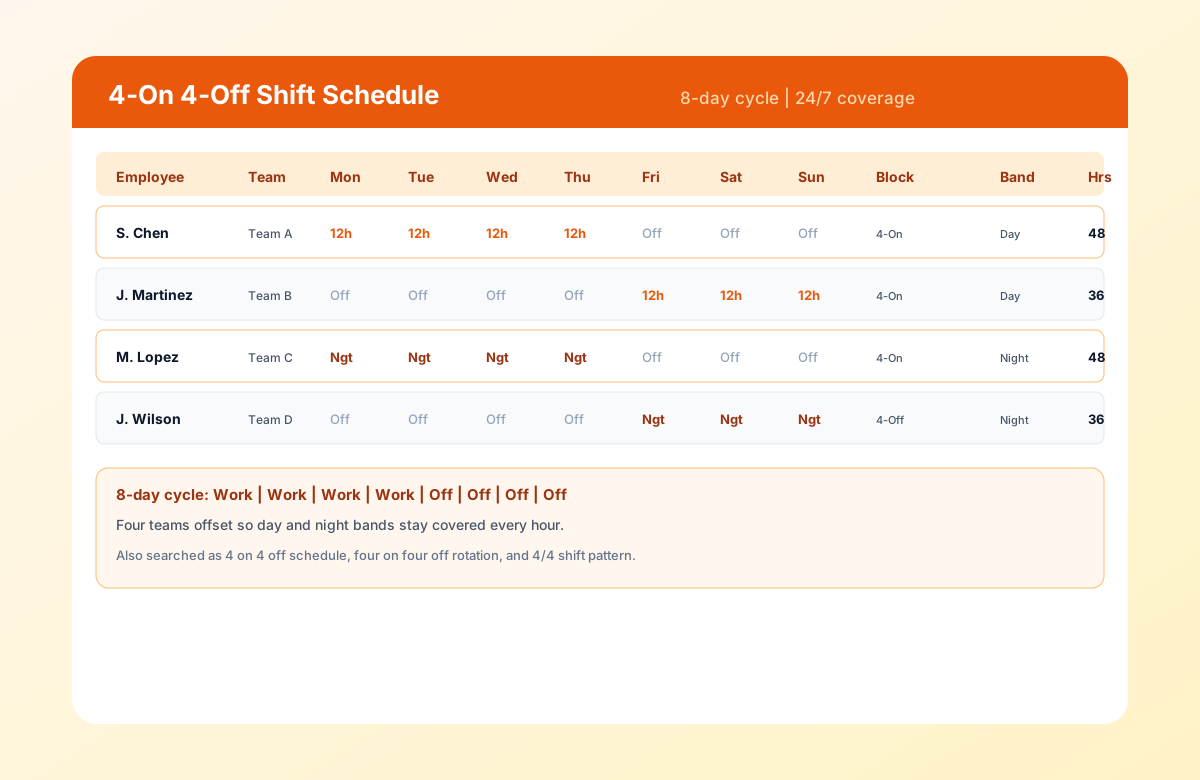
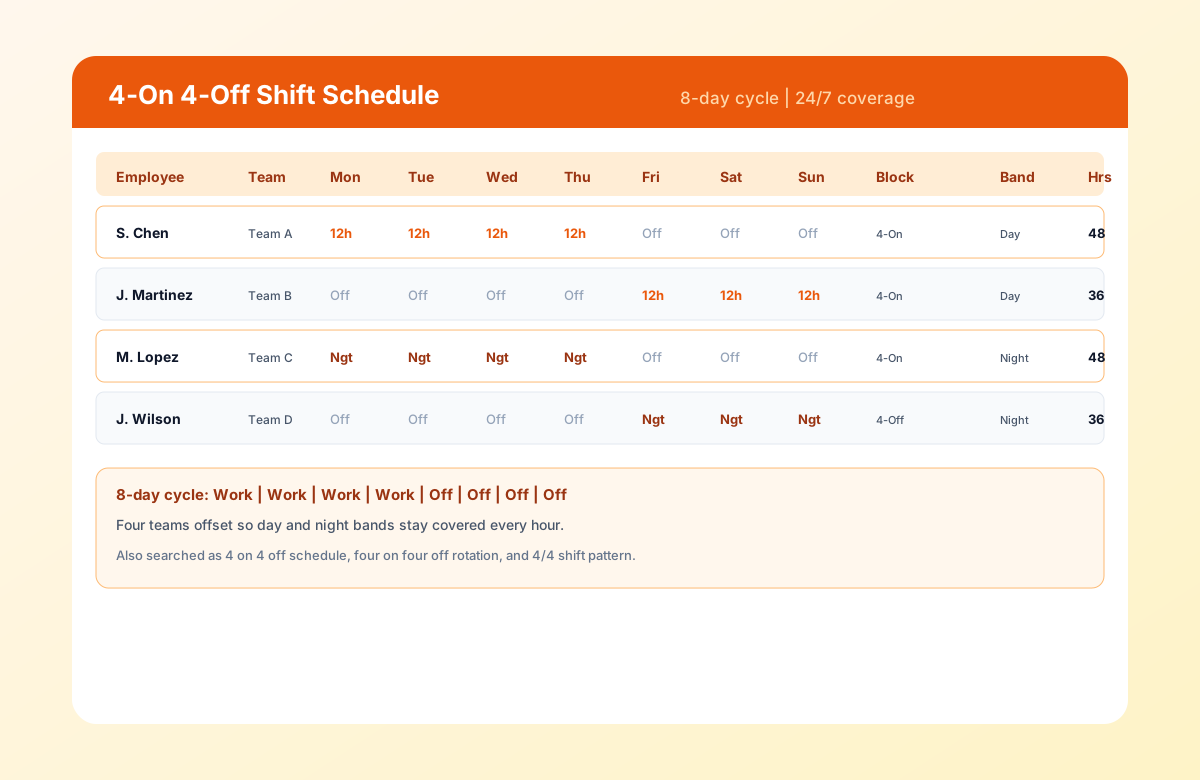
4-on 4-off shift schedule template preview showing four consecutive work days, four days off, and four-team day/night rotation.

Table of contents


Quick overview

Feature Details
Best for Healthcare, manufacturing, security, warehousing
Shift pattern 4-On 4-Off
Coverage 24/7 operations
Schedule type Rotating
Formats Excel, Google Sheets, PDF
Editable Yes
Printable Yes
Cost Free

This pillar guide explains 4-on-4-off rotation planning for hospitals, plants, warehouses, emergency services, security firms, and utilities that need predictable 24/7 coverage.


What is a 4-On 4-Off shift schedule?

A 4-On 4-Off shift schedule is a rotating work pattern where employees work four consecutive shifts followed by four consecutive days off. The cycle repeats continuously, making it one of the most popular schedules for businesses that require 24/7 coverage.

The schedule is commonly paired with 12-hour shifts, allowing organizations to maintain around-the-clock operations with:

  • Predictable rotations employees can memorize
  • Regular rest periods of four full days between work blocks
  • Fewer weekly schedule changes than daily or weekly rebuild models
  • Four-team coverage for simultaneous day and night bands

Because employees always know their work pattern in advance, the 4 on 4 off schedule is often appreciated for consistency and work-life balance compared with irregular weekly grids.

Unlike an 8-hour shift schedule built around three daily bands, a 10-hour 4x10 template for compressed workweeks, or a 2-2-3 Panama rotation with alternating heavy and light weeks, the 4-On 4-Off pattern uses a simple eight-day repeating cycle that many security, utility, and remote-site operators prefer.


How the 4-On 4-Off rotation works

Each employee follows a repeating eight-day cycle.

Example rotation

Day Status
Day 1 Work
Day 2 Work
Day 3 Work
Day 4 Work
Day 5 Off
Day 6 Off
Day 7 Off
Day 8 Off

The cycle then repeats from Day 1.

Calendar week alignment

When Day 1 falls on Monday, a single calendar week shows Mon through Thu work and Fri through Sun off (three off days visible; the fourth off day is the following Monday). Teams offset by two days so another crew covers Fri through Sun while Team A rests.

Many organizations alternate day and night shifts after a complete rotation or after several cycles, depending on union contracts and operational requirements. Document the current band in Day/Night Indicator and the position in the cycle in Cycle Block.


Who should use this template?

This template is designed for organizations with continuous operations.

Healthcare

  • Hospitals and health systems
  • Emergency departments and trauma centers
  • Intensive care units
  • Long-term care facilities
  • Ambulance and EMS services

Pair with the hospital staff roster template and nurse schedule template when clinical and support teams share a campus.

Manufacturing

  • Production plants and assembly lines
  • Food processing facilities
  • Chemical and pharmaceutical manufacturing
  • Automotive and heavy equipment plants

See manufacturing shift scheduling software for multi-plant roll-ups.

Warehousing and logistics

  • Distribution and cross-dock centers
  • E-commerce fulfillment hubs
  • Shipping and sortation operations

See warehouse scheduling software when you operate multiple buildings.

Emergency services

  • Fire departments
  • EMS and paramedic services
  • Public safety and dispatch centers

Security

  • Contract security companies
  • Data centers and airports
  • Government and corporate campuses

Utilities and energy

  • Power plants and grid operations
  • Water treatment facilities
  • Oil and gas production sites
  • Renewable energy operations

What's included?

Column Purpose
Employee Name Identifies scheduled staff
Team Assignment Team A, B, C, D (or custom labels)
Department Unit, plant, site, or cost center
Shift Rotation 4-On 4-Off, custom variant
Start / End / Break (Mon through Sun) 12-hour bands by day
Weekly Hours Often 48 (four 12h days) or 36 when block spans weeks
Overtime Hours Payroll review column
Day/Night Indicator Day, Night, or Rotating
Cycle Block Work Days 1-4 or Off Days 5-8
Supervisor Manager or lead of record
Notes Certifications, site, handoff flags
Leave Status PTO, training, or active

Template features

Weekly and eight-day planning

Publish one calendar week at a time while labeling Cycle Block so crews know whether they are in a work or off segment. Duplicate sheet tabs to build a full 4 on 4 off rotation calendar across multiple weeks.

Four-team rotation

Assign Team Assignment labels so day, night, and off blocks stay visible on one grid without rebuilding daily.

Day and night bands

Enter 12-hour start and end times for each scheduled day. Use Day/Night Indicator for quick scanning on plant floors and nurse stations.

Overtime tracking

Monitor Weekly Hours before publish. Four consecutive 12-hour days equal 48 hours when the full block falls inside one calendar week.

Printable layout

Export PDF for break rooms, security posts, and job trailers. Branded download includes sample four-team rows.


Four-team rotation example

Many organizations divide employees into four teams offset across the eight-day cycle.

Team Current rotation (example)
Team A Day shift, Work Days 1-4
Team B Night shift, Work Days 1-4
Team C Day shift, Off Days 5-8
Team D Night shift, Off Days 5-8

This arrangement helps maintain full staffing while ensuring every employee receives scheduled rest periods. After one full cycle, teams may swap day/night assignments or advance to the next offset position in your contract.

When Team A works days Mon-Thu, Team B typically covers nights Mon-Thu. Teams C and D carry the next off/on blocks so no hour goes uncovered.


Template preview

Employee Team Mon Tue Wed Thu Fri Sat Sun Block Hours
S. Chen A 12h 12h 12h 12h Off Off Off 4-On 48
J. Martinez B Off Off Off Off 12h 12h 12h 4-On 36
4-on 4-off shift schedule template column layout

Four consecutive 12-hour shifts, four days off, and four-team day/night rotation.

Setup guide

How to build a 4-On 4-Off rotation week

Follow these five steps to publish a four-team rotation week with balanced 24/7 coverage and clear work/off blocks.

  1. Set the week and cycle block

    Fill Week Of, Facility / Site, and Cycle Block (Work Days 1-4 or Off Days 5-8) in the header. Confirm where each team sits in the eight-day cycle.

  2. Assign teams

    Label Team Assignment (A, B, C, D) so day, night, and off blocks stay visible on one grid.

  3. Enter 12-hour bands

    Use common bands such as 7 AM to 7 PM (day) or 7 PM to 7 AM (night). Mark Off on rest days. Document breaks in daily Break columns.

  4. Review hours and overtime

    A full four-day work block at 12 hours equals 48 weekly hours when aligned Mon-Thu. Flag Overtime before pickup shifts.

    Overtime risk calculator
  5. Publish and share

    Export PDF for the floor, share read-only Google Sheets with leads, and communicate when each team returns from off block.

    Mobile schedule access
Why use a template

Benefits of the 4-On 4-Off schedule

  • Continuous 24/7 coverage

    Four offset teams provide reliable staffing across all hours without daily schedule rebuilds.

  • Better work-life balance

    Four consecutive days off give employees extended rest for family, travel, and recovery between blocks.

  • Predictable rotations

    The repeating eight-day cycle lets employees plan months ahead with minimal confusion.

  • Fewer commutes

    Four longer shifts per block can reduce weekly commutes compared with five shorter day patterns.

  • Simplified scheduling

    Managers repeat the same rotation pattern with minimal weekly edits.

  • Reduced admin work

    Predictable blocks mean fewer manual schedule changes and less back-and-forth with staff.


Common challenges

Despite its benefits, the 4-On 4-Off schedule requires careful management:

  • Fatigue during long 12-hour shifts, especially on the third and fourth consecutive days
  • Night shift adjustments when teams rotate between day and night blocks
  • Vacation coordination when PTO removes 25 percent of a four-person team
  • Holiday coverage when a work block overlaps a paid holiday
  • Overtime management when pickup shifts extend a 48-hour week
  • Shift handovers at day/night boundaries
  • Last-minute absences during four-day work stretches
  • Training new employees on the eight-day cycle and team offsets

Growing operators often move to employee scheduling software when these challenges become daily work.


Best practices

  1. Publish rotations several weeks in advance so employees see upcoming work and off blocks.
  2. Rotate day and night assignments fairly across teams per union or HR policy.
  3. Schedule adequate meal and rest breaks inside each 12-hour band.
  4. Monitor employee fatigue and overtime, especially on 48-hour work weeks.
  5. Cross-train employees for critical roles on each team.
  6. Plan backup coverage for unexpected absences during four-day blocks.
  7. Use digital tools to communicate cycle changes instantly when you upgrade from spreadsheets.
  8. Review staffing levels regularly to match demand and document surges in Notes.

Common mistakes

  • Publishing rows without Cycle Block labels (Work Days 1-4 vs Off Days 5-8)
  • Mixing 4-On 4-Off with 2-2-3 or 3x12 employees without Shift Rotation labels
  • Leaving day or night band uncovered when two teams are simultaneously on off block
  • Ignoring 48-hour weekly totals before payroll cutoff
  • No cross-training when one absence collapses a four-person team
  • Informal shift swaps without updating the official sheet
  • Assuming calendar weeks align perfectly with eight-day cycles (they do not; track cycle day explicitly)

Getting started checklist

  1. Confirm each team's Cycle Block (work or off segment).
  2. Assign Team Assignment for every employee on the rotation.
  3. Collect availability and PTO before publish.
  4. Enter 12-hour start, end, and break for each work day.
  5. Set Day/Night Indicator on every row.
  6. Sum Weekly Hours (expect 48 when four 12-hour days fall in one week).
  7. Review Overtime Hours before approving pickups.
  8. Verify both day and night bands meet minimum staffing every hour.
  9. Export PDF and post in the work area.
  10. Communicate when the next off block begins before the fourth work day ends.

When this checklist outgrows one shared spreadsheet across sites, evaluate shift scheduling software.


4-On 4-Off staffing math

For 24/7 coverage with four teams on 12-hour shifts:

  • Each calendar day needs 2 shifts (day + night)
  • Each employee works 4 of 8 cycle days at 12 hours = 48 hours per 8-day cycle
  • Over a 16-day window, that employee works 96 hours across two full cycles
  • Average weekly hours: 48 hours × (7 days ÷ 8 cycle days) ≈ 42 hours per week

Minimum headcount example

Need 4 operators on the floor at all times (day and night):

  • 4 operators × 2 bands × 7 days = 56 shift slots per week
  • Each operator covers roughly 3.5 shifts per week on average (4 shifts per 8-day cycle)
  • Minimum 16 operators across four teams before PTO and call-out buffer
  • Plan 18 to 20 operators with leave, training, and surge coverage

Use the Weekly Hours column to confirm totals before publish. When a work block spans two calendar weeks (e.g., Fri-Mon), split hours across tabs or document in Notes for payroll.


Industry quick-start guide

Industry Common 12-hour band Teams Notes
Hospital ICU 7 AM to 7 PM / 7 PM to 7 AM 4 Pair with 12-hour nurse template
Manufacturing 6 AM to 6 PM / 6 PM to 6 AM 4 Changeovers at band boundaries
Warehouse 5 AM to 5 PM / 5 PM to 5 AM 4 Peak volume in Notes
EMS 6 AM to 6 PM / 6 PM to 6 AM 4 Station assignment in Notes
Security 6 PM to 6 AM nights 4 Post ID in Notes
Oil & gas 6 AM to 6 PM / 6 PM to 6 AM 4 Remote site rotation
Utilities 7 AM to 7 PM / 7 PM to 7 AM 4 Maintenance on off blocks

Adjust for union contracts, meal break rules, and state overtime thresholds.


Deep dive: healthcare rotations

Hospitals and LTC facilities use 4 on 4 off shift schedule patterns when they want longer rest blocks than Panama (2-2-3) provides. ED and ICU units may compare both patterns before committing in a union environment.

Clinical teams on 4-On 4-Off still need the same handoff discipline as fixed 3x12 lines. Use Department and Shift Rotation columns to separate units. Bedside staff should not share rows with ancillary 8-hour teams without clear labels.

Pair with healthcare employee schedule template when you mix clinical and support on one campus, and healthcare staff scheduling software when credentials, leave, and multi-unit coverage exceed spreadsheet capacity.

Ambulance services adapt the four on four off schedule for paramedic crews with station assignments documented in Notes.


Deep dive: manufacturing and warehousing

Production plants adopt 4/4 shift pattern rotations to keep lines running 24/7 while giving crews four full days off between blocks. Team A days and Team B nights during Work Days 1-4; Teams C and D offset by four days.

Warehouses align 4-On 4-Off blocks with inbound and outbound peaks. Document dock and zone assignments in Notes when pickers rotate across areas.

Manufacturing schedulers should plan changeovers at 6 AM / 6 PM boundaries when using 12-hour bands. See manufacturing shift scheduling software for multi-plant visibility.

Fulfillment operators searching 4 on 4 off rotation calendar often want a printable PDF for the floor; export after you lock the official week.


Deep dive: security, utilities, and oil & gas

Security companies are among the heaviest users of 4 days on 4 days off schedule patterns. Posts at data centers, airports, and government buildings run 12-hour bands with four-team offsets so no gate goes unmanned.

Utilities run 4-On 4-Off at power, water, and grid control centers where 24/7 monitoring is mandatory. Schedule preventive maintenance on off blocks when possible.

Oil and gas remote sites use the pattern because it minimizes camp turnover and helicopter logistics: four days on platform, four days off rotation. Document hitch start date in Notes so cycle day stays accurate across handovers.

Fire departments and EMS agencies evaluate 4-On 4-Off against 2-2-3 Panama based on union preference for rest block length versus weekend distribution.


Day and night rotation planning

The 4-On 4-Off pattern works best when day and night teams offset within the same work block:

  • Team A: Days during Work Days 1-4
  • Team B: Nights during Work Days 1-4
  • Teams C/D: Offset by four days to cover off/on transitions

Document Day/Night Indicator on every row. Night bands commonly run 7 PM to 7 AM in healthcare and 6 PM to 6 AM in security.

When alternating day/night after each cycle, communicate the swap before the off block ends so crews can adjust sleep schedules.


Breaks, handoffs, and fatigue

Four consecutive 12-hour shifts concentrate fatigue on Days 3 and 4. Mitigate with:

  • Staggered meal breaks (never full-team lunch on critical posts)
  • Two 15-minute rest breaks plus one 30-minute meal on most 12-hour contracts
  • Structured handoffs at day/night boundaries
  • Limit overtime pickups on the fourth consecutive work day

Handoff checklist

  1. Outgoing crew confirms open tasks in Notes.
  2. Incoming crew confirms headcount meets minimum before outgoing leaves.
  3. Supervisor confirms Cycle Block matches the master rotation calendar.

Overtime and compliance basics

Four consecutive 12-hour days equal 48 hours in one calendar week when the block aligns Mon-Thu. That exceeds the standard 40-hour threshold in the United States for non-exempt hourly staff.

Many 4-On 4-Off contracts:

  • Pay overtime on hours above 40 in the workweek
  • Average hours over longer periods in union agreements
  • Use 8-hour four-day blocks in non-clinical settings to cap weekly hours at 32 per work segment

Confirm rules with HR and legal counsel. Use Overtime Hours as a pre-publish check. See the overtime risk calculator when modeling pickup scenarios.


4-On 4-Off vs 2-2-3 vs fixed 12-hour

Factor 4-On 4-Off 2-2-3 (Panama) Fixed 3x12
Cycle length 8 days 14 days 7 days
Consecutive work days 4 max 3 max 3 per week
Consecutive off days 4 2 to 3 4+ between weeks
Weekly hours (12h) 48 or 0 (varies by alignment) 60 or 24 alternating 36 steady
Best for Long rest blocks, security, remote sites Fair weekend rotation Nursing unit stability
Template This page 2-2-3 schedule 12-hour nurse

Choose 4-On 4-Off when employees value four consecutive days off and operators want a simple repeating cycle.

Choose 2-2-3 when you need more even weekend distribution and can manage alternating heavy/light weeks.

Choose fixed 3x12 when clinical units want the same three days every week without eight-day calendar drift.


Monthly and multi-week planning workflow

Operators running 4 on 4 off rotation calendar planning often use this workflow:

  1. Anchor date: Pick a master cycle start date and document it in the workbook header.
  2. Week 0: Label each team's Cycle Block for the publish week.
  3. Week -1: Share read-only Google Sheet with supervisors for gap review.
  4. Week -1 finalize: Merge feedback, check overtime, publish PDF.
  5. Rolling horizon: Maintain four weekly tabs with Cycle Block labels pre-filled from the master calendar.

When four tabs become unmanageable across sites, evaluate employee scheduling software.


Pilot rollout: adopting 4-On 4-Off

  1. Compare patterns: Model 2-2-3 and 4-On 4-Off side by side with union and HR.
  2. Volunteer unit: Pilot one department for two full eight-day cycles.
  3. Four-team map: Confirm day/night coverage every hour before expanding.
  4. Fatigue survey: Check self-reported fatigue after the third and fourth consecutive work days.
  5. Payroll validation: Confirm 48-hour work weeks and overtime rules with payroll.
  6. Expand or revert: Roll out site-wide only after metrics hold steady.

Spreadsheet vs scheduling software

Capability Spreadsheet template Heyshift
4-On 4-Off weekly roster Yes Yes
Manual rotation tracking Yes Automated rotating schedules
Static spreadsheets Yes Live schedules
Manual edits Yes Real-time updates
Shift reminders No Automatic shift notifications
Overtime tracking Manual columns Overtime monitoring
Attendance No Integrated attendance
Mobile access Limited Mobile and web apps
Conflict detection No Automatic conflict detection
Workforce analytics Limited Workforce insights

Spreadsheets work well for pilot rotations and single-site teams. Growing 24/7 operators benefit from software when call-offs, swaps, and leave requests become daily work.


Compare shift patterns

Pattern Cycle Typical hours Best for Template
8-hour Weekly 40 (5 x 8) Three-shift 24/7 8-hour shift schedule
10-hour Weekly 40 (4 x 10) Compressed 4x10 10-hour shift schedule
12-hour (3x12) Weekly 36 (3 x 12) Fixed nursing lines 12-hour nurse schedule
2-2-3 (Panama) 14-day ~42 avg Fair weekend rotation 2-2-3 shift schedule
4-On 4-Off 8-day ~42 avg Long rest blocks This page
DuPont / Pitman 28-day Varies Industrial 24/7 Coming soon

Template Best for
4-On 4-Off shift schedule template Eight-day rotation, long off blocks (this page)
2-2-3 shift schedule template Panama rotation, 14-day cycle
8-hour shift schedule template Morning, afternoon, night bands
10-hour shift schedule template Four-day compressed workweeks
12-hour nurse schedule template Hospital 12-hour clinical rotations
Hospital staff roster template Full-hospital weekly rosters
Healthcare employee schedule template Broad healthcare settings
Nurse schedule template RN, LPN, and CNA unit planning
Clinic staff schedule template Outpatient clinics

DuPont and Pitman templates are planned next. See the rotating shift schedule template hub to compare all patterns.


Frequently asked questions

What is a 4-On 4-Off shift schedule?

Four consecutive work shifts, then four consecutive days off, repeating every eight days. Commonly paired with 12-hour shifts for 24/7 operations.

Which industries use it?

Healthcare, manufacturing, logistics, emergency services, security, utilities, oil and gas, and other continuous operations.

4-On 4-Off vs 2-2-3?

4-On 4-Off offers longer rest blocks; 2-2-3 offers more even weekend rotation. See Compare shift patterns.

Customizable?

Yes. Edit teams, departments, shift times, and cycle labels.

Day and night support?

Yes. Day/Night Indicator and daily start/end columns support both bands.

Small teams?

Yes. Adjust team sizes while keeping four offset crews for 24/7 coverage.

Free?

Yes. Excel, Google Sheets (CSV), and PDF at no cost.

When to use software?

When rotation tracking, leave, and multi-site coverage exceed spreadsheet capacity.

Heyshift support?

Yes. Start a 30-day free trial when ready.

Keep exploring

More templates, guides, and tools for building and running your schedule.