


Healthcare Staff Scheduling Software for Los Angeles (2026)
Discover the best healthcare staff scheduling software for Los Angeles clinics, medical offices, hospitals, and healthcare providers to simplify scheduling and reduce labor costs.
Healthcare staff scheduling software for Los Angeles (2026)
A Pasadena family practice publishes three versions of the same week because one office manager still uses Excel while the other texts updates to staff. An urgent care group in the San Fernando Valley opens Saturday short one medical assistant because the swap never made it onto the official roster. A home health agency coordinator in Long Beach learns about a missed visit when the patient calls, not when the schedule changed.
If you search healthcare staff scheduling software Los Angeles, you need more than a shared spreadsheet and a group chat. You need credential-aware shift blocks, mobile visibility for clinical and front-desk staff, manager-approved swaps, open shift fill, leave beside the grid, and labor hour visibility in a market where staffing gaps hit patient access and revenue fast.
Los Angeles County runs one of the largest healthcare workforces in the United States. Clinics, urgent care centers, dental groups, therapy practices, and home health agencies stretch from downtown to the Valley, the Westside, South Bay, and Orange County-adjacent sites. Healthcare scheduling software Los Angeles buyers in 2026 are evaluating tools that handle multi-site growth, California wage-and-hour visibility, and 24/7 coverage without drowning administrators in manual updates.
This guide explains what medical staff scheduling software Los Angeles providers should prioritize: local scheduling challenges, why manual methods fail, essential features, benefits, organization types that gain the most, how Heyshift helps, evaluation criteria, FAQ, and links into Heyshift's healthcare and workforce content.
Featured answer: What is the best healthcare staff scheduling software for Los Angeles providers? The best fit combines drag-and-drop shift building for clinical and support roles, publish-first roster discipline, mobile schedules staff actually open, manager-approved swap requests, availability and leave beside the grid, attendance tied to shifts, multi-location roll-up across LA sites, and overtime visibility before payroll closes.
Who should read this: Administrators and managers at medical clinics, family practices, urgent care centers, dental clinics, home healthcare agencies, physical therapy clinics, mental health practices, specialty offices, outpatient surgery centers, and multi-location healthcare groups in Los Angeles comparing clinic scheduling software Los Angeles options before demos.
Executive summary
Healthcare staff scheduling software Los Angeles providers trust in 2026 publishes one official week for clinical and support roles, fills call-offs through open shifts on mobile, and keeps attendance beside the roster finance exports.
In this guide you will find:
- Healthcare scheduling challenges specific to Los Angeles and California
- Why manual scheduling breaks down at scale
- Features every LA healthcare buyer should prioritize
- Benefits for utilization, patient care continuity, and admin time
- Organization types that benefit most in Southern California
- How Heyshift helps growing healthcare teams
- Choosing the right platform and FAQ
Table of contents
- Healthcare scheduling challenges in Los Angeles
- Why manual scheduling does not work anymore
- Features to look for in healthcare staff scheduling software
- Benefits for Los Angeles healthcare providers
- Healthcare organizations that benefit
- Why choose Heyshift
- Choosing the right healthcare scheduling software
- Frequently asked questions
- Final thoughts
Healthcare scheduling challenges in Los Angeles
Los Angeles healthcare providers operate in one of the most complex local labor markets in the country. Scheduling is not a back-office task you finish once a week. It is a patient access operation tied to every appointment, session, and visit on the books.
Growing healthcare workforce
The U.S. Bureau of Labor Statistics projects continued growth in healthcare employment nationally, and Southern California adds density fast: new urgent care locations, expanded specialty clinics, and multi-site medical groups acquiring independent practices. More locations and more hourly roles mean more shift blocks, more swap requests, and more managers who need one published source of truth.
The American Hospital Association tracks hospital and health-system trends nationally; ambulatory and clinic buyers in LA often feel the same staffing pressure on a smaller scale: competition for MAs, front-desk staff, therapists, and nurses across neighboring employers.
Multiple facility locations
Healthcare workforce management Los Angeles teams frequently run sites across LA County and into adjacent counties. A group might schedule downtown, Burbank, Torrance, and Irvine from one admin team. Without multi-location scheduling, each site drifts into local spreadsheets, inconsistent publish times, and uneven swap rules.
Traffic and commute patterns matter. Staff who work Valley mornings and Westside afternoons need accurate shift times on mobile before they leave home. Scheduling software that publishes one roster per location while rolling up hours for leadership prevents silent overtime across sites.
24/7 patient care and shift coverage
Urgent care, emergency-adjacent clinics, home health on-call rotations, and hospital-affiliated outpatient units need overnight and weekend coverage. Gap detection before publish beats learning about holes when doors open.
Employee availability and last-minute call-outs
Los Angeles clinical teams juggle second jobs, school schedules, and long commutes. Availability captured beside the grid reduces back-and-forth texts. When call-outs happen, open shifts pushed to qualified staff on mobile fill coverage faster than phone trees.
Overtime management
California overtime rules and daily hour patterns make visible totals while building shifts essential. The California Department of Industrial Relations publishes wage-and-hour guidance employers must follow; scheduling software does not replace legal counsel, but hour roll-ups and overtime indicators help managers see drift before payroll.
Pair scheduling with healthcare overtime management habits so published weeks align with labor targets.
California labor compliance
Healthcare employers in California face meal and rest break expectations, accurate time records, and documentation pressure. Scheduling tied to attendance gives managers shift context beside punches. Confirm specific obligations with qualified HR and compliance advisors; software supports visibility, not legal advice.
The California Department of Public Health oversees licensing and facility requirements for many care settings; operational scheduling discipline supports the staffed, compliant operations those frameworks assume.
Seasonal volume and payer mix
Los Angeles clinics see seasonal swings: flu season urgent care spikes, summer therapy schedules, year-end deductible patterns in specialty offices. Templates let managers clone high-volume weeks without rebuilding from scratch. Reporting by location shows which sites need extra MA or front-desk hours before volume arrives, not after wait times slip.
Competition for clinical and support talent
LA employers compete for the same MAs, medical receptionists, dental assistants, and therapists across hospitals, DSOs, urgent care chains, and boutique practices. Predictable publish cadence and fair swap rules become retention tools, not nice-to-have perks. When staff can see next month on mobile and pick up open shifts without chasing a manager, fewer good people leave for the clinic down the street that "has its act together."
Why manual scheduling does not work anymore
Spreadsheets, paper wall calendars, and group chats worked when teams were small and sites were single-location. Employee scheduling software healthcare Los Angeles buyers typically outgrow manual tools between 15 and 40 hourly staff, or the moment a second location opens.
Excel spreadsheets and paper schedules
Multiple file versions circulate by email. Staff screenshot outdated grids. Managers re-key availability every week. One LA dental group reported three "final" schedules for the same week across two offices; patients saw the wrong front-desk coverage on Tuesday because the published roster was not the file staff saved locally.
Scheduling conflicts and double-booking
Without a single system of record, the same MA appears on two location grids, or a therapist is booked for overlapping sessions. Conflicts surface at check-in, not at publish time.
Communication delays
Swap agreements in SMS threads do not update the official week. Managers approve coverage they never see on the roster finance uses. Healthcare shift scheduling software with manager-approved swap workflows keeps side deals off the books.
Time-consuming schedule updates
Every call-out becomes a manual rebuild. Every new hire requires copying templates by hand. Administrators spend hours on logistics instead of patient access and staff development.
Increased administrative workload
The Medical Group Management Association (MGMA) consistently reports administrative burden as a top practice challenge. Manual scheduling adds hidden labor cost: manager time, rework, missed visits, and overtime from poor visibility.
Features to look for in healthcare staff scheduling software
When evaluating scheduling software for medical practices Los Angeles, prioritize features that match how ambulatory and clinic teams actually work.
| Feature | Why LA healthcare teams need it |
|---|---|
| Drag-and-drop scheduling | Build weeks fast across roles and sites |
| Shift templates | Reuse common patterns for clinics, urgent care, therapy blocks |
| Employee availability tracking | Capture commutes, school, and second-job constraints |
| Open shift management | Fill call-offs without phone trees |
| Shift swap requests | Manager approval on the published roster |
| Attendance tracking | Align punches with scheduled shifts |
| Time tracking | Export hours payroll and finance trust |
| Leave management | PTO beside publish prevents surprise gaps |
| Mobile scheduling | Staff on the 405 check shifts before they drive |
| Multi-location scheduling | One admin team, many LA sites |
| Workforce reporting | Hours, overtime, and coverage by location |
Strong nurse scheduling software Los Angeles searches often mean the same buyer journey: RNs, LVNs, MAs, and support staff on one grid with mobile access and swap discipline. Large inpatient hospitals with acuity-based staffing may need specialized clinical workforce platforms; ambulatory buyers should confirm session-linked publish workflows in trial.
For attendance depth, read healthcare attendance tracking best practices. For home-based care, read home healthcare scheduling best practices.
Benefits for Los Angeles healthcare providers
The right healthcare scheduling software Los Angeles platform pays back in labor cost, staff experience, and patient continuity.
Reduce overtime costs
Visible hour totals while building shifts help managers split coverage before daily overtime accumulates. California patterns make early visibility especially valuable.
Improve staff utilization
Match staffing to appointment volume and session blocks instead of habit. Templates plus reporting show where roles are over- or under-staffed by daypart.
Fill shifts faster
Open shifts on mobile reach qualified staff who are already looking at the roster. Faster fill reduces last-minute manager firefighting.
Increase employee satisfaction
Predictable publish times, fair swap rules, and mobile access reduce "when do I work?" anxiety. Retention improves when schedules feel transparent.
Improve communication
One published roster replaces scattered threads. Managers approve changes; staff see updates instantly.
Save managers valuable time
Administrators reclaim hours each week when templates, copy-week, and swap workflows replace manual rebuilds.
Maintain adequate staffing levels
Gap warnings before publish catch holes while fixes are still easy.
Support high-quality patient care
Continuity matters: patients notice when familiar staff are present. Reliable scheduling supports access, wait times, and follow-through on care plans.
Scale without adding admin headcount
Multi-site groups in Los Angeles often try to avoid hiring a full-time scheduler per location. Centralized publish with location permissions lets one operations lead schedule five clinics while site managers request changes through approved workflows. That model only works when software replaces the coordination work spreadsheets used to absorb.
Audit-ready hour records
When finance asks why overtime spiked at the Torrance site, managers need shift context beside hours worked. Scheduling plus attendance in one stack shortens the investigation from days of text threads to a single export aligned to the published roster.
Healthcare organizations that benefit
Different LA care settings share scheduling pain with different emphasis. Medical staff scheduling software Los Angeles should flex across these models.
Medical clinics and family practices
Primary care and family medicine run appointment-linked MAs, nurses, and front desk across long weekday blocks. Multi-provider days need role coverage beside each session type. Read medical office scheduling best practices for whole-practice coordination habits.
Dental practices
Hygienists, assistants, and front office rotate chairside and admin blocks. Double-booking a hygienist breaks the entire day. Location-level publish rules keep DSO-style groups consistent.
Urgent care centers
Evenings, weekends, and holiday peaks demand 24/7 templates and fast open-shift fill. Swap discipline prevents unauthorized coverage changes before busy shifts.
Home healthcare agencies
Field staff move between visits across LA's geography. Mobile schedules, visit-block templates, and on-call rotations matter more than wall-mounted grids. See best employee scheduling software for home healthcare agencies.
Physical therapy clinics
Therapist sessions, aide support, and front desk share tight calendars. Session-linked shifts reduce no-show chaos when the published roster matches the book.
Mental health clinics
Group sessions, telehealth blocks, and intake hours need flexible templates. Privacy-conscious teams still need one official week staff trust.
Outpatient surgery centers
Pre-op, PACU, and sterile processing roles align to OR blocks. Credential mix and start-time precision reward publish-first discipline.
Multi-location healthcare groups
Roll-up reporting, consistent swap approval, and location grouping separate scalable operators from spreadsheet collections. Compare best healthcare staff scheduling software for national vendor criteria alongside this LA-specific guide.
Why choose Heyshift
Heyshift gives Los Angeles healthcare providers healthcare staff scheduling software Los Angeles teams can adopt without enterprise implementation timelines.
Employee scheduling and shift planning
Build weeks with drag-and-drop shifts, templates, and copy-week. Publish one official roster clinical and support staff open on mobile.
Attendance management and time tracking
Track attendance beside scheduled shifts so managers see context, not isolated punches. Export hours finance can reconcile.
Leave management
PTO and leave requests beside the grid prevent publish surprises when approved time off was never on the schedule.
Multi-location support
Schedule downtown, Valley, and South Bay sites from one account with location-level visibility and roll-up reporting.
Mobile access
Staff check shifts, request swaps, and pick up open shifts from their phones before commutes.
Workforce reports
Hours, coverage, and overtime indicators help administrators align labor to volume across LA locations.
Easy-to-use interface
Clinic office managers adopt fast without weeks of training. Healthcare teams need software that works on Monday morning, not after a quarter of change management.
Affordable pricing for growing healthcare teams
Ambulatory groups and multi-site clinics get enterprise-style publish discipline without hospital-system pricing. Review pricing and start a 30-day free trial.
Choosing the right healthcare scheduling software
Use this checklist when comparing clinic scheduling software Los Angeles vendors.
| Criterion | What to verify in trial |
|---|---|
| Ease of use | Can an office manager publish next week in under an hour? |
| Scalability | Does it handle a second and fifth location without new workflows? |
| Mobile accessibility | Do clinical staff actually open schedules on phones? |
| Reporting | Can you see hours and overtime by site before payroll? |
| Customer support | Is help available when Monday publish breaks? |
| Integrations | Does it export hours your payroll path accepts? |
| Pricing | Are per-user costs predictable as headcount grows? |
| Security | Role-based access, audit trails, and data handling fit healthcare expectations |
Run a two-week pilot with one location and one messy week: call-outs, swaps, and a holiday hour pattern. If the published roster matches attendance exports at period end, expand.
Ask vendors how multi-location permissions work: can a Valley site manager edit only their grid while corporate sees roll-up hours? Can therapists see session blocks without editing front-desk shifts? Role-based access prevents accidental overwrites when several people touch the same week.
Confirm security expectations for healthcare-adjacent data: access logs, least-privilege roles, and export controls. Ambulatory buyers are not always full HIPAA-covered entities for every workflow, but staff schedules still deserve serious access hygiene. Document your vendor review with IT or compliance stakeholders before scaling past a pilot site.
National buyers comparing platforms should read best employee scheduling software for healthcare teams alongside this Los Angeles guide. For time and attendance depth beyond scheduling, see time tracking software for NYC small businesses as a workflow reference in the broader Heyshift city cluster.
Final thoughts
Healthcare staff scheduling software Los Angeles providers choose in 2026 should publish one official week for clinical and support roles, fill call-offs through open shifts on mobile, and keep attendance beside the roster admin and finance trust.
Southern California's staffing pressure, multi-site sprawl, and California labor visibility reward operators who move off spreadsheets into publish-first healthcare scheduling software Los Angeles teams will actually open on mobile before the first patient arrives.
In Los Angeles healthcare, scheduling software wins when the published roster is the only week your clinical team trusts before the first patient checks in, not the spreadsheet your office manager emailed on Sunday night.
Related Healthcare Resources
Frequently Asked Questions
Continue with related topics
More articles on topics related to this one.
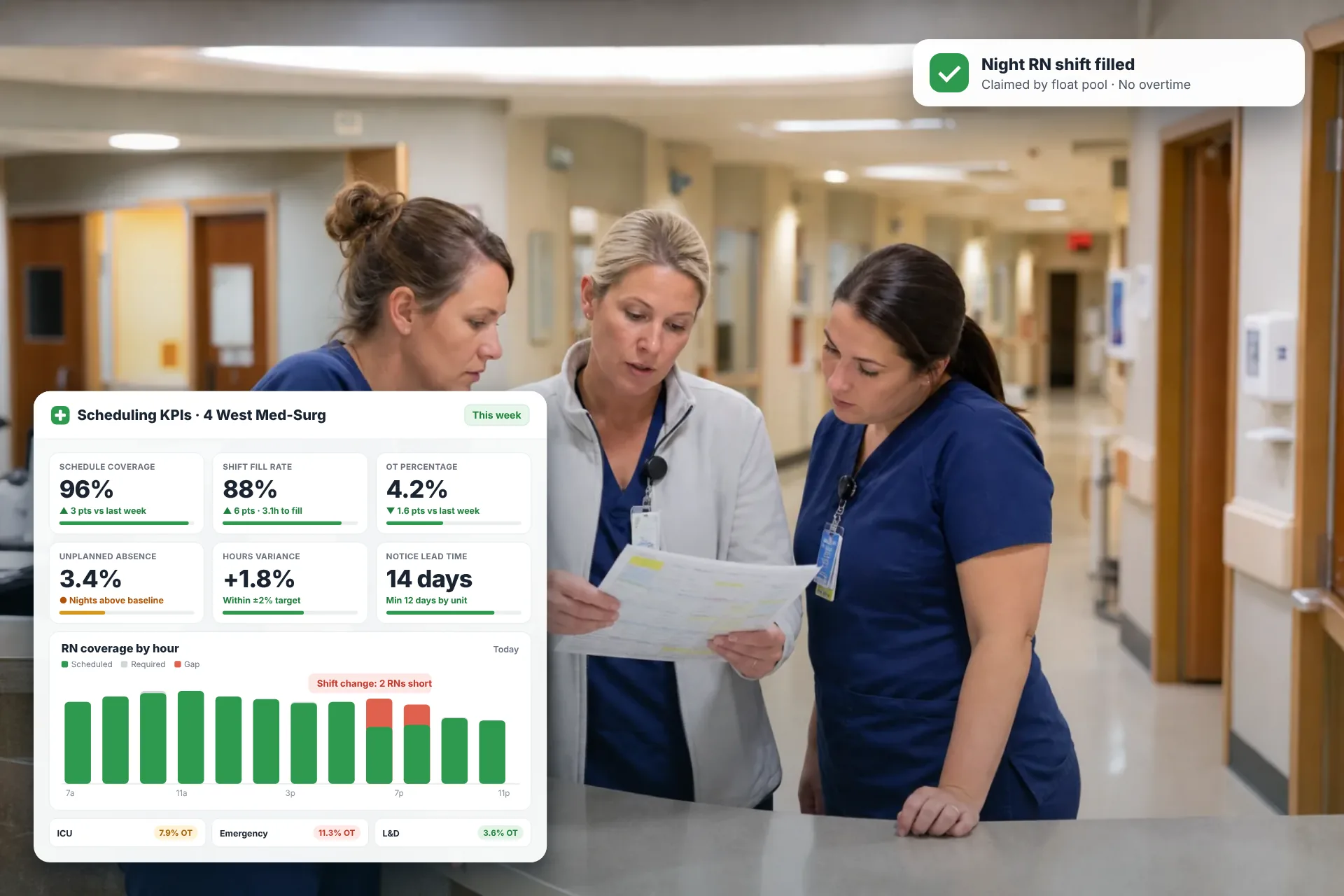
Employee Scheduling KPIs: 12 Metrics Every Operations Manager Should Track
Twelve employee scheduling KPIs with formulas, review cadences, and first actions, plus the trade-offs between them that most KPI lists skip.
Read article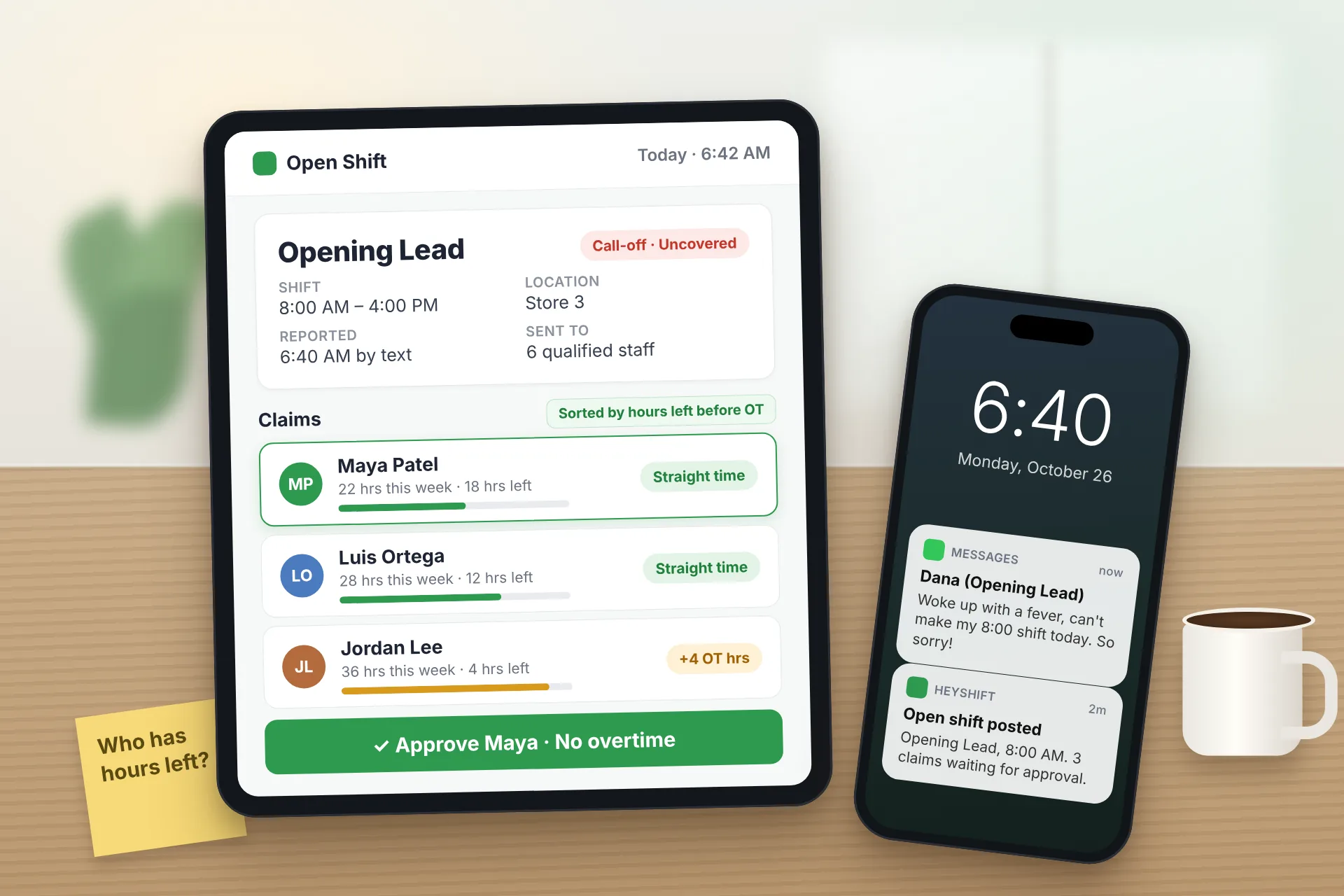
Same Day Employee Call Off Coverage: How to Handle Call-Offs Without Creating Overtime
A 30-minute response sequence for same-day call-offs: build a qualified list, post an open shift to everyone at once, and check overtime before you approve anyone.
Read article
Employee Schedule Change Management: One Official Roster
Learn employee schedule change management: a simple approval workflow, change log and notification process that keeps one official roster.
Read article