Medical office scheduling best practices
These eight habits apply across family medicine, specialty, urgent care, and diagnostic sites.
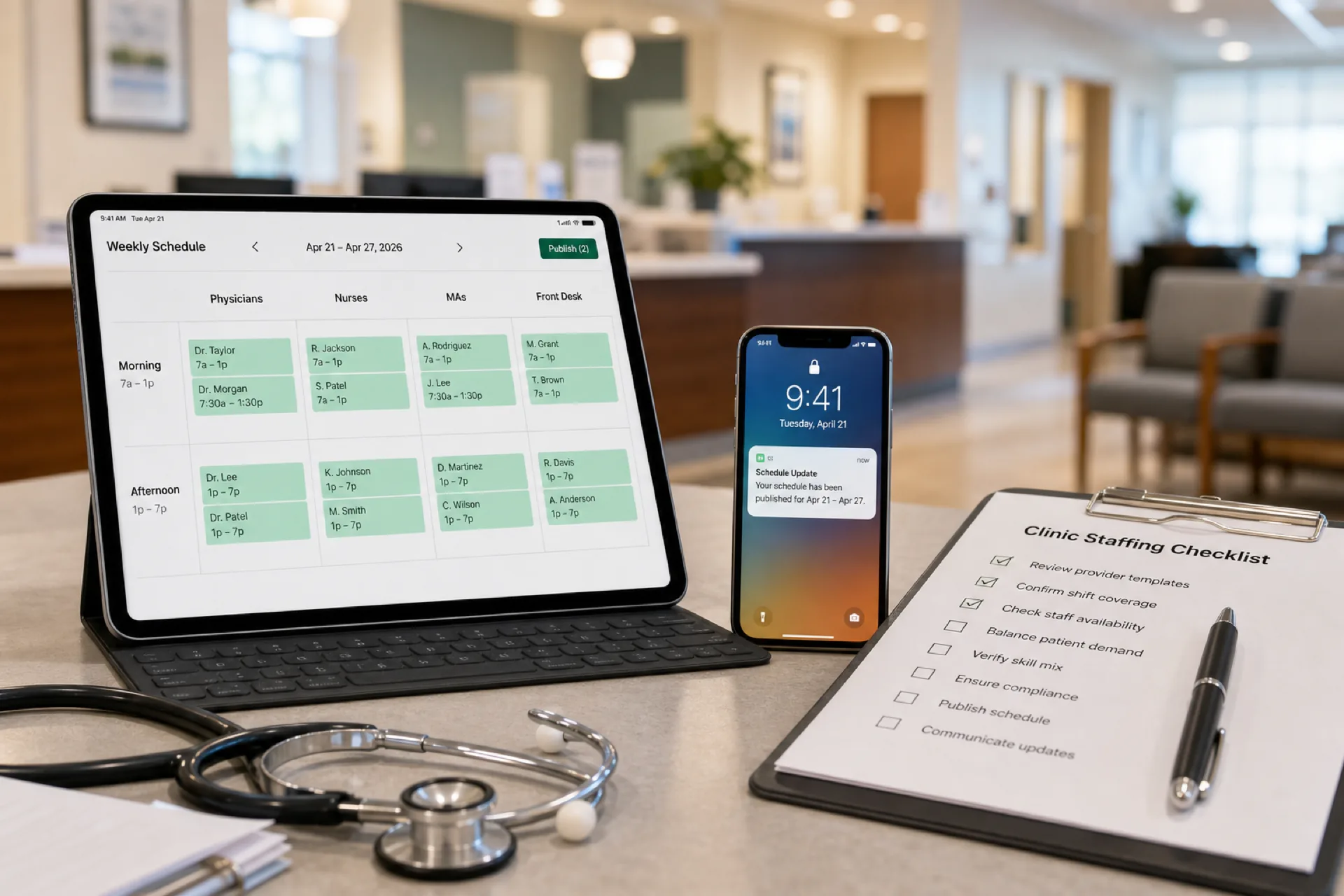
1. Publish schedules in advance
Give staff at least one to two weeks visibility when policy allows. Early publish reduces call-off chaos and gives managers time to post internal open shifts before overtime.
2. Track employee availability
Availability, PTO, and credential limits belong beside the grid, not in a separate HR email thread.
3. Balance workloads fairly
Rotate weekends, late closes, and float assignments using documented rules. Read fair staff rotas when staff push back on uneven bands.
4. Reduce unnecessary overtime
Review hour totals on draft schedules. Use overtime risk calculator before lock. Cross-link prevent overtime before payroll.
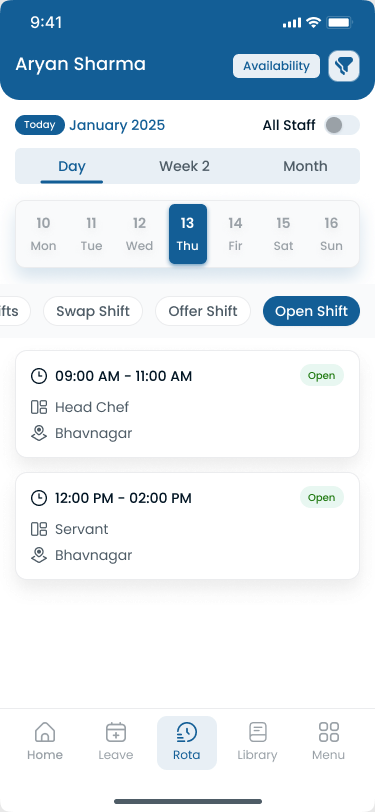
5. Enable shift swaps with approval
Flexibility reduces turnover when swaps are logged on the official roster, not in side texts.
6. Improve staff communication
Mobile notifications on the published app beat forwarded screenshots. Explore shift scheduling and mobile app.
7. Monitor attendance
Tie punches or check-ins to planned assignments. Compare attendance management software.
8. Review schedules weekly
Practice managers should review last week's variance, call-offs, and OT with clinical leads every week, not only at payroll.
Publish-first checklist
| Step |
Owner |
Frequency |
| Import approved leave |
Office manager |
Before draft build |
| Match staff to appointment template |
Clinical lead |
Weekly |
| Post internal open shifts |
Scheduler |
After draft |
Demand-based staffing for appointment templates
Map weekly appointment volume to role hours before names hit the grid.
- Export or estimate visits by day and hour from your EHR or practice management system
- Assign minimum reception, MA, and RN hours per band
- Subtract approved leave and education blocks
- Add float rows for known surge periods (flu, physicals, post-holiday backlog)
- Review hour totals against budget before publish lock
Practices that staff to average headcount instead of peak bands wonder why wait times spike every Tuesday afternoon.
30-day medical office scheduling improvement plan
| Week |
Focus |
| 1 |
Baseline OT, call-offs, and manager hours on scheduling |
| 2 |
Standardize shift labels; adopt medical office schedule template |
| 3 |
Publish one site or department on one official channel |
| 4 |
Add attendance tie-in and weekly variance review with finance |
Do not skip week one measurement. Buyers who cannot state current OT by site rarely prove ROI after rollout.
Staff scheduling strategies by role
Medical staff scheduling differs by role. One grid cannot treat physicians like receptionists.
Physicians and advanced practice providers
Schedule session blocks aligned to room count and expected visit volume. Block admin time separately so clinical staff are not scheduled into impossible bands.
Nurses and medical assistants
Staff to room throughput: vitals, procedures, injections, and turnover between patients. Urgent care needs higher MA ratios during evening surge than a single-specialty office.
Reception and patient access
Cover open, lunch, and close. Phone coverage must survive when one receptionist calls off. Many wait-time complaints start here.
Billing and back office
Align coding and referral staff to claim volume and payer deadlines, not only to front-door hours.
Float and cross-trained staff
Maintain a small float pool with documented skills. Float only works when hour totals are visible across the practice.
Scheduling by practice type
| Practice type |
Scheduling focus |
| Family medicine |
Session templates, flu season surge rows |
| Specialty clinics |
Procedure days, equipment room coverage |
| Urgent care |
Evening and weekend bands, rapid fill |
| Outpatient surgery centers |
Pre-op and recovery ratios |
| Diagnostic imaging |
Modality windows and tech credentials |
| Physician groups |
Multi-site provider float and central staffing office |
For deeper clinical outpatient playbooks, read clinic staff scheduling best practices. Hospital-owned practices with inpatient overlap should also review hospital staff scheduling best practices.
Technology, automation, and software benefits
Healthcare scheduling software for medical offices should unify workforce operations, not replace your EHR appointment book.
What software should handle
| Capability |
Practice outcome |
| Employee scheduling |
One official roster per site on mobile |
| Attendance tracking |
Planned versus worked alignment |
| Leave management |
PTO blocks before assignments lock |
| Shift changes |
Approved swaps and manager edits logged |
| Mobile notifications |
Publish and open-shift alerts |
| Multi-location management |
Site tags and district reporting |
| Workforce reporting |
OT, fill rate, variance by department |
Automation that matters
- Hour totals and OT alerts while building the draft week
- Open-shift posts to qualified staff before mandatory doubles
- Leave calendar sync before publish
- Attendance exceptions routed to manager approval
- Weekly export path toward payroll
Explore workforce visibility and cost and labor insights when finance joins the evaluation.
EHR versus workforce scheduling
Your EHR schedules patients. Medical scheduling software schedules employees. Integrations help, but the workforce layer must stand alone so managers publish one truth.
Compare vendors in best healthcare staff scheduling software (2026) and the pillar healthcare workforce management guide.
Spreadsheets versus scheduling software
| Method |
Best for |
Breaks when |
| Paper or whiteboard |
Single-provider micro practice |
Second MA or second site added |
| Excel or Google Sheets |
Stable single-site roster |
Multi-manager edits and versions |
| EHR staff module only |
Patient booking focus |
Workforce OT and attendance need depth |
| Workforce scheduling platform |
20+ staff, multi-role, multi-site |
Never adopted on mobile |
Read workforce scheduling software vs Excel when leadership debates timing.
Integrations practice managers should ask about
- Payroll export or API path
- HRIS employee record sync where applicable
- Time clock or mobile punch options
- Single sign-on for larger groups
Scheduling software does not need every integration on day one. It needs one official workforce timeline managers trust before payroll export.
Workforce trends in 2026
The BLS medical assistant outlook projects strong ambulatory growth. The BLS healthcare practitioners outlook shows sustained demand across outpatient settings. When hiring lags volume, software amplifies discipline you already need: earlier publish, float pools, and OT pacing.
How a multi-specialty clinic improved scheduling
Before: 85 employees, three locations, manual grids
A multi-specialty clinic with roughly 85 employees across three locations struggled with manual scheduling. Each site maintained its own spreadsheet. Physicians, nurses, reception, and billing leads edited separate tabs. Call-offs triggered phone trees. Overtime stacked on the same medical assistants during peak hours. Attendance lived in a different system than the published week.
What changed
Leadership centralized medical office scheduling on one platform:
- Publish-first weekly rosters per site with shared templates
- Physician session rows linked to MA and RN support bands
- Reception coverage matched to open hours and lunch gaps
- Approved leave visible before weekly lock
- Attendance tied to planned assignments
- Mobile open shifts for qualified clinical and front-office staff
- Weekly OT review with practice manager and finance
| Area |
Before |
After |
| Scheduling |
Three Excel files |
One official roster per site |
| Conflicts |
Frequent double-booking |
Leave blocks on grid |
| Peak coverage |
Reactive doubles |
Open shifts before OT |
| Manager time |
Hours merging tabs |
Single publish workflow |
| Attendance |
Separate from plan |
Planned versus worked aligned |
Outcome
Managers reduced scheduling conflicts, improved coverage during peak appointment hours, and spent less time updating spreadsheets. Staff reported clearer weeks. Finance saw fewer payroll surprises.
Lessons for other practices
- Standardize shift labels across sites before migration
- Pilot the busiest location, not the easiest manager
- Train reception and clinical staff on mobile together
- Stop email PDF rosters on a fixed cutover date
- Link scheduling habits to healthcare attendance tracking
Metrics the practice tracked after rollout
| Metric |
Direction after 90 days |
| Manager hours on scheduling |
Down |
| Schedule conflicts per week |
Down |
| OT hours on peak bands |
Down |
| Internal open-shift fill rate |
Up |
| Payroll variance |
Down |
| Staff schedule satisfaction survey |
Up |
The group did not change clinical protocols. They changed how workforce information moved through the week.
Common medical office scheduling mistakes
| Mistake |
Why it hurts |
| Relying on spreadsheets |
Version chaos across sites and roles |
| Scheduling without demand forecasting |
Understaffed peaks, overstaffed slow blocks |
| Ignoring employee availability |
Assignments on approved PTO |
| Publishing schedules too late |
Call-offs and doubles increase |
| Poor communication during changes |
Parallel texts erode trust |
| Staffing to headcount only |
Ignores appointment volume curves |
| Splitting attendance from schedule |
Payroll variance every period |
| No float or cross-training plan |
Every absence becomes crisis OT |
Avoid treating home health or caregiver field rules as identical to office workflows. Field teams need visit windows and routes. See home healthcare scheduling best practices and caregiver scheduling best practices only when those models apply.
Reducing wait times through roster discipline
Wait times rarely improve from asking clinical staff to work faster alone. They improve when check-in, vitals, and session bands match appointment volume.
| Signal |
Scheduling response |
| Lobby backup at open |
Earlier reception arrival band |
| Vitals queue after 9 a.m. |
Add MA row to morning template |
| Afternoon session overruns |
Align nurse support to provider blocks |
| Checkout lines at close |
Extend front desk thirty minutes |
Review patient feedback alongside OT and fill-rate reports in weekly workforce meetings. Scheduling is a patient experience lever when managers treat it as operations infrastructure.
Communication and schedule change discipline
Medical offices break down when managers announce changes in group texts that contradict the published week. Medical practice scheduling needs one communication path tied to the official roster.
| Channel |
Use for |
| Mobile publish alert |
New week available |
| Open shift post |
Qualified internal fill |
| Approved swap |
Documented flexibility |
| Manager edit |
Official roster correction |
| Announcement |
Policy, training, weather |
Communication rules for practice managers
- Official roster lives in the workforce app, not email attachments
- Post open shifts before calling individuals
- Require manager approval on swaps for the published week
- Reference assignment bands in surge messages, not names in side chats
Read employee shift swapping best practices and open shift and swap approvals. Explore location communication.
Compliance and record keeping for medical offices
Medical practices must maintain accurate time records for wage and hour compliance, internal policies, and payroll reconciliation. Medical office scheduling systems support documentation; they do not replace legal counsel.
| Area |
Practice action |
| Meal and rest periods |
Document breaks relative to shift length per state rules |
| Minor labor rules |
Track age-appropriate bands where applicable |
| Overtime thresholds |
Configure alerts on draft schedules |
| Record retention |
Keep planned assignment, changes, and worked time aligned |
Pair scheduling with labor compliance management and smart attendance rules. When disputes arise, use attendance corrections workflow.
State rules vary for meal, rest, and overtime. Confirm requirements for each state where you employ staff during vendor setup and policy review.
Medical office scheduling software buying guide
Practice managers evaluating medical scheduling software should score platforms on connected workflow, not checkbox features.
Must-have capabilities
| Capability |
Why practices need it |
| Employee scheduling |
Official publish per site |
| Attendance tracking |
Planned versus worked on one timeline |
| Leave management |
Blocks before lock |
| Mobile app |
Front desk and clinical adoption |
| Overtime alerts |
Catch stacks before publish |
| Workforce reporting |
OT and variance for leadership |
| Multi-location support |
Site tags without merged Excel |
Demo questions for practice managers
- Show physician session plus MA support on the same weekly view.
- How do reception coverage gaps trigger open-shift posts?
- Can we run three sites in one account with roll-up reporting?
- How are swap and leave approvals logged for payroll?
- What does attendance variance look like before export?
Heyshift fits growing medical practices and clinic groups (roughly 20 to 500 employees) that want scheduling, attendance, leave, overtime visibility, and multi-location support without enterprise implementation overhead.
Review pricing. Start a 30-day free trial or book a demo.
Read shift scheduling software buyer's guide and employee scheduling software ROI guide when building your business case.
Implementation timeline for growing practices
| Phase |
Duration |
Milestone |
| Configure |
Weeks 1-2 |
Sites, roles, templates, leave types |
| Pilot |
Weeks 3-6 |
One busy location live on mobile |
| Expand |
Weeks 7-10 |
Remaining sites and billing bands |
| Optimize |
Weeks 11+ |
OT alerts, district reporting, finance cadence |
Pilot the location with the messiest schedule, not the most cooperative manager. Pain there proves the platform faster.
Who should own the buying decision
| Role |
Evaluation focus |
| Practice manager / administrator |
Daily publish workflow, mobile adoption |
| Clinical director |
MA, RN, and session alignment |
| Finance |
OT pacing, payroll export, variance |
| IT (if present) |
SSO, integrations, security review |
Buying committees that exclude finance often discover payroll variance problems after go-live. Include nursing and front-office leads in the pilot, not only administrators. Document publish deadlines and swap policy before go-live so adoption has clear rules from week one.
Frequently asked questions
What is medical office scheduling?
Organizing physician, nurse, receptionist, and support staff schedules so the practice has adequate coverage, smoother patient flow, and controlled labor cost.
How is medical office scheduling different from clinic staff scheduling?
Medical office scheduling covers the full practice operation including billing and front office. Clinic staff scheduling goes deeper on clinical outpatient room coverage and MA/RN ratios.
How far in advance should clinic schedules be published?
Most groups aim for one to two weeks when policy allows. Urgent care and high-volume primary care benefit from earlier publish when call-off rates are high.
How can clinics reduce scheduling conflicts?
Sync leave before publish, use one official roster, post internal open shifts early, and require manager-approved swaps.
What software is best for medical office scheduling?
Practices need publish-first scheduling, attendance alignment, leave on the grid, mobile access, and multi-site reporting. Compare best healthcare staff scheduling software.
How does scheduling software improve patient care?
Better coverage at check-in, vitals, and session bands reduces wait times and room stalls. Software does not replace clinical skill; it supports consistent staffing.
Can scheduling software reduce overtime?
Yes, when hour totals and open shifts are visible during planning. See healthcare overtime management.
Should medical offices use the same system as hospitals?
Hospital-owned practices may share policies with acute sites, but outpatient medical offices usually need appointment-template scheduling, not inpatient unit grids.
Does scheduling software replace our EHR?
No. EHR handles patient appointments. Workforce software handles employee schedules, attendance, and labor reporting.
How do multi-location physician groups schedule?
Use site templates, central float visibility, consistent publish deadlines, and district OT reporting. Read healthcare workforce management guide.
What roles belong on a medical office roster?
Physicians, APPs, nurses, MAs, reception, lab and imaging support, billing, and float staff as applicable.
How do urgent care centers schedule differently?
Higher evening and weekend bands, faster open-shift fill, and separate templates from daytime primary care.
Is mobile access required?
Yes for MAs, nurses, and front desk staff who rarely live in desktop email.
How do we measure scheduling ROI?
Track manager hours on scheduling, OT per site, payroll variance, wait-time complaints, and turnover on high-OT roles.
Can small practices with 15 employees use scheduling software?
Yes, when a second provider, extended hours, or second site adds complexity.
What template should we start with?
Use the medical office schedule template to standardize rows before software.
Does Heyshift support multi-location medical offices?
Yes. Heyshift supports multi-location areas, mobile access, attendance, leave, and workforce reporting for growing practice groups.
Where should buyers compare vendors?
Read best healthcare staff scheduling software (2026) and healthcare staff scheduling software.
How do specialty clinics schedule procedure days?
Build separate templates for injection clinics, surgical prep days, and routine follow-up sessions. Staff equipment rooms and recovery support explicitly, not only provider sessions.
What is the first step to fix medical office scheduling?
Measure manager hours, OT by site, call-off rate, and payroll variance for 30 days. Then standardize publish rules before buying software.
Should billing staff share the same schedule as clinical staff?
Yes, on one workforce platform with role-specific rows. Billing hours often follow claim volume, not only front-door traffic.
How do diagnostic centers schedule technologists?
Credential and modality tags matter. Schedule CT, MRI, and ultrasound techs to equipment windows with crossover float only where licensed.
Final thoughts
Medical office scheduling is the operating rhythm behind patient flow, staff retention, and practice margin. When publish, attendance, leave, and communication live in one system, practice managers stop reconciling spreadsheets and start staffing to demand.
As medical practices grow, managing staff schedules manually becomes increasingly difficult. Heyshift helps clinics simplify employee scheduling, attendance tracking, leave management, and workforce communication from one centralized platform.
Review pricing. Start a 30-day free trial, book a demo, or contact Heyshift with your site count, specialties, and scheduling goals.
One line to keep: staff the whole office to appointment demand, publish once, and let every role see the same week on mobile.