

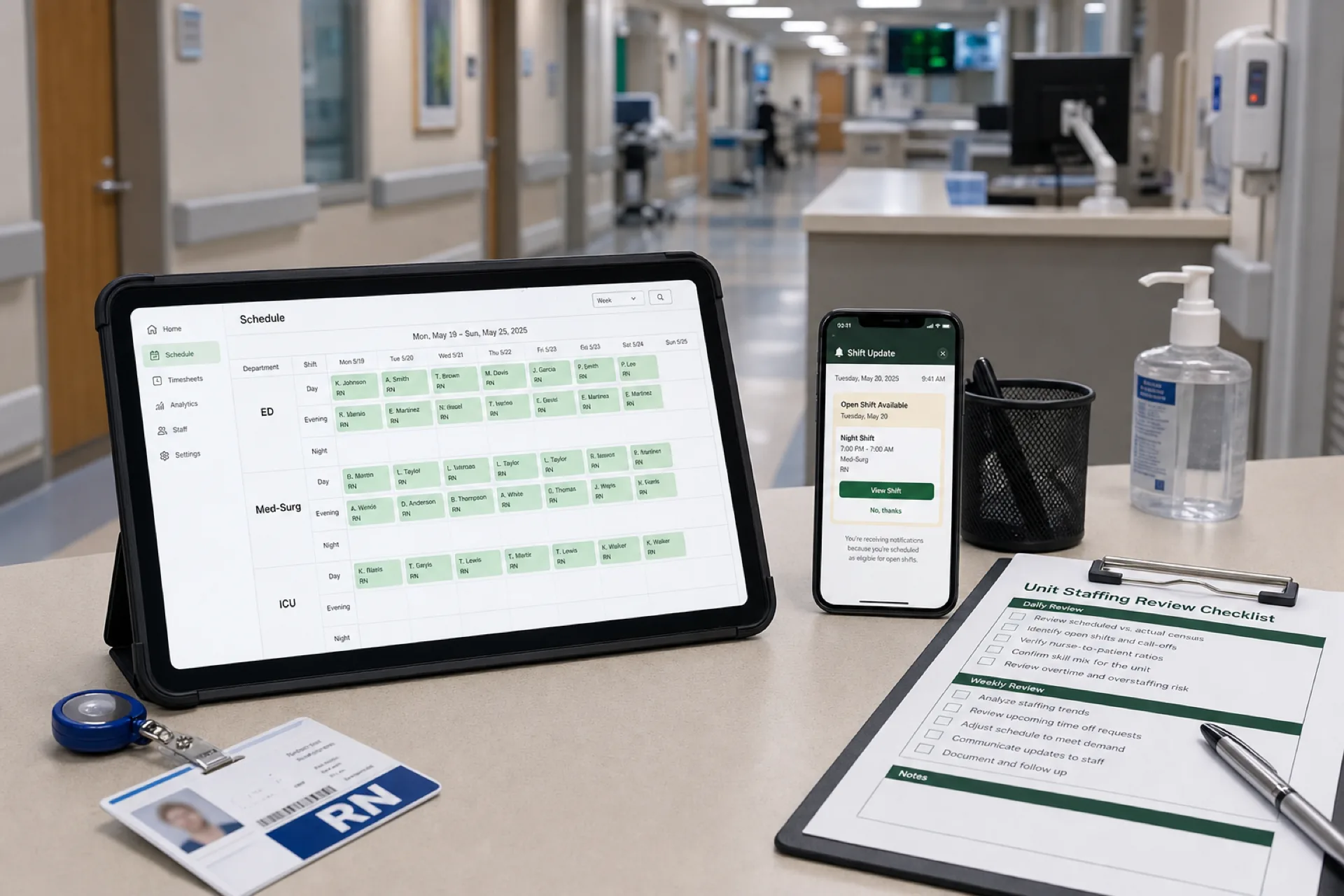
Hospital Staff Scheduling: Best Practices to Improve Coverage and Reduce Labor Costs (2026)
Learn hospital staff scheduling best practices to improve nurse coverage, reduce overtime, optimize workforce planning, and enhance patient care across inpatient, emergency, and surgical units with publish-first scheduling software.
Hospital staff scheduling: best practices to improve coverage and reduce labor costs (2026)
Hospitals never close. Emergency departments surge at midnight. A med-surg unit admits three patients during shift change. The float pool is already on overtime, and the official roster lives in three Excel files that do not agree. When hospital staff scheduling breaks, patient safety, nurse burnout, and labor cost all move in the wrong direction at once.
Acute care scheduling is one of the hardest workforce problems in healthcare because it combines 24/7 coverage, variable acuity, cross-trained float staff, agency premium, and compliance scrutiny on the same Tuesday night.
This guide covers hospital staff scheduling best practices for community hospitals, regional medical centers, specialty hospitals, and multi-department campuses with roughly 100 to 600 clinical and support staff evaluating hospital scheduling software.
Featured answer: What is hospital staff scheduling? Hospital staff scheduling is the process of assigning nurses, physicians, technicians, and support staff to shifts while ensuring appropriate patient coverage, regulatory compliance, employee well-being, and operational efficiency.
Who should read this: Nurse managers, staffing offices, charge nurses, and operations leaders who need practical inpatient roster habits before they compare platforms.
Compare healthcare staff scheduling software, nurse scheduling software, and attendance management software. For vendor comparison, see best healthcare staff scheduling software (2026). For related playbooks, read healthcare attendance tracking best practices, healthcare overtime management, clinic staff scheduling best practices, and how to create a nursing home staff schedule. Use the overtime risk calculator before you publish the week.
Executive summary
Effective hospital workforce scheduling protects patient safety, controls labor cost, reduces nurse burnout, and gives leaders one official roster across units and departments. Hospitals that publish early, staff to acuity, manage float pools deliberately, and track attendance beside the schedule spend less time on crisis texts and more time on throughput and quality.
In this guide you will learn:
- What hospital staff scheduling includes across acute care settings
- Why scheduling matters for safety, retention, and compliance
- Hospital workforce trends shaping 2026
- Biggest scheduling challenges from float pools to agency dependence
- Nine best practices you can apply this month
- Essential software features and scheduling method comparisons
- Benefits of digital scheduling for modern hospitals
- How a 250-bed regional hospital improved coverage across ED, surgical, and inpatient units
- Buying checklist, common mistakes, and fifteen FAQs
Table of contents
- What is hospital staff scheduling?
- Hospital workforce trends in 2026
- Why hospital staff scheduling matters
- Biggest hospital scheduling challenges
- Hospital scheduling by department type
- Hospital staff scheduling best practices
- Sample inpatient staffing model
- Float pools and agency staff
- Holiday and weekend scheduling in hospitals
- Nurse scheduling in acute care hospitals
- Handling call-offs and emergency admissions
- Scheduling methods compared
- Features every hospital needs
- Benefits of digital hospital scheduling
- How a regional hospital improved staff scheduling
- Choosing hospital scheduling software
- Common hospital scheduling mistakes
- 30-day improvement checklist
- Compliance and workforce planning notes
- Frequently asked questions
- Final thoughts
What is hospital staff scheduling?
Hospital staff scheduling assigns clinical and support teams to units, departments, and shift bands so patient care continues safely around the clock.
It typically includes:
- Nurse and CNA assignments by unit and acuity band
- Physician and APP coverage blocks where your model includes them on workforce rosters
- ED, ICU, med-surg, surgical, and specialty unit templates
- Float pool and per-diem staff visibility across departments
- Respiratory, lab, imaging, and environmental services support where in-house
- On-call and callback roles with explicit hour tracking
- Published roster discipline tied to attendance and payroll
Hospital shift scheduling differs from outpatient clinic grids: hospitals run 24/7 bands with handoffs, surge admissions, and float coverage that spreadsheets hide until the unit is short.
Download the nurse schedule template, hospital staff roster template, or 12-hour nurse schedule template for starting weekly grids before you move to software.
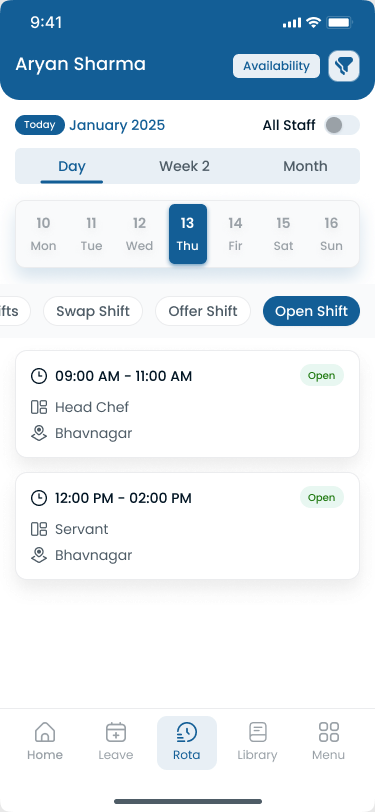
Hospital adoption works when every unit sees the same official week on mobile, not a charge nurse's personal spreadsheet.
Hospital workforce trends in 2026
Hospitals enter 2026 with nurse vacancies, rising acuity, and labor cost pressure that makes "we'll cover it on the floor" an expensive habit. Operators stabilizing margin publish earlier, staff to census and acuity signals, and give nurses one mobile roster they trust.
| Trend | What operators see | Scheduling implication |
|---|---|---|
| RN vacancies | Open roles; overtime and agency fill gaps | Publish two to four weeks ahead where contracts allow |
| Higher inpatient acuity | More intensive nursing per bed | Rebuild ratios by unit, not one hospital-wide template |
| ED boarding and surge | Volume spikes stress inpatient handoffs | Separate ED templates with surge float rules |
| Float pool dependence | Cross-unit staff cover daily holes | Track float credentials and hour limits centrally |
| Agency premium | Travel and agency nurses at high rates | Fill internal open shifts before agency default |
| Survey and CMS focus | Staffing documentation under scrutiny | One official roster for operations and leadership review |
Nurse demand stays elevated in hospitals
The BLS registered nurse outlook projects continued demand in hospitals and ambulatory settings with replacement needs across the occupation. The American Hospital Association workforce resources describe ongoing hospital staffing pressure and the need for sustainable scheduling models. When hiring lags volume, scheduling must assume scarcity: maintain float discipline, cap repeat overtime on the same staff, and post internal open shifts first.
Acuity and census shift faster than static grids
Observation stays, surgical backlog, and seasonal respiratory surges reshape daily need. Static spreadsheets cannot absorb admission spikes without version conflicts. Publish-first software plus daily unit review beats rebuilding tabs at shift change.
Quality programs tie operations to staffing confidence
CMS nursing home and hospital quality programs under Medicare quality initiatives increase visibility on organized care delivery. Scheduling software does not replace clinical staffing standards or licensure rules. It helps nurse leaders align planned coverage with worked hours when questions arise.
Roles hospitals schedule on workforce rosters:
- Registered nurses and licensed practical nurses
- Nursing assistants and patient care technicians
- Respiratory therapists and diagnostic technicians
- Surgical and procedural support staff
- Environmental services and patient transport
- Unit secretaries and patient access where applicable
- Float, per-diem, and agency staff (where tracked in workforce systems)
Hospital scheduling software does not replace your EMR, nurse staffing committee process, or collective bargaining agreements. It gives staffing offices one workforce layer for publish, attendance, leave, and communication. Read employee scheduling software ROI guide when you frame labor savings during evaluation.
Why hospital staff scheduling matters
Hospital operations depend on predictable coverage more than almost any other industry segment. A retail store can close early when short staffed. A hospital cannot defer admissions because the night roster was built on Friday afternoon guesses.
Patient safety: Understaffed units delay assessments, medications, and escalation response. Charge nurses compensate with heroic doubles, but fatigue erodes the margin between "covered on paper" and safe in practice.
24/7 operations: Night and weekend bands need the same discipline as Monday day shift. Many labor disputes and retention problems trace back to uneven weekend rotation, not base pay.
Nurse shortages: Thin benches turn every call-off into mandatory overtime or agency premium. When vacancy rates stay elevated, scheduling becomes workforce strategy, not clerical work.
Compliance: Policies, union rules, and survey documentation assume you can show who was assigned, when they worked, and how changes were approved. Parallel spreadsheets fail that test the first time leadership asks for a defensible record.
Overtime costs: Premium hours compress margin fast in acute care. Finance sees overtime as a line item; nurse managers see it as a symptom of late publish, weak float discipline, and invisible PTO.
Burnout: Consecutive nights, skipped breaks, and unfair weekend rotation drive turnover. Replacing one experienced ICU nurse costs far more than publishing two weeks earlier.
Staff retention: Early publish, fair rotation, and visible hour limits keep experienced nurses longer. Mobile access to the official roster signals respect for bedside time better than another break-room printout.
Explore shift scheduling and workforce visibility for publish-first hospital basics. Pair scheduling discipline with attendance management software when payroll accuracy is part of the business case.
Biggest hospital scheduling challenges
| Challenge | What breaks on inpatient units |
|---|---|
| Shift shortages | Care delays and supervisor crisis texts |
| Emergency admissions | Census jumps mid-shift without roster adjustment |
| Float pool gaps | Wrong skill mix sent to high-acuity units |
| Weekend and holiday staffing | Fairness disputes and burnout spikes |
| Sick leave and call-offs | Doubles on already tired staff |
| Shift rotations | Inconsistent night and weekend patterns |
| Multiple departments | Parallel spreadsheets per unit |
| Agency dependence | Premium cost when internal open shifts go unfilled |
| Attendance separate from schedule | Payroll disputes and weak accountability |
Pair fixes with healthcare attendance tracking best practices and prevent overtime before payroll.
Hospital scheduling by department type
Emergency department
Staff surge templates separately from inpatient ratios. Plan float coverage for ambulance peaks and boarding hours when admitted patients wait in ED beds.
ED scheduling breaks when inpatient units treat the emergency department as an infinite float source. Define escalation paths: which units release float staff, in what order, and how those moves appear on the official roster before the handoff.
Peak bands often include Friday night, Sunday evening, and post-holiday respiratory surges. Build historical call-off rates into those templates instead of assuming full attendance because the grid looked fine on paper.
Medical-surgical and step-down units
Rebuild templates when census bands change. Tag charge nurse coverage and CNA ratios explicitly on the published roster.
Med-surg is where admission spikes show up first. When observation patients stack, ratios that worked last month are unsafe this week. Daily census review should trigger float rows on the published schedule, not side conversations at the nurses' station.
ICU and critical care
Credential tags are non-negotiable. Limit casual float into ICU without verified skills on the schedule record.
ICU assignments should never rely on a charge nurse's memory of who is ICU-verified. Tag skills in the scheduling system and filter open shifts to qualified staff only.
Surgical services and periop
Align pre-op, OR, and PACU bands to case volume days. Weekend and add-on case lists should trigger roster review, not only surgeon schedules.
Periop teams often schedule from case logs while nursing rosters live elsewhere. One workforce layer prevents PACU gaps when add-on cases run long and inpatient units still expect their float nurses back on time.
Environmental and support services
Patient throughput depends on transport, environmental services, and dietary coverage as much as bedside ratios. Include support roles on the same publish calendar when they gate discharges and room turns.
Specialty and community hospitals
Smaller campuses still need unit-specific templates. One hospital-wide grid hides med-surg gaps when specialty units have different acuity.
Community hospitals with 80 to 150 beds feel spreadsheet pain as soon as they add a second inpatient unit plus ED. Central publish pays off earlier than enterprise campuses because there is no backup staffing office to reconcile files.
For long-term care patterns, see how to create a nursing home staff schedule. For outpatient patterns, see clinic staff scheduling best practices.
Hospital staff scheduling best practices
1. Publish schedules earlier
Give nurses and support staff maximum advance notice allowed by contracts and policy. Many hospitals aim for two to four weeks on stable units; shorter horizons increase overtime and agency use.
Publish-first means one official roster on mobile, not a PDF in a group email.
2. Forecast staffing demand
Review census trends, scheduled surgeries, seasonal respiratory patterns, and historical call-off rates when building the week. Staff to expected acuity, not only bed count.
Demand signals to review weekly:
- Average daily census by unit
- Scheduled surgical cases and procedure minutes
- ED visit trends and boarding hours
- PTO and leave calendars
- Historical call-offs by day band
3. Match staffing to patient acuity
Assign nurses and CNAs using acuity tags, not only headcount. A med-surg unit at high observation census needs different ratios than a stable rehabilitation wing.
4. Balance weekend and holiday shifts fairly
Track rotation history in the scheduling system. Fair weekend and holiday distribution improves retention more than reactive bonuses after a brutal month.
5. Reduce overtime proactively
Review hour totals while building the week. Use the overtime risk calculator before publish. Fill internal open shifts before automatic doubles.
6. Track employee availability accurately
Maintain credentials, float eligibility, PTO, FMLA blocks, and secondary job constraints in the same system you publish from.
Explore people and availability.
7. Enable manager-approved shift swapping
Flexibility improves retention when swaps respect skill mix and hour limits. Route requests through the published roster with charge nurse or manager approval.
Read employee shift swapping best practices and open shift and swap approvals.
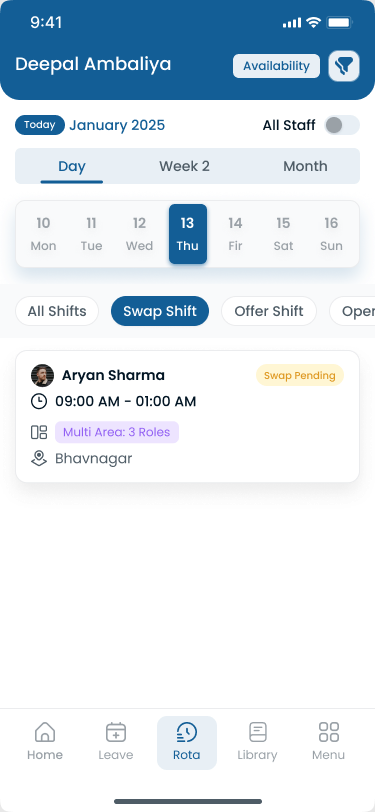
Swap requests should update the same published week staffing offices and payroll trust.
8. Use mobile schedule access
Nurses and CNAs need phone access to unit assignments, open shifts, and change notifications. Paper in the break room is not a system.
Use the Heyshift mobile app.
9. Run daily staffing reviews
Morning huddle beats weekly surprise. Charge nurses and staffing coordinators should confirm open shifts, float assignments, call-offs, and hour limits before handoffs stack.
Daily staffing office checklist
| Step | Question |
|---|---|
| Unit minimums | Is each unit at required ratio for current acuity? |
| Float coverage | Are float staff assigned with correct credentials? |
| Call-offs | Did internal open shifts fill before overtime or agency? |
| ED and surgical surge | Do today's admissions or cases require roster adjustment? |
| Overtime | Who is near hour limits today and this week? |
Sample inpatient staffing model
Adapt to your hospital size, union rules, and acuity tools. This table is an operational planning example for a med-surg unit band, not legal staffing advice.
| Shift band | RN | CNA / PCT | Charge nurse |
|---|---|---|---|
| Day (7a-7p) | 6 | 8 | 1 |
| Night (7p-7a) | 5 | 6 | 1 |
How to use this model:
- Adjust RN count when observation or telemetry census rises
- Add float RN row on the published roster during flu surge weeks
- Tag charge nurse separately from bedside assignments
- Review ratios daily against census, not only against last month's average
Start from the hospital staff roster template or 12-hour nurse schedule template.
Float pools and agency staff
Float pool: cross-trained staff who cover multiple units. Effective float scheduling requires credential tags, hour visibility, and fair rotation across high-stress units.
Agency and travel staff: premium labor that should follow internal open-shift exhaustion, not replace publish discipline.
| Staff type | Scheduling habit |
|---|---|
| Unit-based staff | Default home unit on roster; predictable rotation |
| Float pool | Named availability by skill; central visibility |
| Per-diem | Open-shift pickup with approval |
| Agency | Documented only after internal fill attempts per policy |
What is a float pool? A designated group of employees qualified to work multiple units who fill gaps when home-unit staff call off or census spikes.
Holiday and weekend scheduling in hospitals
Weekend and holiday bands concentrate fairness complaints, overtime spikes, and retention risk. Hospitals that treat holiday grids as a last-minute patch inherit predictable premium labor every December and July.
Weekend rotation: Track who worked last weekend before you assign this weekend. Rotation history belongs in the scheduling system, not a manager's notebook.
Holiday pools: Pre-build holiday templates with minimum skill mix per unit. Publish holiday weeks earlier than standard weeks when contracts allow.
Premium pay alignment: When holiday or weekend premiums apply, tie approved assignments to the published roster so payroll does not reconstruct shifts from texts.
Post-holiday surge: Plan float availability for the shifts after major holidays when call-offs historically rise.
Read prevent overtime before payroll when holiday coverage stretches existing staff.
Nurse scheduling in acute care hospitals
Nurse scheduling is the operational core of hospital workforce planning. Physicians and APPs often follow separate on-call models, but bedside coverage, charge roles, and float movement determine whether units stay safe through the night.
Effective nurse scheduling software for hospitals should support:
- 8-, 10-, and 12-hour band templates by unit
- Charge nurse and preceptor tags on the same grid
- Float eligibility and ICU or ED credentials on employee profiles
- Self-serve open shifts filtered to qualified nurses
- Manager approval on swaps that cross units or push hour limits
- Overtime visibility while the schedule is still a draft
Compare dedicated nurse scheduling software against general healthcare staff scheduling software when you evaluate vendors. Charge nurses publish faster when availability and credentials are visible before assignments lock.
For rotation-heavy units, plan documented night and weekend rules beside unit templates. Read nurse shift rotation best practices for pattern selection and fairness discipline across settings.
Handling call-offs and emergency admissions
Call-offs: publish open shift to qualified unit or float staff on mobile before mandatory overtime texts.
Emergency admissions: charge nurse escalates to staffing office; adjust float or per-diem assignments on the official roster.
Census spikes: use pre-approved surge templates instead of ad hoc doubles every night.
Document approved changes on the published schedule so healthcare attendance tracking and payroll align.
Read reduce employee no-shows and last-minute call-offs.
Scheduling methods compared
| Scheduling method | Best for | Limitations |
|---|---|---|
| Paper rosters | Very small departments | Hard to update; no mobile; weak audit trail |
| Excel | Small hospitals piloting process | Error-prone; version conflicts; no alerts |
| Calendar apps | Basic visibility | Limited workforce, OT, and leave features |
| Scheduling software | Modern multi-unit hospitals | Subscription cost; rollout discipline required |
Most hospitals outgrow Excel when they exceed two critical units or 150 bedside staff. Hospital scheduling software wins when publish, attendance, leave, swaps, float visibility, and reporting must stay on one timeline.
See why spreadsheets fail for workforce scheduling.
Features every hospital needs
| Feature | Hospital outcome |
|---|---|
| Nurse scheduling | Unit templates with skill tags |
| Attendance tracking | Planned vs worked hours before payroll |
| Leave management | PTO and FMLA visible before publish |
| Overtime monitoring | Alerts while planning, not after export |
| Workforce analytics | OT, fill rate, and call-off trends by unit |
| Mobile app | Nurses see assignments and open shifts |
| Open shifts | Internal fill before agency |
| Shift swapping | Approved flexibility without coverage holes |
| Multi-department scheduling | ED, ICU, med-surg in one account |
| Multi-location management | Health system roll-up when applicable |
Explore nurse scheduling software, attendance tracker, and attendance reports and analytics.
Benefits of digital hospital scheduling
Digital hospital employee scheduling helps organizations:
- Improve patient coverage with acuity-aware templates
- Lower overtime through alerts and internal open shifts
- Reduce burnout via fair rotation and earlier publish
- Improve communication with app notifications
- Support payroll accuracy when attendance ties to plan
- Raise employee satisfaction with visible, fair schedules
- Scale across departments without merged spreadsheet files
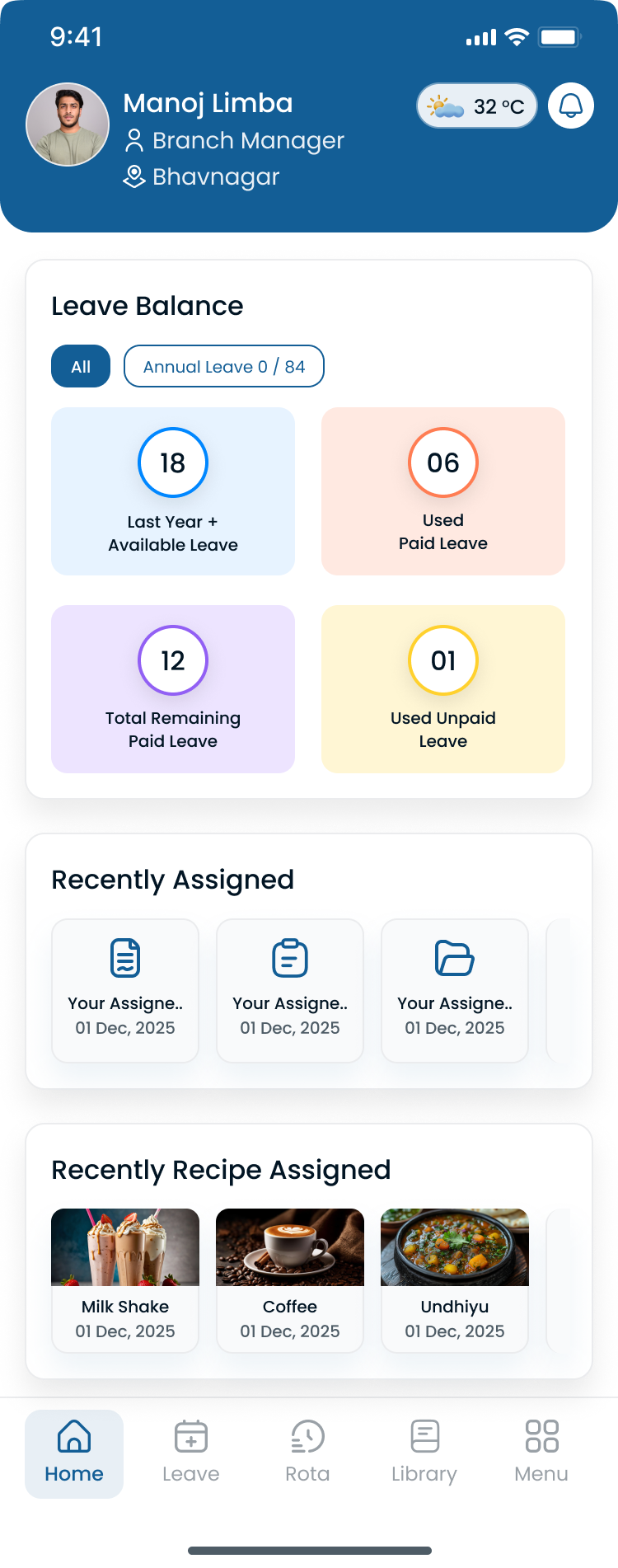
Staffing offices should see hour totals by unit before the week is published.
How a regional hospital improved staff scheduling
Before: 250 beds, 450 staff, manual unit grids
A 250-bed regional hospital with roughly 450 clinical and support staff ran hospital staff scheduling through department Excel files, charge nurse notebooks, and staffing office texts. Emergency, surgical, and inpatient units each maintained separate grids. Overtime stacked on the same nurses. Agency use rose when internal open shifts were invisible. Payroll corrections cited roster mismatches weekly.
The week that forced central discipline
During a respiratory surge, med-surg floated two nurses to step-down without updating the official roster. ED boarding rose while inpatient units thought float coverage was set. Finance flagged premium hours on nurses already at overtime thresholds. Leadership could not answer which grid was authoritative for survey questions.
After: centralized schedules and open-shift notifications
The hospital moved to centralized hospital scheduling software with unit tags, publish-first discipline, float credential labels, manager-approved open shifts, mobile notifications, and attendance tied to published bands.
| Challenge | Before | After |
|---|---|---|
| Schedule versions | Excel per department plus notebooks | One published roster per unit on mobile |
| Float visibility | Texts and memory | Credential-tagged float assignments on official grid |
| Call-off fill | Phone tree to overtime names | Open shifts with approval on official app |
| Overtime | Discovered at payroll export | Hour totals visible while building the week |
| Agency use | Default when grids were opaque | Internal fill attempted first per policy |
| Staffing office time | Hours reconciling files | Faster publish; more time on census matching |
Software did not replace staffing committee policy or union rules. It gave nurse leaders one workforce layer operations and finance could trust.
Compare healthcare staff scheduling software and nurse scheduling software.
Choosing hospital scheduling software
Evaluate hospital scheduling software on:
| Requirement | Why it matters |
|---|---|
| Scheduling flexibility | Unit templates, rotations, float rules |
| Mobile access | Bedside staff live on phone |
| Attendance tracking | Payroll accuracy beside shifts |
| Leave management | PTO before unit publish |
| Compliance support | Meal, rest, and hour rules where configurable |
| Reporting | OT and fill trends by department |
| Payroll integration or export | Clean finance handoff |
| Scalability | New units without new spreadsheets |
| Open shift workflow | Internal fill before agency authorization |
| Multi-site roll-up | Health system visibility without merged files |
Implementation sequence for hospital staffing offices
| Phase | Focus | Outcome |
|---|---|---|
| Phase 1 | One inpatient unit plus ED | Prove publish discipline on mobile |
| Phase 2 | Float pool and per-diem | Central credential tags and hour limits |
| Phase 3 | Attendance and leave | Planned vs worked on one timeline |
| Phase 4 | Analytics and payroll export | OT trends and clean finance handoff |
Rollout beats big-bang when unions, per-diem habits, or agency contracts vary by unit. Pilot where pain is highest, usually med-surg plus ED, then expand.
Demo questions for hospital staffing offices
- Can we template ED, ICU, and med-surg separately with skill tags?
- How does float staff appear across units without duplicate records?
- Do open shifts notify only qualified nurses for each unit?
- Does attendance reference the published shift assignment?
- Can system leaders roll up OT and call-offs across departments?
Hospitals need accurate schedules, real-time workforce visibility, and reliable attendance tracking to deliver quality patient care. Heyshift helps healthcare organizations schedule employees, manage attendance, monitor overtime, and coordinate teams across departments and locations from one platform.
Review pricing. Start a 30-day free trial, book a demo, or contact Heyshift with your unit count and shift models.
Common hospital scheduling mistakes
Publishing too late: forces overtime and agency premium.
Ignoring fatigue: consecutive nights and short turnarounds drive errors and turnover.
Excessive overtime: trains staff to expect premium pay instead of open-shift pickup.
Poor communication: parallel texts undermine the official roster.
No staffing visibility: float and per-diem hours hide until payroll.
Manual scheduling at scale: version chaos across departments.
Separate attendance systems: planned vs worked mismatches.
Treating agency as first fill: premium cost when internal open shifts would work.
One template for every unit: acuity mismatch and unsafe ratios on paper.
Skipping daily review: yesterday's roster is not today's census truth.
30-day improvement checklist
| Week | Focus | Actions |
|---|---|---|
| Week 1 | Baseline | List units, shift models, float rules, current publish rhythm |
| Week 2 | One roster | Official publish channel; stop notebook parallel schedules |
| Week 3 | Acuity and OT | Review census bands; Friday hour-total review before publish |
| Week 4 | Float and mobile | Credential-tag float pool; confirm nurses use official app |
Pilot one inpatient unit and ED before hospital-wide rollout if change management is tight.
Compliance and workforce planning notes
Hospitals operate under federal and state wage and hour rules, meal and rest requirements, union contracts where applicable, and internal safe staffing policies. Scheduling software supports operational discipline; it does not replace legal counsel, nurse staffing committees, or licensure compliance.
The Occupational Safety and Health Administration publishes healthcare worker safety guidance relevant to shift length and fatigue. SHRM workforce planning resources tie labor forecasting to retention and cost control.
Pair scheduling with healthcare attendance tracking best practices, leave management, and payroll integration planning before finance cutover.
Frequently asked questions
What is hospital staff scheduling?
Hospital staff scheduling is the process of assigning nurses, physicians, technicians, and support staff to shifts while ensuring appropriate patient coverage, regulatory compliance, employee well-being, and operational efficiency.
How can hospitals reduce nurse overtime?
Publish early, staff to acuity, track hour totals while planning, post internal open shifts first, manage float hours centrally, and review OT trends weekly. Use the overtime risk calculator.
What software is best for hospital scheduling?
The best fit depends on unit mix, float model, and contract rules. Compare nurse scheduling software and healthcare staff scheduling software.
How do hospitals handle last-minute call-offs?
Publish open shifts to qualified unit and float staff on mobile, follow surge templates, document changes on the official roster, and review hour totals before approving doubles.
What is a float pool?
A designated group of employees qualified to work multiple hospital units who fill coverage gaps when home-unit staff are unavailable or census spikes.
How can hospitals improve scheduling efficiency?
Centralize publish on one platform, template by unit, automate notifications, tie attendance to plan, and run daily staffing review with census inputs.
How is hospital scheduling different from nursing home scheduling?
Hospitals staff acute 24/7 units with surge admissions and float pools. Nursing homes staff residential wings on recurring bands. See how to create a nursing home staff schedule.
How is hospital scheduling different from clinic scheduling?
Hospitals run inpatient and ED bands around the clock. Clinics staff outpatient sessions by appointment demand. See clinic staff scheduling best practices.
Should hospitals link scheduling to attendance?
Yes. Planned vs worked hours on one timeline reduces payroll corrections. Read healthcare attendance tracking best practices.
Can scheduling software reduce agency dependence?
Yes, when internal open shifts are visible, credential-filtered, and filled before agency is authorized per policy.
What shift lengths do hospitals use?
Many inpatient units use 12-hour bands; others use 8-hour or hybrid models. See 12-hour nurse schedule template.
How do health systems manage multiple hospitals?
Use one platform with site and department tags and executive roll-up via multi-location areas.
Where should hospitals start if they use Excel today?
Download the hospital staff roster template, publish one unit for four weeks on one channel, then expand.
How do I evaluate ROI on hospital scheduling software?
Track staffing office hours, overtime per unit, agency spend, payroll corrections, and nurse turnover on high-OT units before and after rollout.
Does Heyshift support ED and inpatient units in one account?
Yes. Heyshift supports multi-department scheduling, mobile access, attendance, leave, swaps, and workforce visibility for growing hospital operators.
Final thoughts
Better hospital staff scheduling improves patient coverage, reduces labor cost, supports nurse well-being, and gives leaders defensible staffing records across departments.
Hospitals that publish early, staff to acuity, manage float pools deliberately, and replace spreadsheet rotas with modern hospital workforce scheduling software gain the visibility to keep units covered without burning out the same team every surge week.
One line to keep: staff to acuity, publish once, and review the roster every morning before handoffs stack.
Related Healthcare Resources
Continue with related topics
Pulled from shared tags when possible, otherwise the newest notes from the blog.

Nurse Shift Rotation: Best Practices to Improve Staff Well-Being and Patient Care (2026)
Learn nurse shift rotation best practices to reduce burnout, improve staffing coverage, balance workloads, and create fair healthcare schedules with publish-first nurse scheduling software.
How to Create a Nursing Home Staff Schedule That Reduces Overtime (2026 Guide)
Learn how nursing homes build efficient staff schedules, reduce overtime, improve shift coverage, and manage nurses, CNAs, and caregivers with modern scheduling strategies.

Healthcare Leave Management: Best Practices for Hospitals, Clinics & Care Providers (2026)
Learn healthcare leave management best practices to reduce scheduling conflicts, improve staffing coverage, manage PTO, and simplify workforce scheduling for hospitals, clinics, nursing homes, and care providers.